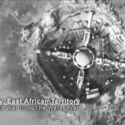
"Take your dream suppressants." The opening line in Wanuri Kahiū's Pumzi, directed at our protagonist Asha, enforces the order of severing ties with hopeful futures and ancestral memories in pasts shared to compel her focus on the perpetual present in the Maitu Community's heterotopia of an enclave. The bird's-eye view shot of the Maitu reveals a sterile, drone-like structure with a panoptic sphere at its center where normal human behavior is medicalized. The layout is built around closed-loop recycling systems as apt as a self-sufficient organism, designed to escape the toxic environment of a sickly Earth, where every pipe and corridor is engineered to harvest human excretion for water generation, thereby absorbing the roles of nature and state both. The community's architecture perfectly translates the film's message with its physicality.
Across folklore, film, and art, the same move recurs: architecture translates an elsewhere, whether ancestral, spiritual, or speculative, into form that can be seen or entered. The sections below follow that translation from the Kasubi Tombs to Kizazi Moto, and show that the elsewhere is a way of reading the present.


Folklore: A Place for Collective Meetings
Related Article
Michelle Mlati's Afrofuturist Approach To Spatial PlanningTo understand how architecture translates the elsewhere in Africanfuturism, one must first learn to read the scripts of time-old. In the east, along the shores of Lake Victoria, walked Kintu, the first man to ever exist. According to Buganda legend, he was the first muganda and kabaka (i.e., king) whose journey to earth brought forth the region's first basic materials to create life. He is said to have wandered into a forest and never returned, which has become the customary fate of all kabakas – they do not die; they disappear and transcend into the spiritual realm. This belief is most powerfully embodied at Kasubi Tombs, where four successive kings are interred, now a UNESCO World Heritage Site and a place of worship.
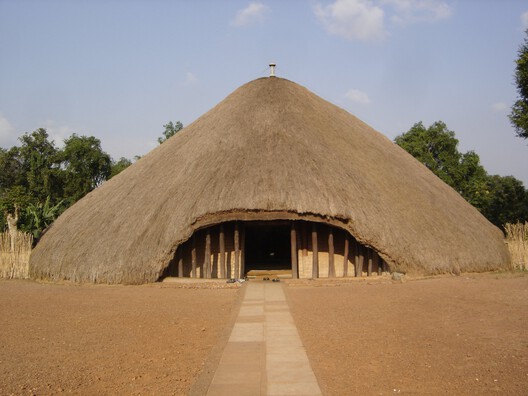
At the heart of the vast complex, Muzibu Azaala Mpanga rises as a monumental grass-thatched hut. It is a chef-d'oeuvre of Ganda architecture, crafted in the image of a typical Buganda house, where a central wooden pole of fig is anchored as a spine supporting a circular frame of thinner poles tied at the top to form an overturned basket skeleton sloping all the way to the ground, giving rise to a dome-shaped hut upon dressing. Reflecting a womb in its philosophy, the sloping circular design is meant to represent the cycles of life. The wooden poles are wrapped in barkcloth – the traditional 'linen' of the Baganda – to the satisfaction of the artisans, who must only belong to the Mbogo and Ngeye clans. The frame is then covered with reed to mark thresholds and sacred boundaries, and spear grass-thatch to mark royal authority and guardianship.
Fifty-two concentric rings of elephant-grass reed and palm fronds form a spiraling roof that both stabilizes Muzibu Azaala Mpanga and symbolizes the unity of Buganda's clans: the clan system is then both genealogical and symbolic; they trace ancestry, and their totems embody identity; the kabakas' authority is legitimized by the clans. This is also reflected in the spiral that rests on the strength of all the 52 rings. The central circle, replaced as needed by the kabaka, floats at a height of 7.5 meters, while the robust barkcloth-clad wooden poles that carry the roof stand in the picture of a forest; an architectural gesture so that the kabakas may disappear into the ancestral realm when their time comes, as Ssekabaka Kintu had.
A wide, low-hanging arch framed with woven reeds marks the entrance to Muzibu Azaala Mpanga. The coolness of the vegetal materials seeps into the bones instantly, augmented with a deep loamy citrus fragrance emanating from the wild lemongrass mats. Behind a barkcloth curtain towards the deeper parts of the enclosure lies the kibira, accessible only to royals and custodians, a "sacred inner forest" where the tombs are, while the lithe shooting poles rise through the open space, lending a somber stillness to the air.
Kasubi then presents as a blueprint for proto-Africanfuturism. By functioning as a space where the ancestral past guides the trajectory of the living community, the Tombs collapse linear temporality and assert a connectedness to the future through design.
To the northeast, and in Sudanese folklore, the Nile was believed to be protected by ancient spirits, some benevolent and others malevolent; their deep-rooted cultural significance echoing at the riverbanks, figuratively and literally. The soundscape in the tales is tangible in everyday life, since the waters carry sound as though it were a massive audio conduit. This has influenced the layouts of buildings by its banks, most notably being that of Omdurman's iconic Al-Nilin Mosque, which graces the crescent of the White Nile bank before it meets the confluence. Its twelve octagonal pavilions, built for schooling, stand closest to the river's edge, lofty and elevated, leaving the ground-level undercroft completely open for recitation so that the Nile might catch the sacred sounds and carry them downstream.
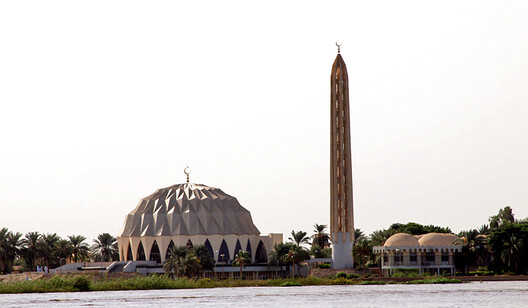
When architect Gamar Eldowla Abdelgadir designed the modern structure in the 1970s – the beginnings of which were for his graduation thesis project – he envisioned the light aluminum space-frame hemispherical dome of the mosque building as a radiant jewel. This is a reflection of the belief that mosques are the spiritual and cultural hearts of communities as well as their centers for education and gathering. By modeling the geodesic-like dome after a gemstone, column-less, the mosque sought to mirror the enduring strength and values of these civic ideals, transforming itself into a beacon that continuously projects its light outwards. Though designed as a sacred place and rooted deeply in Islamic traditions, the exterior still evokes a space-age aesthetic. Yet, while the era's media and records categorize Al-Nilin Mosque under the broad umbrella of national progress and mid-century modernism, this striking vision invites a more contemporary reading: it makes a strong case study for Africanfuturism, coined by writer Nnedi Okorafor, which is largely defined as a philosophy focused on African-based technological advancement in dialogue with its myths, pasts, beliefs, cultural identities and futures.
The interior is enriched with an intricately carved wooden ceiling and a series of pointed arch windows that flood the hall with natural light. True to its sacred purpose, the detailed, geometric plasterwork and mosaics are an ode to traditional Islamic design. The craftsmanship was brought to life by master artisans sent courtesy of Morocco's king at the time, who appear to seamlessly blend the (perceived) space-age architecture with classical North African Islamic artistry.
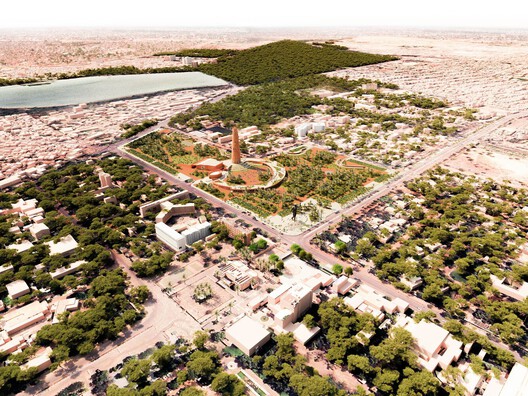
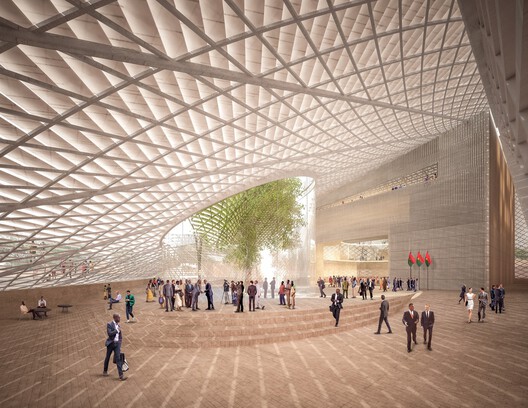
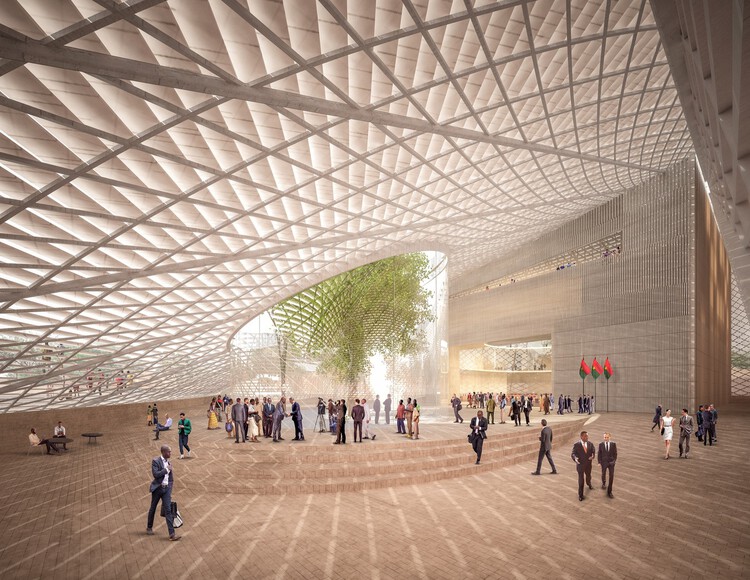
More prominent examples that have architecture as translation include 2022 Pritzker Prize Laureate Francis Kéré's unbuilt Burkina Faso National Assembly and his ongoing Thomas Sankara Mausoleum. They both embody Africanfuturism by fusing West African and Burkinabè technologies with eco-conscious forms to further progress the people: the National Assembly is designed in the image of a massive, stepped ziggurat with green terraces embedded to inspire collectiveness in civics and agriculture, while Thomas Sankara Mausoleum – built to foster remembrance, respect and hope – features a 34-meter, locally-sourced laterite and clay-brick dome with heliocentric skylights that illuminate the 13 concentric tombs sequentially by the hour, and a pending 100-meter tower to invite the younger generations to dream.
Cinematic Protopias: A Continuum
Folklore revels in storytelling, which in turn thrives in cinema. Set in a post-apocalyptic East Africa 35 years after World War III (the "Water War"), the aforementioned film Pumzi (2009) explores how nature has been completely devastated, forcing the Maitu to survive within subterranean, hyper-contained, hyper-functionalist, techno-dystopian architectural systems that suppress ecological hope, until one woman risks everything to regenerate the Earth outside. Inside the Maitu Community, the sterile layout is heavily influenced by a blend of industrial minimalism and dialed-down cassette futurism, with kinetic machinery integrated directly into living spaces to force the human body into supplying the building's energy grid. Ironically, even though the bunker was built to escape environmental collapse, its architecture becomes a prison so absolute that our protagonist, Asha, must then perform a second act of escapism to reconnect with the earth's actual ecological heritage (and in the process secure her autonomy).

A more expansive, joyous iteration of this continuum can be found in the animated anthology Kizazi Moto: Generation Fire (2023) by Triggerfish Animation Studio and various independent creators and animation houses. Across its episodes, creators draw directly from their homelands – such as Ugandan, Zimbabwean and Egyptian urban landscapes – to depict futuristic African metropolises.
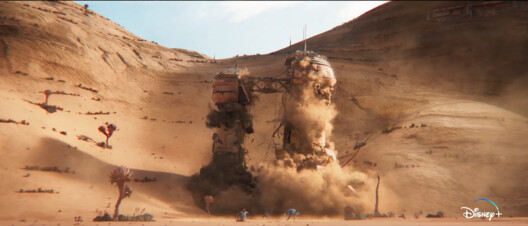
The first episode, Herderboy, by Ugandan director Raymond Malinga, appears to draw from the mythology of the Bachwezi and its King Ndahura, presenting a vision of a future where the ancient lineage of cattle-herding nomadism is reimagined via high-tech cybernetics and augmentation. The architecture in its worldbuilding also features a tower inspired by the traditional ngalabi, and incorporates patterns derived from traditional Ugandan basket-weaving.
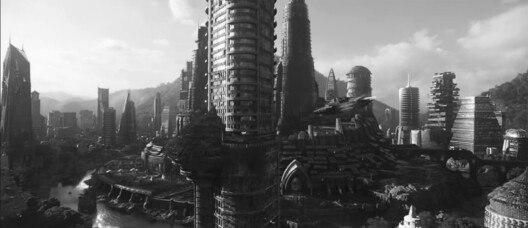
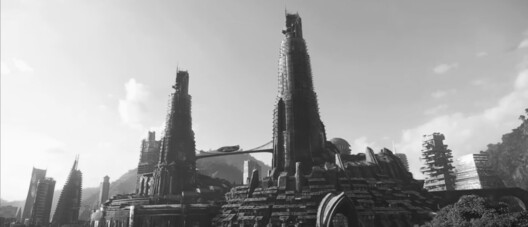
Unlike the fictional kingdom of Wakanda in Black Panther (2018), which often presents an insular tech-utopia with its Zaha Hadid-esque cityscape blend of earthy tones, rondavels and Malian landmarks, Kizazi Moto offers protopias: worlds that are not perfect, but continuously adapting and alive, set in existing places. Both media, however, have an architectural fabric that is a hybrid of advanced digital infrastructure and vernacular forms.
Speculative Fiction in Art: A Manifesto
In the same vein, artist Olalekan Jeyifous explores in his Shanty Megastructures of Lagos a juxtaposition between wealthy Lagos real estate and colossal vertical slums to give visibility to the dispossessed. Moreover, their physical exposition sheds a critical light by casting a long shadow over the conversations on their systematic deprivation of basic needs such as sanitation, electricity, healthcare, and modern communications.
Similarly, artist Rayan Elnayal utilizes magic realist techniques to create spaces of belonging for marginalized communities. She layers cultural motifs over futuristic forms to visualize fictional and calligraphic urbanisms that offer safe habitats as imagined elsewhere, which echo in her Digital Sanctuaries.
When alternative realities, whether otherworldly or contemporaneous, are explored as acts of reclamation to examine issues or find joys without abandoning the present or drowning in its complexities, architecture is the language used to translate them. The elsewhere will always be a mirror, if not a portal, to the here and now, or the then and what's to come. These projects show that Africanfuturism is already here, in architecture and arts before us all, to lead us into an equitable present.
This article is part of the ArchDaily Topic: The Lure of Escapism in Architecture and Alternative Worlds. Every month we explore a topic in-depth through articles, interviews, news, and architecture projects. We invite you to learn more about our ArchDaily Topics. And, as always, at ArchDaily we welcome the contributions of our readers; if you want to submit an article or project, contact us.