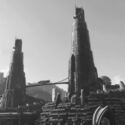
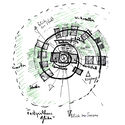
"Take your dream suppressants." The opening line in Wanuri Kahiū's Pumzi, directed at our protagonist Asha, enforces the order of severing ties with hopeful futures and ancestral memories in pasts shared to compel her focus on the perpetual present in the Maitu Community's heterotopia of an enclave. The bird's-eye view shot of the Maitu reveals a sterile, drone-like structure with a panoptic sphere at its center where normal human behavior is medicalized. The layout is built around closed-loop recycling systems as apt as a self-sufficient organism, designed to escape the toxic environment of a sickly Earth, where every pipe and corridor is engineered to harvest human excretion for water generation, thereby absorbing the roles of nature and state both. The community's architecture perfectly translates the film's message with its physicality.
Across folklore, film, and art, the same move recurs: architecture translates an elsewhere, whether ancestral, spiritual, or speculative, into form that can be seen or entered. The sections below follow that translation from the Kasubi Tombs to Kizazi Moto, and show that the elsewhere is a way of reading the present.