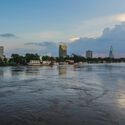
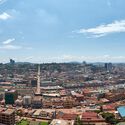
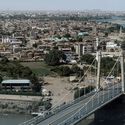
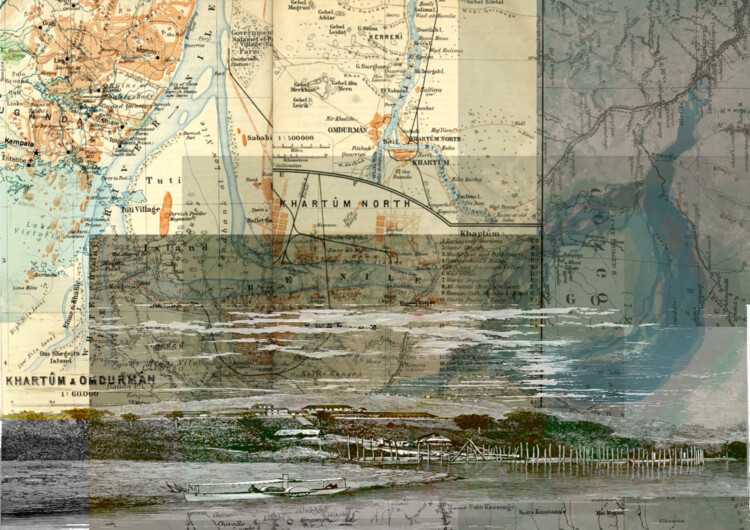
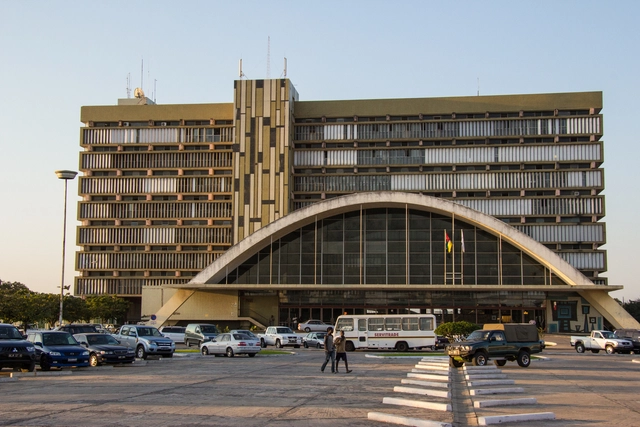
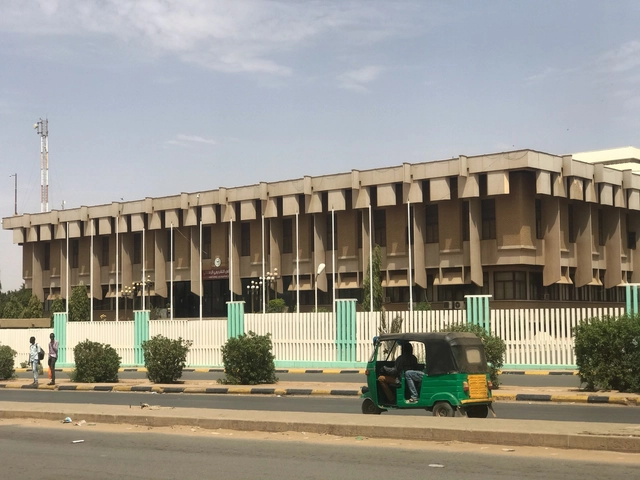
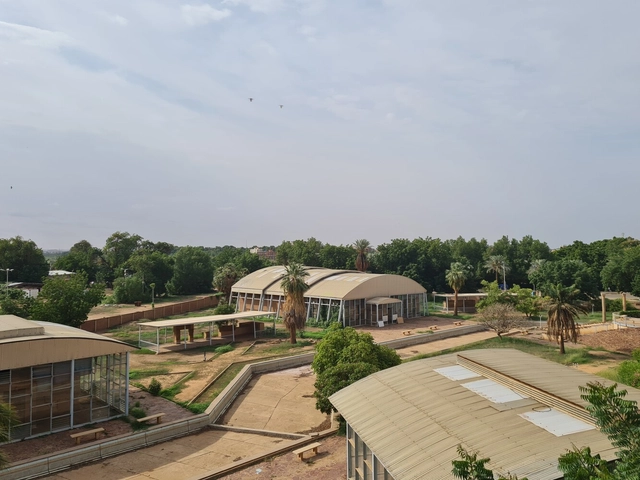
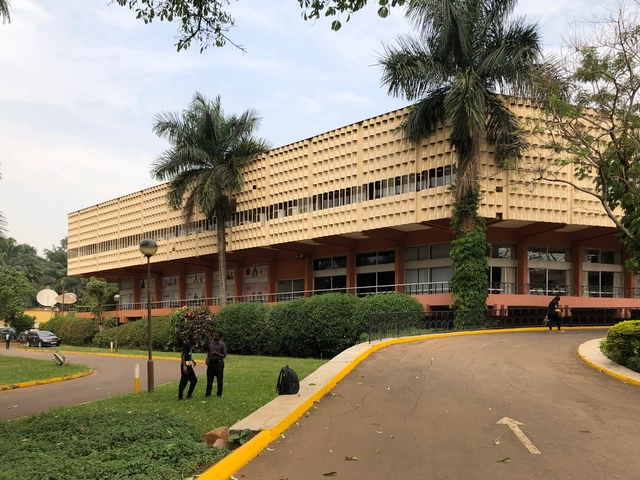
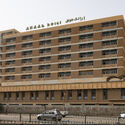
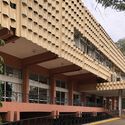
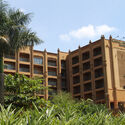
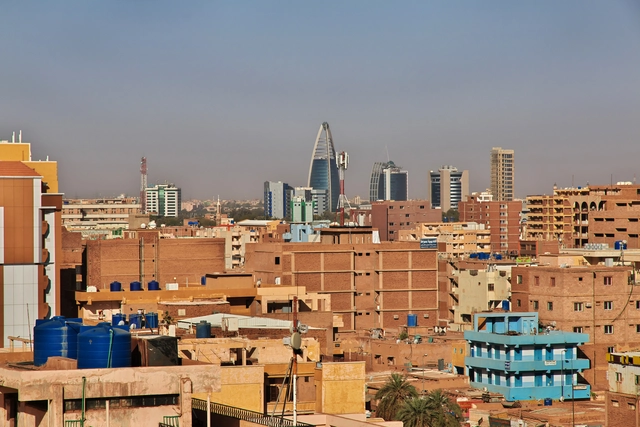
Conceptual map collage of Kampala, Khartoum and Kinshasa. Illustration by Maisa Elamein via Wikimedia Commons and Public Domain sources.
Colonial violence in African cities bled through the political dimensions into the spatial realm. It is infused into street grids, land tenure systems, drainage infrastructure and residential zones that continue to organize inequality and displacement today. Kinshasa, Khartoum, and Kampala each carry this afterlife in their urban morphology, at once historical artifacts and an active structure; shaping who has access to services, who occupies flood-prone land, and catalyzing a deepening climate instability that forces this apparatus into entirely new dimensions - including geological ones.
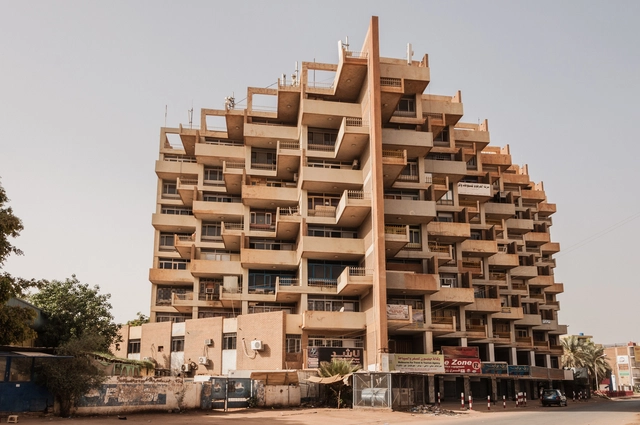
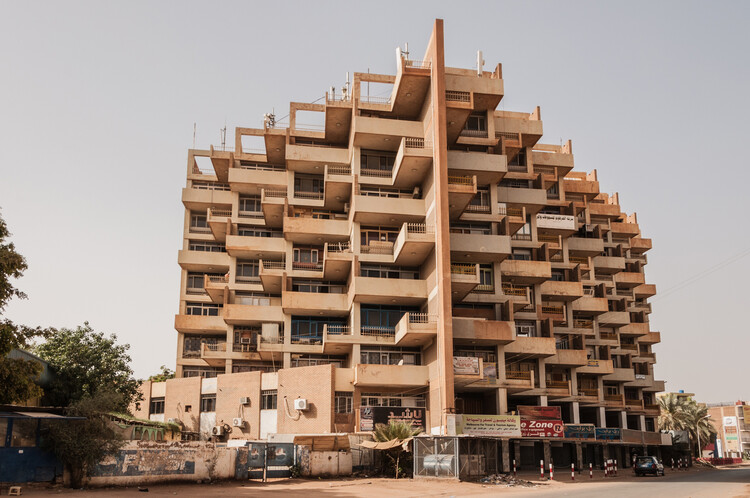
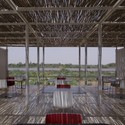
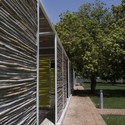
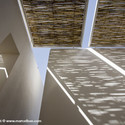
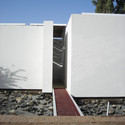
Little has been written about the work of Abdelmoneim Mustafa, one of the most respected architects in his homeland of Sudan and a pioneer in his profession in the mid-twentieth century. Esra Akcan, who made extensive research of his work with a team in Sudan during a small window of opportunity between 2019 and 2021, laments this lack of recognition thus, "How could someone as gifted as Moneim Mustafa… designer of some of the most exciting mid-century modernist buildings anywhere, be so neglected, so ignored out of Sudan, that to this day there is no internationally accessible publication in his name." Akcan's writings, coupled with the personal blog of Hashim Khalifa, who trained under Mustafa, shed light on his extensive legacy.
The use of technology has become vital in the documentation and conservation of heritage, especially in difficult or urgent circumstances. After many landmarks of the historic city of Palmyra were destroyed during Syria's war in 2015, conservators built three-dimensional digital models of the destroyed city to aid its future reconstruction. The destruction of the Buddhas of Bamiyan in Afghanistan in 2001 with very little prior documentation prompted action in the documentation of vulnerable monuments, such as the establishment of CyArk. More recently, detailed digital surveys and a heritage BIM model were essential in the restoration of Notre-Dame Cathedral in Paris after it was devastated by fire in 2019.
The mid-twentieth century marked a transformative period for Africa as 29 countries achieved independence between 1956 and 1964, signaling the dawn of the nation-state across the continent. This era resonated with a spirit of liberation and progress, paralleling the global movements of that time, such as the establishment of international organizations like the United Nations (1945) and the Organization of African Unity (1963). Within this context, Modernist architecture emerged as a powerful symbol of national identity, ambition, and the collective aspiration for a brighter future. As newly independent nations sought to define themselves apart from their colonial pasts, the adoption of Modern Movement principles facilitated the construction of key infrastructures, such as convention centers, parliament buildings, and hotels, as well as the development of architectural education, as native-trained architects begun to either replace or cooperate with foreign-born professionals.
This article inaugurates a new series titled Rediscovering Modernism in Africa, aiming to explore the architectural legacy of the Modern Movement in Africa, highlighting its role in nation-building and the evolution of architectural education, while shedding light on the architects and movements that shaped this transformative era.
As, one by one, the African nations gained their independence in the middle of the twentieth century, building programs were central to the process of nation-building. In several of those countries, this included the construction of the state's institutions such as their respective national assembly. These buildings not only facilitate the legislative process but also symbolize the new nation's governance, identity, and aspirations. The period of independence movements also coincided with the introduction of the Modern Movement across the continent, which was associated with progress and a break from the colonial past. Across Africa, some national assemblies were constructed early and were part of the nationalization process that preceded independence, while some were constructed long after.
Two museums in Africa built in the mid-twentieth century carry the name 'National Museum.' They reflect the story of their respective nation's history and are tied to notions of national identity. Both are also examples of fine architecture built on the principles of Modernism, a movement associated with nation-building in Africa. However, their inception and purpose followed very different paths. This article explores the under-reported architecture of the National Museum of Ghana in Accra and the Sudan National Museum in Khartoum.
The middle of the Twentieth Century saw the independence of most countries on the African continent. Those euphoric times brought forward-looking sentiments and a wish to break with the past. As an architectural movement, Modernism was ideal for the day, and newly independent countries had extensive building programs to assert themselves as fully functioning nations.
Hotels are one type of building that illustrates the complex architectural and political history of the times. Some were built specifically to host international delegations, others to boost tourism, while some were built as strong leaders' wishes. Although a marginal building type, several hotels across Africa stand as physical records of important parts of their respective country's history. Following an exploration of the histories of West Africa's Modernist Hotels, this second article turns to East Africa to uncover the ways in which this understated typology relates to larger histories of independence and national identity.
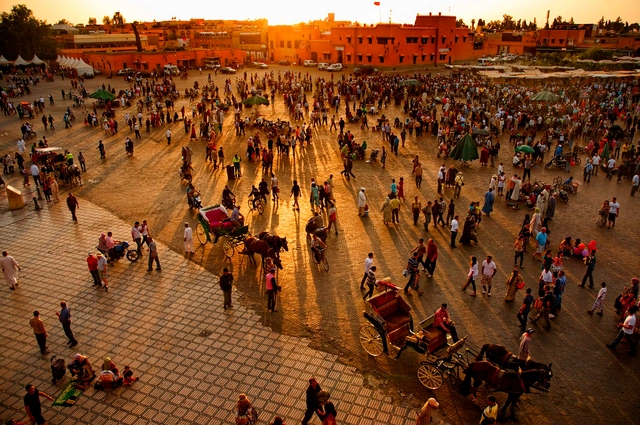
Protest has always been a powerful tool for creating change, and public spaces provide a platform for social engagement in societies. As part of the International Day of Democracy, we examine Africa, its series of emerging protests in the past year, and how citizens in various countries question political justice, demand better living standards from their government, and interrogate their nation’s sovereignty. With demonstrations ranging from organized large-scale marches to smaller spontaneous outbursts, residents of these countries have explored public spaces in symbolic and significant ways to amplify their voices. These spaces include public squares with cultural and historical meaning, sites of political buildings, or makeshift protest areas such as roads and open areas. Through this, African cities show how people make these spaces their own and how the power of their conglomeration cannot be ignored in unwrapping the democratic essence of public spaces.