Craft in contemporary interiors is increasingly valuable in the way materials are joined and brought into relation with one another. As the appetite for fast, inexpensive, and profitable retrofitting grows, there is also a parallel desire for interiors that feel thoughtfully resolved: spaces where details are integrated, material assemblies are considered, textures transition with intention, and hardware is treated as part of the architectural language rather than an afterthought. In many contemporary Chinese interiors, craft operates quietly through the treatment of surfaces and structures: timber that retains its irregularity, terrazzo that records aggregate and handwork, or finishes that reveal the care of their making.
This is especially important in an era when digital images increasingly reward smoothness. Rendered interiors often appear seamless, frictionless, and complete before construction has even begun. Craft complicates this image. It introduces tolerance, texture, material resistance, and the sense that a surface has passed through human hands before becoming architecture. Imperfection is not necessarily a failure of precision. To the eye that knows how to read it, it can become evidence of process.


The six projects discussed here suggest three ways handcraft surfaces shape contemporary interiors in China. Some use timber structure to make craft part of the spatial order itself. Others depend on plaster, paint, terrazzo, and local construction techniques to define the tone of the interior. A third group introduces a concentrated craft material as a defining piece for the project, such as handmade paper or reclaimed wood, as a precise atmospheric accent. Together, they show that craft is not only a matter of nostalgia or decoration, but a way of giving interiors thickness and care.
Related Article
The Productive Clash: Heritage Interiors, Contemporary Projects, and the Value of Imperfection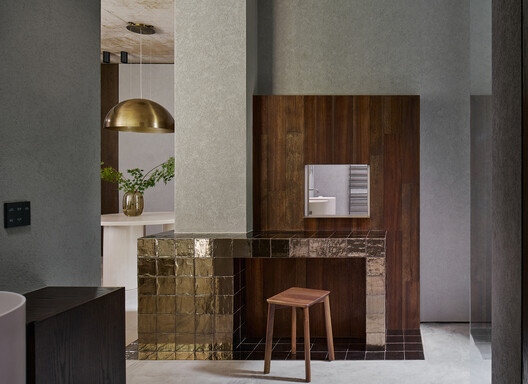
Timber as Structure, Texture, and Memory
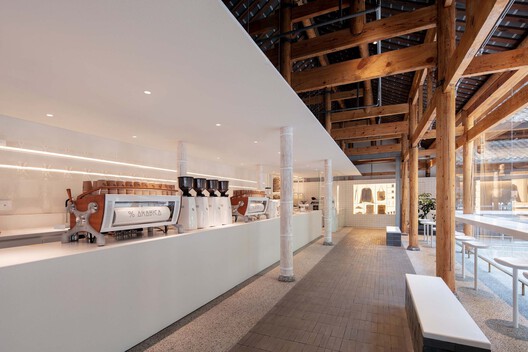
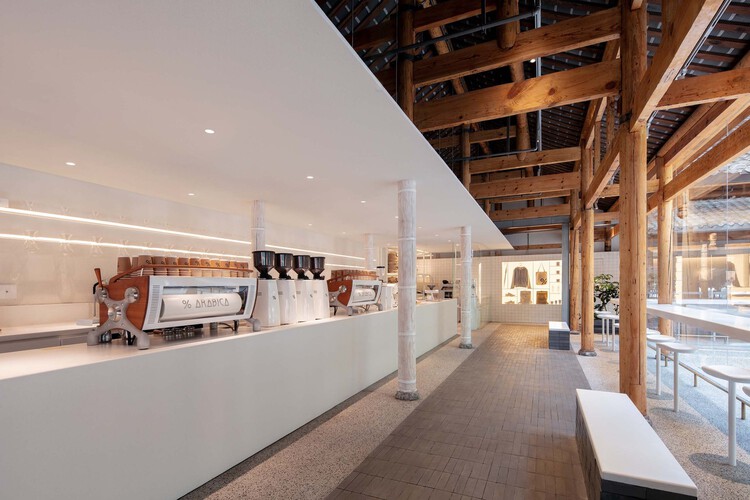
In % Arabica, Wide & Narrow Alley in Chengdu by B.L.U.E. Architecture Studio, craft begins with the existing building. The project occupies a traditional western-Sichuan residence in Chengdu's Kuanzhai Alley, where the architects removed later additions and restored the original courtyard organization. They also polished off black paint from the timber columns to reveal the authentic color and texture of the wood, while partially reinforcing the original timber structure with steel. The handmade surface here is not added as a finish; it is recovered from the building itself.
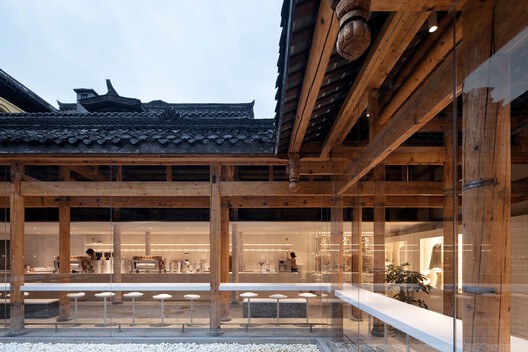
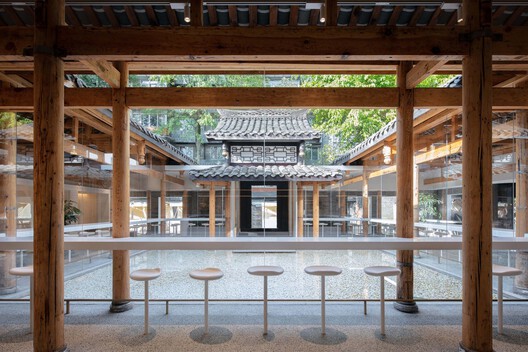
This recovery is paired with new material interventions. The café's looped interior street is paved with old grey bricks, while a small semi-open private seating area is surfaced with handcrafted bricks whose irregular surfaces produce a simple, natural texture. The result is not a return to historical reconstruction, but a conversation between the minimal white bar, glass enclosure, timber structure, water courtyard, and rougher handmade surfaces. Craft becomes a way of making the contemporary interior remain answerable to the site.
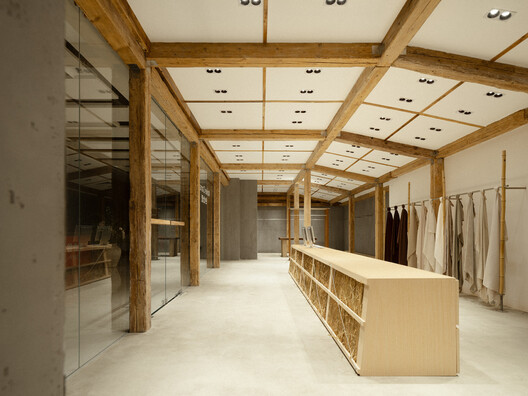
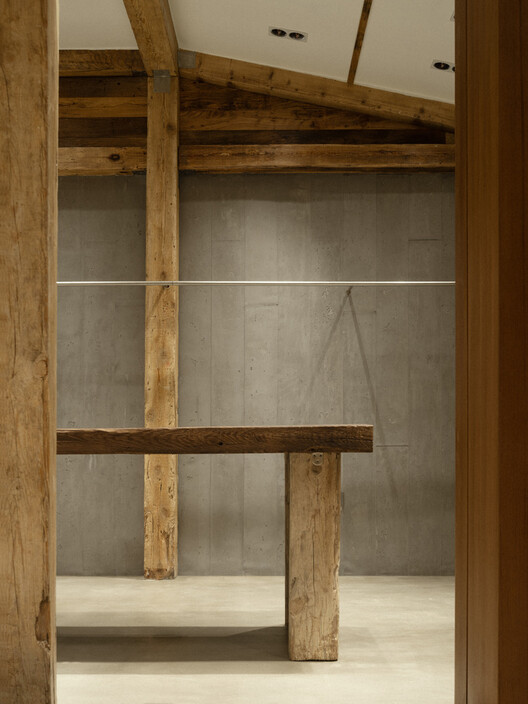
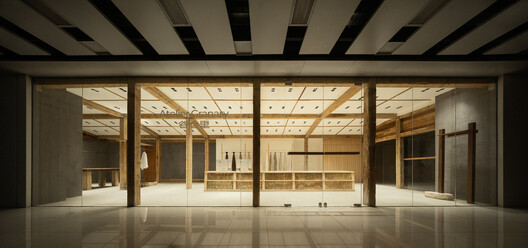
Barn Inside by Unknown design approaches timber from the opposite direction. Rather than refining an existing heritage structure, the project introduces a new wooden frame that feels intentionally rough, direct, and unstandardized. The space accepts bareness, coarseness, and traces of time as expressive texture rather than defects. Wooden piles form the skeleton of the interior, with cracks and annual rings left visible as records of material time. Here, craft and inconsistencies are not polished into smoothness. They are allowed to remain close to the condition of the raw material.
Ground, Plaster, and the Craft of Construction
If timber can make craft legible via structures, floors and walls can make it atmospheric. Terraced Courtyard by Team BLDG is useful because its craft is not concentrated in a single object, but dispersed through the construction process. The architects describe rural construction as requiring a different kind of on-site engagement, where the building phase demanded more energy than the design phase and more than 80 mock-ups were produced. In this context, craft becomes less a romantic image of local labor than a process of testing, adjusting, and negotiating with available techniques.
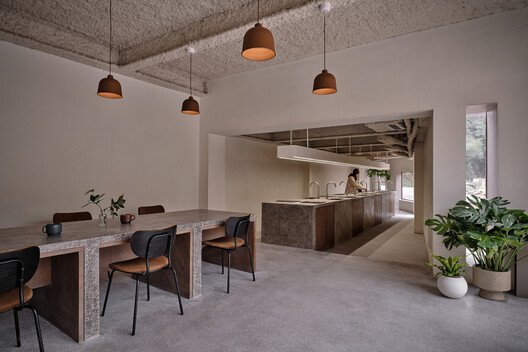
This is most evident in the project's exterior and surface treatment. After difficulties in finding skilled labor for washed stone, the architects shifted to texture paint, working with master workers through repeated on-site tests of color, texture, and thickness. The resulting rough and uneven handcrafted traces were intended to respond to the local environment and the red soil of the surrounding mountains. Rather than demanding perfect execution, the project allowed construction errors to be adjusted and absorbed. Craft here is a form of judgment: knowing when to correct, when to accept, and when imperfection becomes part of the building's fit with its place.
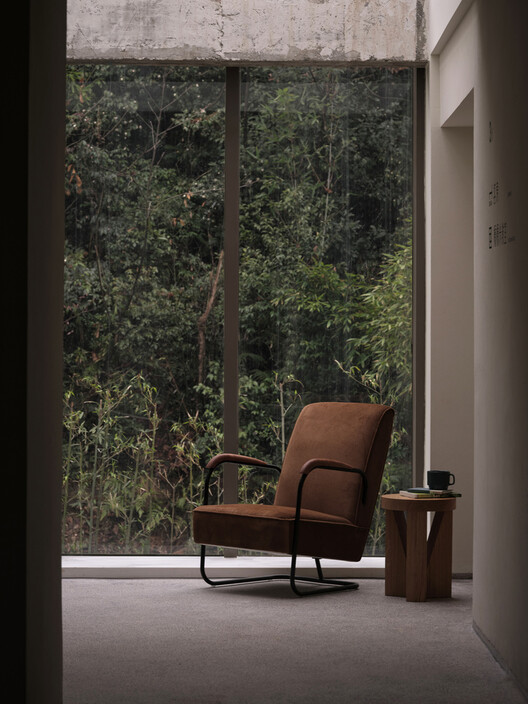
Chapter and Verse Hotel by New Practice Studio offers a more composed version of this approach. In the hotel interior, natural wood, handcrafted plaster, custom terrazzo, and artworks are used to connect the project to the history and atmosphere of Wuzhen. The surfaces are not presented as isolated craft statements, but as part of a larger spatial mood. Wooden screens filter light at the street-facing façade, while plaster and terrazzo help give the interior a calm, tactile continuity. In this case, craft works through atmosphere rather than roughness alone.
Accents of Light, Paper, and Reclaimed Wood
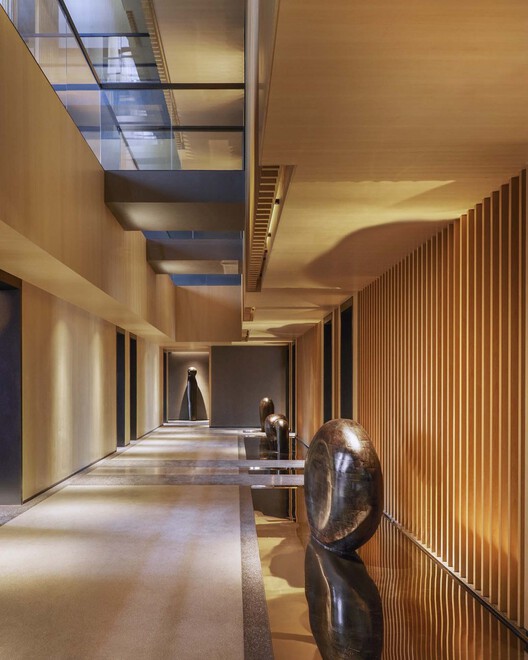
A handmade surface can also operate through concentration and isolation. In Art Vessels by OPEN Architecture, the most striking example is a glowing glass wall made from traditional Chinese handmade paper, which functions as both lighting and spatial divider. The material is fragile in origin, but architectural in effect. Laminated into glass, the handmade paper becomes a luminous surface that softens light and gives the lobby a more atmospheric presence.
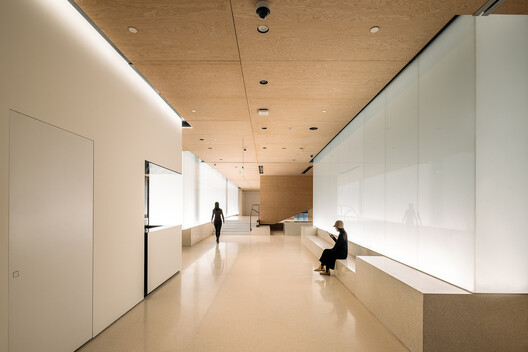
This single surface is part of a broader strategy of craft within the project. Glazed ceramic tiles, custom bronze door handles, interlocking blocks for reception counters, and intricately shaped ventilation panels are all designed and crafted as part of the interior. Yet the handmade paper wall is especially important because it shows how craft can be translated into light. Its value does not lie only in texture that can be touched, but in the way material irregularity changes the atmosphere of the room.
Anadu Pine Villa by Studio8 offers another kind of accent, rooted in reclaimed wood and artisan labor. Much of the woodwork is made from reclaimed wood sourced from local markets, with 80% of the pieces handcrafted by skilled artisans. The wood is shaped to harmonize with the scale and spirit of the surrounding environment, continuing local craft knowledge through the interior. In this case, the handmade surface carries both material reuse and human work. It is a finish, but also a condensed record of sourcing and adaptation.
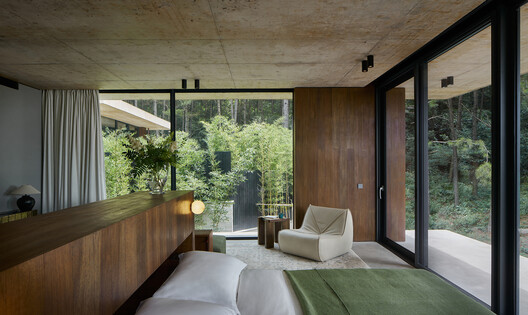
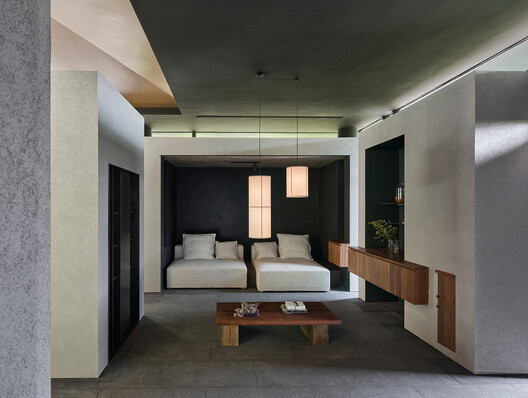
Together, Art Vessels and Anadu Pine Villa show that craft does not need to dominate an entire interior to transform it. A paper wall, a reclaimed timber surface, a handmade handle, or a carefully shaped panel can recalibrate the experience of a space. The handmade accent works precisely because it is concentrated. It slows the eye and body, reminding the visitor that even a highly controlled contemporary interior can still contain surfaces marked by process, labor, and touch.
Craft Beyond Smoothness
Across these contemporary Chinese projects, the handmade surface is not a single aesthetic. It can be rough or refined, structural or atmospheric, recovered or newly made. What connects the examples is their resistance to seamlessness. They allow interiors to hold evidence of making: timber grain, cracks, aggregate, plaster thickness, paper fiber, reclaimed wood, and uneven handcrafted traces. These surfaces do not simply decorate the room. They make construction legible.
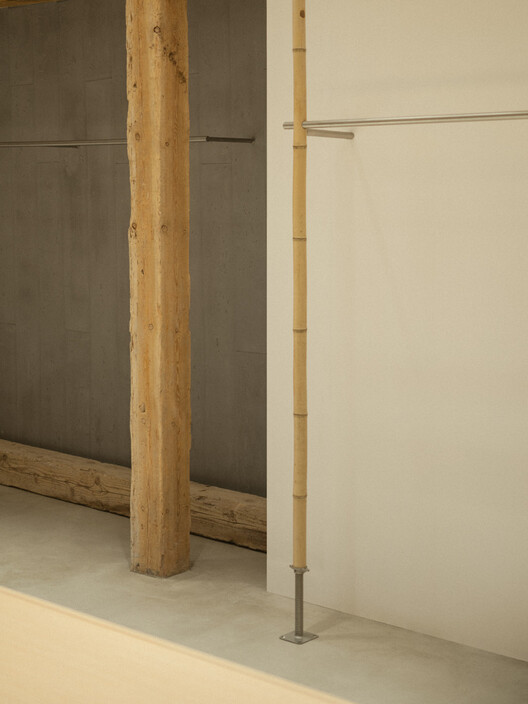
This may be one of craft's most important roles in the digital age. It reminds architecture that material meaning is not produced only through concept, form, or image, but through the way a surface meets the hand, the tool, the worker, and the site. In contemporary Chinese interiors, imperfection can therefore become more than an atmospheric preference. It can become a form of responsibility: toward material memory, local knowledge, and the human labor through which architecture becomes real.
This article is part of the ArchDaily Topic: The Architecture of Craft: Handmade Stories in a Digital Age. Every month we explore a topic in-depth through articles, interviews, news, and architecture projects. We invite you to learn more about our ArchDaily Topics. And, as always, at ArchDaily we welcome the contributions of our readers; if you want to submit an article or project, contact us.


