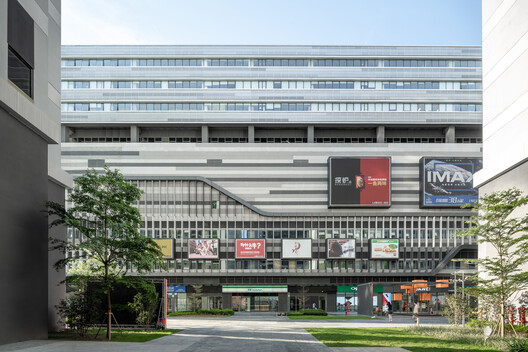
In many Asian cities, the summer climate can increasingly be experienced from a distance. In Hong Kong, it is possible to move from an apartment tower through a podium mall, enter the Mass-Transit-Railway system (MTR), arrive beneath another commercial complex, and continue through enclosed footbridges or underground passages while encountering remarkably little of the atmosphere outside. Heat, humidity, rain, and seasonal variation remain present, but they can be largely bypassed through a continuous network of conditioned interiors.
Over several decades, air-conditioning has expanded from a technology for cooling individual rooms into an infrastructure capable of producing an alternative urban environment. This has been particularly visible in parts of East Asia and South East Asia, where transit-oriented development frequently combines railway stations, shopping centres, housing, offices, and other everyday services within interconnected complexes. The Railway plus Property model has helped institutionalize this relationship between transport and development, creating districts where movement through the city is often inseparable from movement through privately managed interiors.
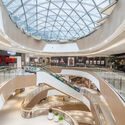
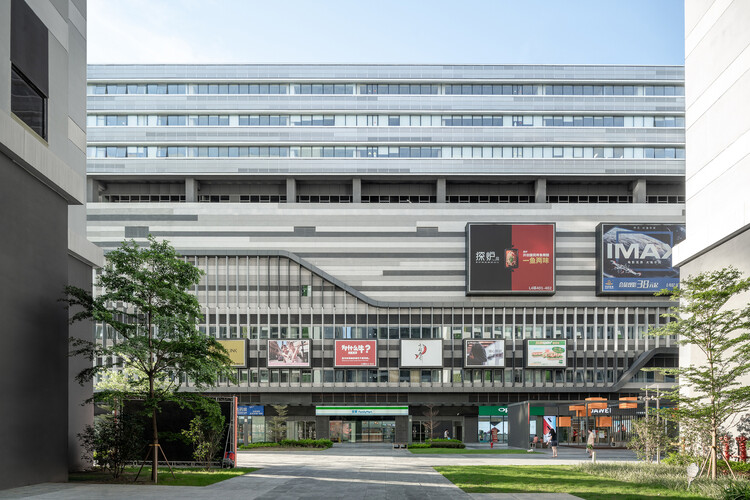
There is much to admire in these systems. They allow dense populations to move efficiently, concentrate daily activities around public transport, and provide relief from heat, humidity, heavy rainfall, and other climatic extremes. In many cases, the shopping mall has become far more than a destination for consumption; it functions as part of the city's circulation network and everyday infrastructure. The success of these environments lies precisely in how seamlessly they make urban life more comfortable and convenient.
Related Article
Digital Worlds and the Limits of Frictionless Space: Rethinking Scale and Materiality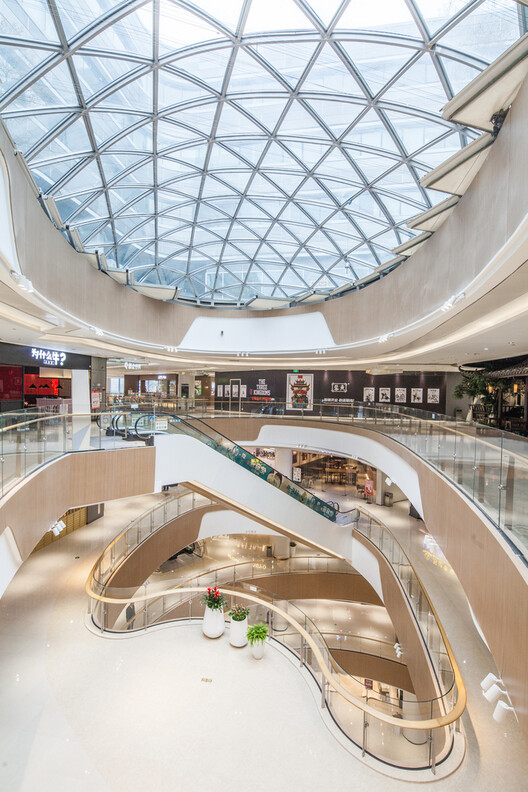
Yet that success also raises a more uncomfortable question. At what point does adapting to climate become escaping from it? As conditioned environments become larger, more interconnected, and more continuous, the exterior city can begin to register primarily as the uncomfortable interval between controlled interiors. What begins as climatic relief may gradually become a form of climatic withdrawal, reshaping not only how cities are built, but how inhabitants understand and expect to experience the climate of the places in which they live.
When the Mall Becomes the City
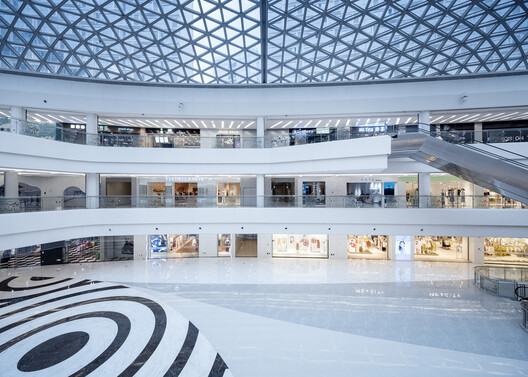
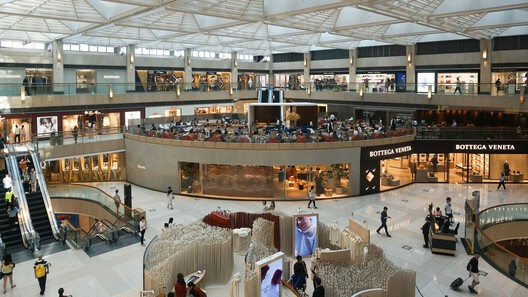
The contemporary Asian mega-mall differs considerably from the familiar image of the suburban shopping centre as an isolated destination surrounded by parking. In Hong Kong, the mall often functions as circulation infrastructure. One passes through it to reach a railway station, executes most of their vertical circulation within the city, collects groceries on the way home, eats, meets friends, and eventually reaches a residential or office tower above. In everyday use, what is technically a commercial interior begins to perform many of the functions traditionally associated with streets, squares, and other parts of the public city.
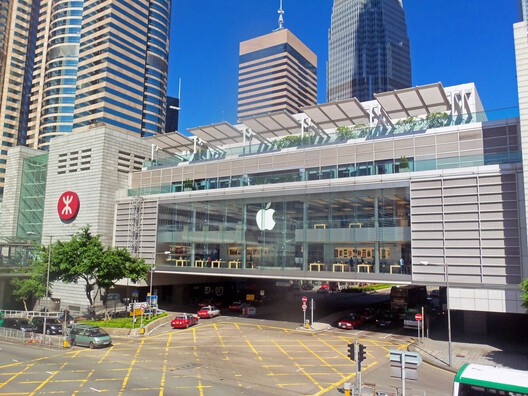
This condition makes the mall difficult to dismiss simply as an architectural expression of consumerism. Its success lies precisely in its usefulness. By combining transport, commerce, services, and circulation into compact developments, Hong Kong has produced an extraordinarily convenient model of dense urban life. The mall has not withdrawn from the city so much as absorbed substantial parts of it. Walking, waiting, meeting, eating, moving between transit modes, and passing from work to home can all occur within a sequence of managed interiors.
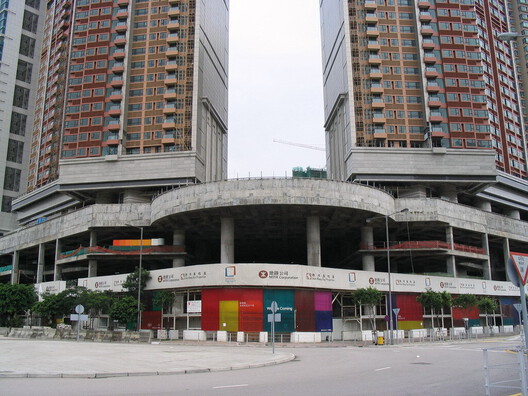
Elsewhere in the region, similar networks have become explicit planning tools. Singapore's Urban Redevelopment Authority supports covered, elevated, and underground pedestrian connections between developments and rapid-transit stations, with some districts planned around comprehensive multi-level networks intended to provide comfortable, seamless, all-weather movement. In Bangkok, One Bangkok combines shaded outdoor routes with enclosed air-conditioned spaces as parallel responses to pedestrian comfort in the city's climate. The result is not simply a collection of climate-controlled buildings, but an increasingly continuous interiorized urban landscape.
The environmental cost of maintaining such interiors is not insignificant. In Hong Kong, air-conditioning alone accounted for around 30 percent of total electricity consumption in 2023, according to the Electrical and Mechanical Services Department. As a rough order-of-magnitude exercise, and depending on assumptions about system efficiency and how that electricity is ultimately dissipated, this level of consumption can be thought of as producing a comparable quantity of waste heat over time. Averaged across the year, that would be on the order of the heat output from nearly 800,000 two-kilowatt electric heaters running continuously. The comparison is necessarily approximate, but it helps convey the scale of the energy involved in keeping the city's interiors cool.
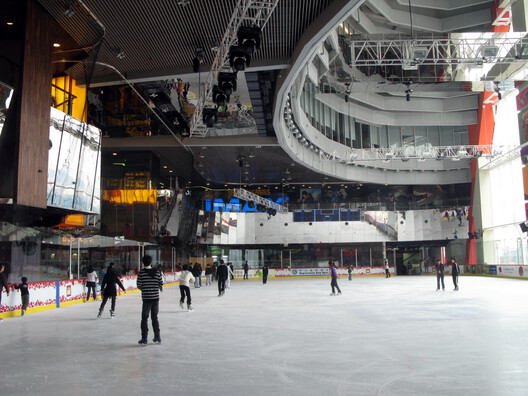
But energy consumption is only part of the architectural question. As conditioned interiors become larger and better connected, they also begin to alter expectations of what urban comfort should mean. A comfortable city is no longer necessarily one that makes its outdoor spaces inhabitable; it can increasingly become one that makes exposure to those spaces optional.
Escaping the Street
This shift creates a subtle feedback loop. As more daily activities migrate into conditioned interiors, investment and attention naturally follow them. The mall becomes cleaner, cooler, more convenient, and more densely programmed, while the exterior street is increasingly experienced as the interval one crosses to reach the next controlled environment. The less comfortable that interval feels by comparison, the more attractive the interior becomes. Climatic escape can therefore reinforce the very conditions that make further escape desirable.
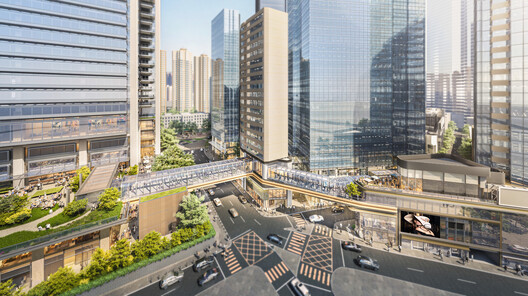
The difference is important. Air-conditioning was initially a means of improving particular interiors; it can now participate in reorganizing the city around them. If heat can be solved by moving indoors, there is less pressure to make an exposed pedestrian route comfortable. If heavy rain can be avoided through a tunnel or enclosed bridge, the street edge no longer needs to carry the same burden of shelter. As circulation migrates above, below, and through buildings, the architectural threshold between inside and outside can become increasingly abrupt. One environment is controlled; the other is something to pass through.
This does not mean the answer is to return nostalgically to a city before mechanical cooling. Nor is complete climatic exposure inherently more authentic. In increasingly hot and humid cities, air-conditioning can be essential to health and everyday comfort. The more relevant question is whether conditioned space remains one form of urban experience among many, or becomes the assumed destination of urban life itself. Singapore offers an instructive counterpoint in this respect: alongside underground and elevated networks, its planning guidelines continue to require and incentivize open-sided covered walkways, sheltered public routes, landscaping, and at-grade connections that provide climatic protection without necessarily enclosing pedestrians from the outside environment altogether.
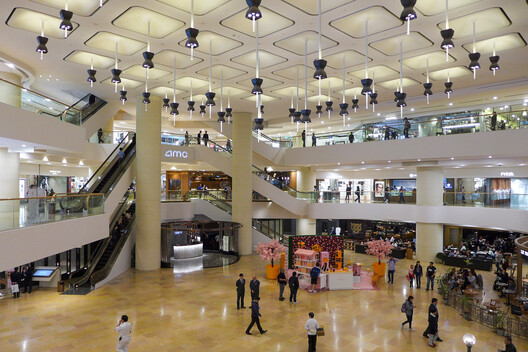
The distinction may become most apparent across generations. For those who experienced tropical Asian cities before widespread air-conditioning, entering a cooled interior represented a conscious form of relief: one knew exactly what was being escaped. For subsequent generations, the conditioned environment increasingly forms the ordinary background of urban life. Moving from an air-conditioned home into a lift lobby, through a podium, onto a railway, and into another mall or office no longer necessarily feels like retreating from the city. It simply feels like the city. Escapism becomes most complete when the alternative environment ceases to register as alternative at all—a possibility for younger generations who have known the air-conditioned city less as an exception than as the default.
This normalization can also change what inhabitants expect architecture to provide. Seasonal variation becomes an inconvenience to be eliminated rather than a condition around which everyday habits might adjust. A comfortable environment is expected to remain relatively constant regardless of what is happening outside. At their most extreme, mega-developments begin to resemble urban-scale refrigerators: enormous interiors capable of maintaining preferred atmospheric conditions while the weather, season, and climate continue beyond their envelopes. The accomplishment is technologically impressive, but it also produces a particular relationship to place—one in which environmental differences can increasingly be suspended rather than encountered.
Returning to the Climate
The challenge is therefore not to reject the air-conditioned city, whose convenience has become fundamental to contemporary urban life. Nor should mega-malls and transit-oriented developments be dismissed simply because they are enclosed or privately managed. In cities such as Hong Kong, their density and integration with public transport have produced real urban efficiencies, while protected circulation can make cities significantly more usable during extreme heat and rainfall. The question is what happens when this model becomes so successful that the world outside begins to matter less.
Between the sealed mall and the exposed street lies a much broader architectural territory. Covered walkways, shaded public rooms, planting, open-sided arcades, breezeways, semi-conditioned thresholds, and spaces capable of changing with weather can offer protection without requiring complete environmental separation. The objective is not to remove air-conditioning, but to prevent mechanical conditioning from becoming the only imaginable definition of comfort.
Escapism becomes problematic not when architecture offers relief from an uncomfortable climate, but when the relief becomes so complete that the climate outside ceases to register at all. As cities face hotter temperatures and greater climatic uncertainty, architecture will undoubtedly need cooling. But it will also need to retain the knowledge required to make streets, thresholds, and public spaces inhabitable without enclosing all of them within a single artificial atmosphere. The question may therefore be less about how successfully Asian cities can escape their climates than how architecture can allow people to remain within them. If architecture makes it possible to live without encountering the climate, eventually it may also become possible to forget how to design for it.
This article is part of the ArchDaily Topic: The Lure of Escapism in Architecture and Alternative Worlds. Every month we explore a topic in-depth through articles, interviews, news, and architecture projects. We invite you to learn more about our ArchDaily Topics. And, as always, at ArchDaily we welcome the contributions of our readers; if you want to submit an article or project, contact us.


