
Every evening when we get home, without ceremony, we perform a small rite. We arrive at a door, we open it, and we step through into a space that belongs to us in a way no other space does. It is such a mundane act that we rarely notice it has a structure at all, and yet philosophers and anthropologists have written entire books describing these psychological structures. Interestingly, visual works such as the animated worlds of Studio Ghibli seem to reflect this dynamic to create worlds which contain architecture and layouts that provide a path to escape by tapping into our memories in a legible yet enchanted form.
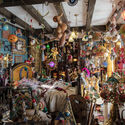


Gaston Bachelard called the discipline of reading a house's psychological weight on a person's life as "topoanalysis". It is the idea that the corners, stairs, and attics of the home we grew up in are not neutral backdrops but are physically inscribed in us. The stair that was an inch too high, the particular quality of light in a childhood bedroom: these become part of the body's memory, carried forward into every space we inhabit in later stages of our lives. This space that has been "loved" and provides a protective psychological value becomes almost sacred to us, and Bachelard calls it a "felicitous space".
In his account, felicitous space is already shadowed by nostalgia, so that every house we inhabit later becomes an attempt to recover the first house that can never quite be returned to. In that context, for Bachelard, the house we live in is never simply a shelter. It is where physical reality and what he calls the virtuality of imagination and dream converge, a little cosmos and safe space, built from the layers of our past experiences and the "dreams" of everyone who has lived there before. To understand this idea better, we can look at the work of Juhani Pallasmaa. For him, we do not live separately in material and mental worlds, but rather, these dimensions are pretty much intertwined.
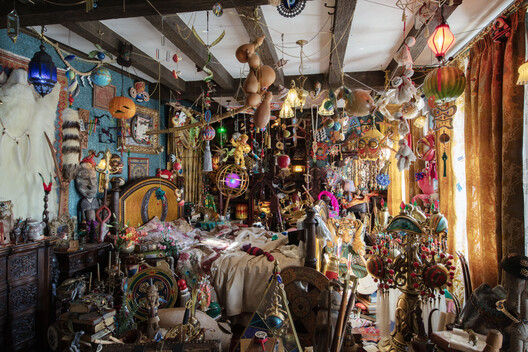
"Architectural constructions are built in the world of matter and Euclidean geometry, but lived space always transcends the rules of physics and geometry." — Juhani Pallasmaa
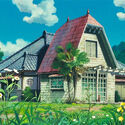
This idea that a house holds an imagined mental world alongside its physical one is not an abstraction if you have seen Studio Ghibli's My Neighbor Totoro. When the two protagonist sisters arrive at their new, yet well-lived, home, they are told the spaces are full of small soot spirits that scatter when a room is disturbed. The spirits in this context are not intruders; they are what an empty house is already imagined to contain before any memories have had time to accumulate there. The movie is dramatizing, almost literally, what Bachelard is describing: a house is never just physical space waiting to be filled. It arrives already half-inhabited by what we expect and hope to find in it.
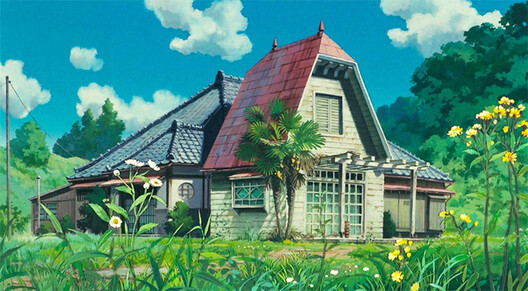
In that sense, if the house is where interior life and physical space converge, then crossing into it is not architecturally neutral either. Instead, it becomes more of what Arnold van Gennep describes as a rite of passage, which according to his writings unfold in three stages: separation from a prior state, a liminal or threshold stage of transition, and incorporation into the new state. Van Gennep was not writing about coming home from work, but the structure maps cleanly onto it.
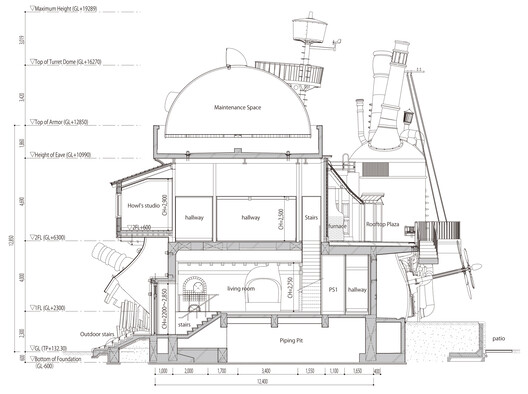
Standing at your own front door is a small rite of separation, where the outside world demands a stop. Then, opening the door and stepping across the threshold is the liminal moment itself; it is the brief and rarely noticed moment where people transition from the profane into their sacred. Finally, settling into the core of the home like the chair, the room, the ritual of taking off shoes and setting down a bag, is incorporation, the return to the self or the miniature cosmos that only exists in that space. The door, in this reading, is not simply an architectural feature, but rather a portal. As magical or esoteric as this might sound, cultures have marked such portals for centuries. In Japan, for example, a Shinto Torii gate announces, visually, before anyone crosses it, that the space beyond is no longer profane. The threshold is doing symbolic work the moment it comes into view.
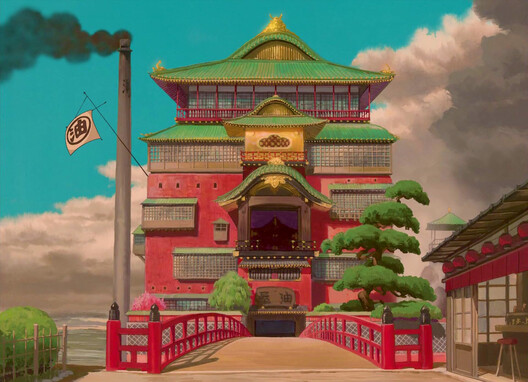
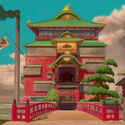
Studio Ghibli's films seem not just to gesture at this ritualistic structure mentioned above, but rather they build entire plots out of it. In Spirited Away, Chihiro the main character crosses a bridge to transition into the world of spirits dominated by a big bathhouse, with the movie developing around her incorporation into the world. The bathhouse itself tracks her growth, only presenting its spaces gradually as Chihiro grows. In Howl's Moving Castle, Sophie, the main character, enters through a magic threshold into the castle. The interior space seems to be a representation of the interior world of the other main character, the Wizard Howl. In this case, Sophie slowly cleans the space as she incorporates into this new reality. In both films the characters remain in this in-between condition or liminal space, not fully their old reality, but also not completely immersed in their new one yet.
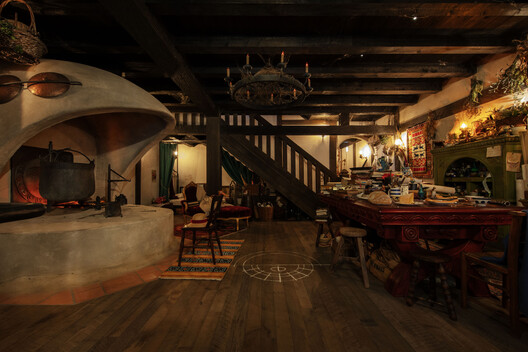
However, in contemporary living, apartments that have open-plan layouts or monospaces, often create undifferentiated rooms, making that rite of entry become diffused. Hybrid work, for example, drags the demands of the exterior world across the very threshold that used to end them. Homes we admire in social media tend to be staged so they are legible to strangers, instead of showing the accumulated memory that makes a space felicitous in the first place. Interestingly, Bachelard was already describing this in 1958, lamenting that in the modern city "there are no houses," only inhabitants living in "superimposed boxes".
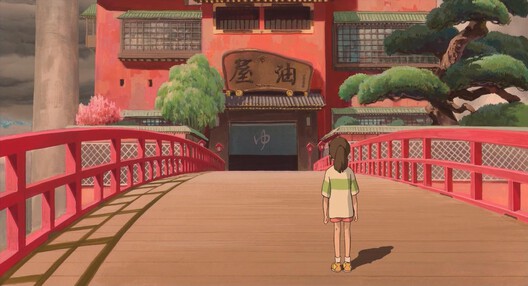
On that note, Ghibli's films also offer another opportunity to escape our fast lives by immersing us into moments of stillness amid seemingly magical/real spaces. Once they have incorporated the viewers into their worlds, movies like Spirited Away dedicate entire scenes to silence. In this case, the shot lingers for about 4 minutes on Chihiro sitting in a train with no dialogue. In Howl's moving castle the movie dedicates a full minute to Sophie sitting in front of a fire, while the shot emphasizes the architectural details of the big fireplace and the half-lit room around it. Susan Napier, in her work "Miyazakiworld: A Life in Art", actually identifies this characteristic in the films with the Japanese term "mono no aware", a gentle awareness of the transience of ordinary moments, valued precisely because they do not last.
As we live in a time where our environment encourages us to live a productivity-oriented life, these quiet moments and the film's representations of the rites allow us to escape into spatial and psychological dynamics that we don't seem to have time for anymore. In a way, they help us reconnect with our own felicitous space. That nostalgia evoked by the films is not a coincidence; it is a reminder for architects that we can use our practice to build worlds that are worth loving and returning to every evening. A house cannot give anyone more hours in a day, but it can be built and arranged, deliberately, to hold that kind of stillness.
This article is part of the ArchDaily Topic: The Lure of Escapism in Architecture and Alternative Worlds. Every month we explore a topic in-depth through articles, interviews, news, and architecture projects. We invite you to learn more about our ArchDaily Topics. And, as always, at ArchDaily we welcome the contributions of our readers; if you want to submit an article or project, contact us.