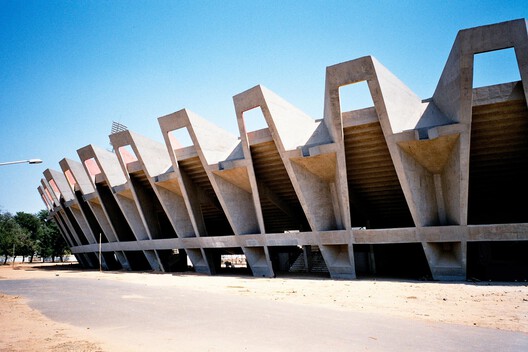
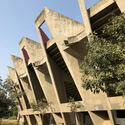
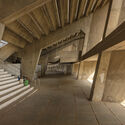
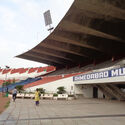
In the heart of Ahmedabad's Navrangpura district in India sits the Sardar Vallabhbhai Patel Stadium. More than just a cricket ground, the stadium stands as one of India's earliest experiments in modernist public architecture. Built in the decades following the country's independence, the structure has not only become an engineering landmark, but also a major public space within Ahmedabad's urban fabric. Despite the building's architectural and historical significance, as well as its deep involvement in daily community life, it has suffered significant physical degradation as a result of decades of poor maintenance and lack of funding. That fragility is precisely why it has drawn international attention. In 2020, the World Monuments Fund (WMF) placed the Sardar Vallabhbhai Patel Stadium on its World Monuments Watch, a global list highlighting cultural heritage sites facing urgent preservation challenges.

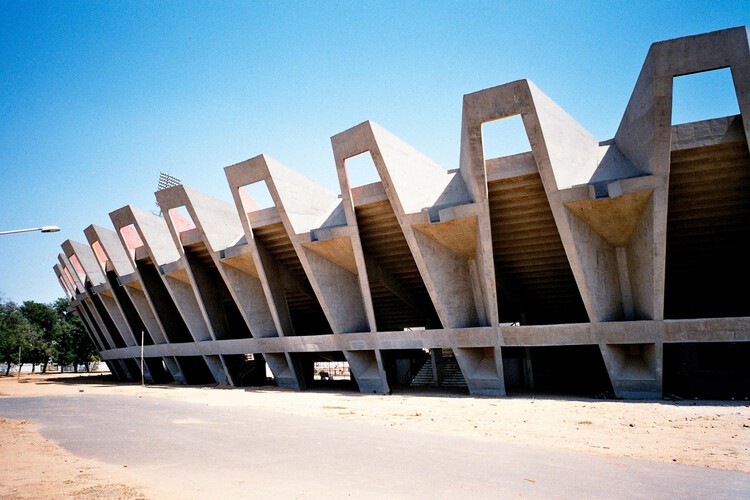
To understand this project better, it helps to look at India during the early years after independence in 1947. Under Prime Minister Jawaharlal Nehru, the nation set out to modernize rapidly by industrializing its cities and founding new academic and civic institutions. Part of this process was also searching for an architectural language that could express a forward-looking identity distinct from its colonial past. That is why Nehru's government invited internationally renowned architects, including Le Corbusier, to help build entirely new cities and institutions, most famously the city of Chandigarh.