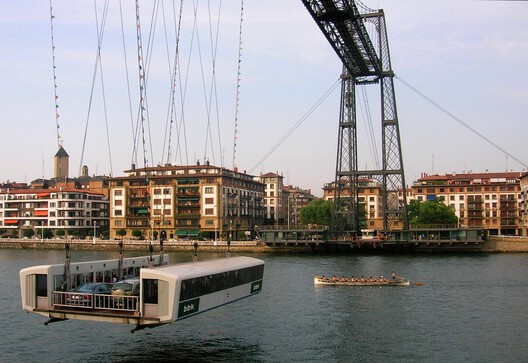
What role do transportation infrastructures play in shaping the culture and economy of societies? How do they bridge cultural, ideological, and geographic divides while transforming the lives of the communities they serve? One of the most remarkable iron structures of the European Industrial Revolution stands west of Bilbao, spanning the Nervión River at the mouth of the Ibaizabal Estuary. It is the Bizkaia Bridge, which combines nineteenth-century ironworking traditions with the innovative use of lightweight alternating-twist steel cables. Recognized as the world's first transporter bridge, it became a model for similar structures built throughout Europe, Africa, and the Americas.
Constructed to connect the opposite banks of the Nervión estuary, it was the first bridge in the world to allow ships, passengers, and vehicles to cross simultaneously by means of a suspended gondola. This innovative system improved communication between two small seaside resort towns while allowing uninterrupted navigation through one of Europe's busiest inland ports.
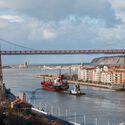
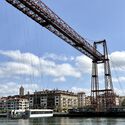
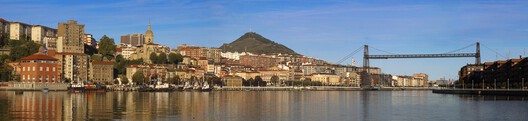
The Bizkaia Bridge is located in northern Spain, where the navigable Bilbao Estuary opens into the Bay of Biscay. Today, the Bilbao metropolitan area extends to the mouth of the Nervión River, where the municipalities of Portugalete and Getxo share a long and intertwined history. Both communities originated during the Middle Ages, when the estuary became a vital commercial corridor. At that time, Portugalete was one of the most important ports in the Province of Biscay, while Getxo remained a small settlement inhabited primarily by fishermen, ranchers, and farmers.
Because of their coastal location, Portugalete and Getxo entered a new phase of development in the mid-nineteenth century as fashionable summer resorts, attracting members of the Spanish aristocracy and the wealthy upper bourgeoisie who had prospered through Bilbao's industrialization. During this period, both towns were transformed by the construction of luxurious bathhouses, villas, and mansions designed to accommodate affluent visitors seeking the fresh sea air and direct access to the coast.
The arrival of these new social classes encouraged the construction of ambitious infrastructure projects, including the Bizkaia Bridge, which connected the two shores through an innovative suspended mechanical transport system. The bridge was designed by the Basque architect Martín Alberto de Palacio y Elissague, who is also known for his contribution to the construction of Madrid's Crystal Palace in Retiro Park. French engineer Ferdinand Joseph Arnodin oversaw the bridge's construction, while Bilbao textile entrepreneur Santos López de Letona served as the project's principal promoter and financier.
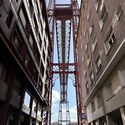
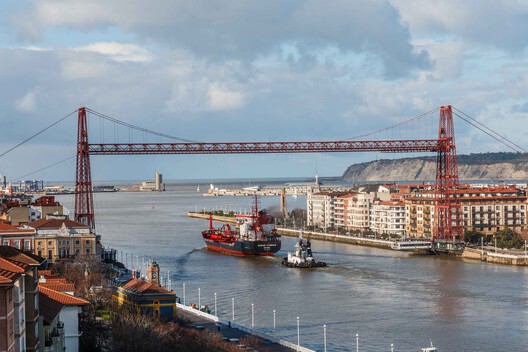
The origins of the bridge date back to the late nineteenth century. When architect Martín Alberto de Palacio began developing the project, he conducted a thorough study of every transportation solution available at the time, evaluating proposals ranging from rail-mounted ferries, barges, and floating pontoons to swing, draw, bascule, submerged, and elevated bridges. Each alternative was ultimately rejected following careful technical analysis until he conceived a new type of bridge capable of transporting passengers and freight without obstructing river navigation, while also offering a reasonable construction cost and reliable service. Three successive designs preceded the final proposal, which features a structural system consisting of two horizontal trusses supporting the rails, carried by four towers founded on the docks along both banks of the estuary.
During the second half of the nineteenth century, iron was regarded as the ultimate symbol of industrial progress. It was the material used to build machines, ships, railroads, vast roof structures and towers, monumental exhibition halls for the World's Fairs, and many of the great bridges constructed throughout Europe and the Americas. By the end of the century, the Bilbao Estuary had become one of Spain's principal centers of industrial activity, fueled by the large-scale extraction of a rich iron ore deposit stretching more than 25 kilometers across the mines of Biscay. It was the same mineral that had once supported Spain's colonial expansion, but now it was mined for export and industrial production, giving rise to an extraordinary boom in mining companies, shipping firms, steel manufacturers, banks, and other industries.
Against this backdrop, Palacio and Arnodin proposed the construction of the Bizkaia Bridge in 1888, embodying key principles of modern engineering, including structural efficiency, an honest expression of construction, and the practical application of technology to meet social needs. The project was financed by a group of local entrepreneurs led by Santos López de Letona, an industrialist who had amassed his fortune in Mexico's textile manufacturing industry. The bridge was intended to serve the nearly half a million passengers who crossed the Bilbao Estuary each year aboard rowboats. Palacio also envisioned several complementary features, including opening the upper walkway to pedestrians and installing panoramic elevators to provide public access to the bridge.
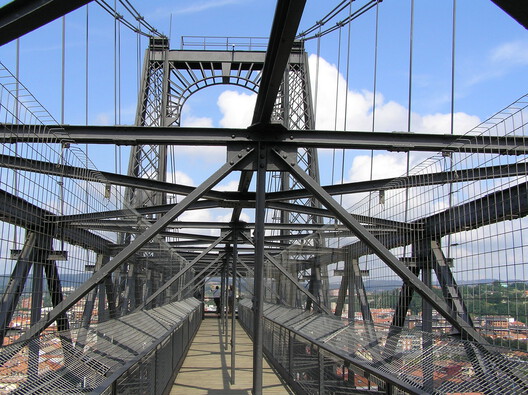
Construction began on April 10, 1890, on the Portugalete side of the estuary, with the first phase devoted to surveying and preparing the site. Although the sandy soil presented significant engineering challenges, these difficulties were successfully overcome, allowing construction to proceed. Once the excavation work was completed, the foundations were laid, and the towers were erected in sections using extensive wooden scaffolding. Although the steel framework was initially assembled with bolts, these connections were ultimately replaced with rivets—approximately 400,000 in total—to secure the structure.
After the towers were completed, the stay cables and bracing were installed before work began on the horizontal trusses spanning the estuary. The trusses were assembled in sections, each lifted into place from a barge before being connected to form the completed structure. Construction then shifted to the transporter gondola, originally built of timber planks reinforced with steel plates at the suspension cable connections. Reflecting the social hierarchy of the period, the gondola was divided into first- and second-class passenger areas separated by a net partition. First-class passengers occupied three rows of covered benches along both sides of the platform, while second-class passengers shared the open central section with horse-drawn carriages, freight, and livestock.
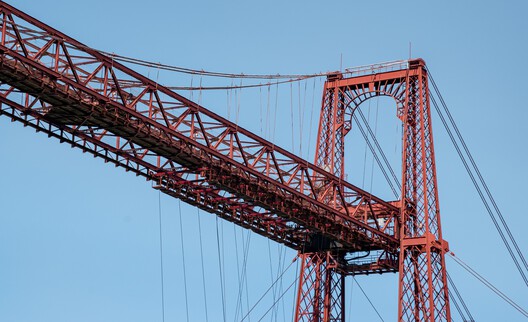
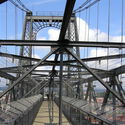
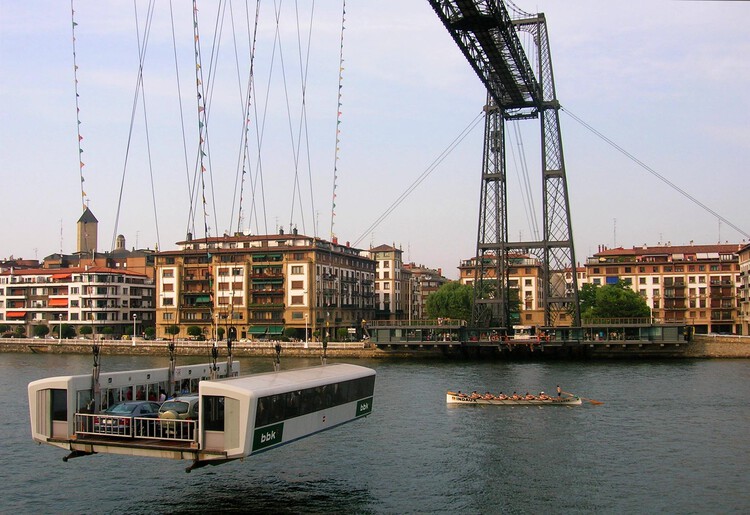
Once construction was complete, the gondola underwent load testing with 26 tons of ballast, bringing its total weight to 40 tons—approximately four times its maximum normal operating load. Under these conditions, it completed multiple crossings at different speeds to evaluate the bridge's structural performance, and the results proved entirely satisfactory. The Bizkaia Bridge officially opened on July 28, 1893. The structure consists of four riveted lattice steel towers, stabilized by stay cables and arranged in two pairs, each rising 51 meters (167 feet) above the ground. Between the towers, parabolic suspension cables support a 160-meter-long (525-foot) upper crossbeam suspended 45 meters (148 feet) above sea level at high tide. Without interfering with river traffic, a mechanical trolley travels along this crossbeam, carrying a suspended gondola that remains level with the riverbanks and is capable of transporting approximately twelve vehicles and two hundred passengers at a time.
However, the story of the Bizkaia Bridge did not end with its inauguration. When the Spanish Civil War broke out in 1936, the bridge witnessed the conflict firsthand, surviving several aerial bombings without sustaining irreparable damage. In 1937, as Nationalist forces approached Bilbao, the Engineering Battalion of the Army of the North was ordered to destroy every crossing over the Nervión River in an effort to slow the advance of Franco's troops. Following a powerful explosion, the bridge's upper crossbeam collapsed into the estuary. Five days later, the Battle of Bilbao came to an end. Reconstruction was approved in 1939, with engineer Juan José Aracil placed in charge of the project. Although the bridge was faithfully restored, several modifications were introduced, including improvements to the suspension system, the deck and transverse beams, and the upper trolley. Ferry service resumed in 1941.
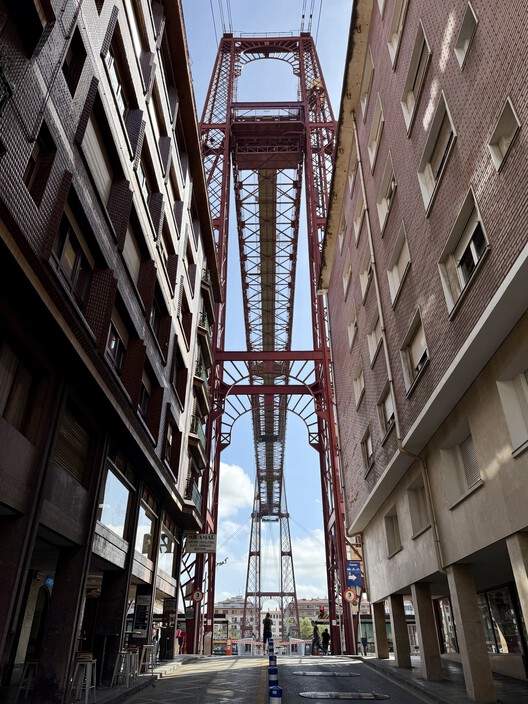
Throughout its history, the Bizkaia Bridge has undergone numerous upgrades and modernization efforts to meet evolving operational needs while preserving the characteristics that define its heritage value. The replacement of the transporter gondola, the installation of new electrical systems and elevators, and the removal of secondary structural elements was among the interventions necessary to keep the bridge in continuous operation while maintaining its authenticity as a functioning industrial monument. Although these new components are not visually identical to the originals, they provide practical engineering solutions that respond to contemporary requirements. For example, the original gondola was replaced with a lighter version, while the iron wheels that once ran along the upper rails were substituted with polyurethane rollers to reduce vibration and improve operational performance.
Around 2011, additional engineering work was carried out, including the replacement of more than 250 components, such as suspension cables, structural elements, and a new rail. A comprehensive structural analysis also revealed that the bridge's jet-black finish absorbed excessive solar radiation, accelerating thermal fatigue in the steel towers and upper crossbeam. As a result, the structure was repainted in "Vena Roja Hematites Somorrostro", a color considered better suited to the bridge's long-term preservation.
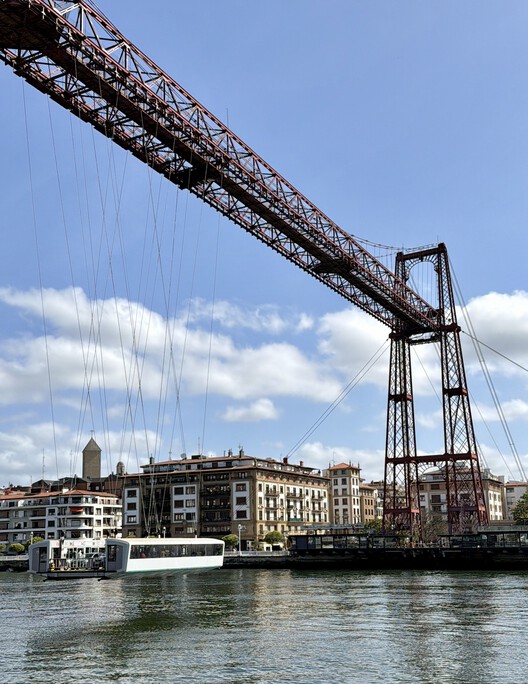
Designated a UNESCO World Heritage Site in 2006, the Bizkaia Bridge continues to operate between Portugalete and Getxo, communities whose economies have increasingly diversified around tourism, culture, recreation, and the modern port. Combining engineering innovation with technical ingenuity, the bridge was celebrated from the moment of its completion as a triumph of the emerging industrial age, introducing both a groundbreaking structural solution and an entirely new mode of transportation. Over time, however, its significance has extended far beyond its original function, demonstrating how a single piece of transportation infrastructure can foster profound social, cultural, and economic transformation across an entire region. The bridge's ongoing conservation reflects the value it continues to hold for the people who cross it, rely on it, and live alongside it every day. Today, it completes more than 300 transporter crossings daily and carries an average of four million pedestrians and half a million vehicles each year.
By connecting two communities, the Bizkaia Bridge represents far more than a remarkable feat of nineteenth-century engineering. It demonstrates how technological innovation, when guided by genuine social needs, can bridge physical, cultural, and territorial divides while transforming the lives of thousands of people. As patterns of mobility continue to evolve, how should future transportation infrastructure be designed to connect our communities? And how can planners, architects and engineers work more closely with local residents to better understand patterns of movement and respond to the mobility needs of today and tomorrow?
This article is part of the ArchDaily Topic: Architectures of Movement: Land, Borders, and the Politics of Belonging. Every month we explore a topic in-depth through articles, interviews, news, and architecture projects. We invite you to learn more about our ArchDaily Topics. And, as always, at ArchDaily we welcome the contributions of our readers; if you want to submit an article or project, contact us.


