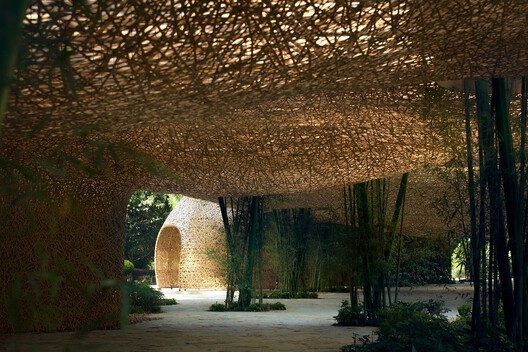
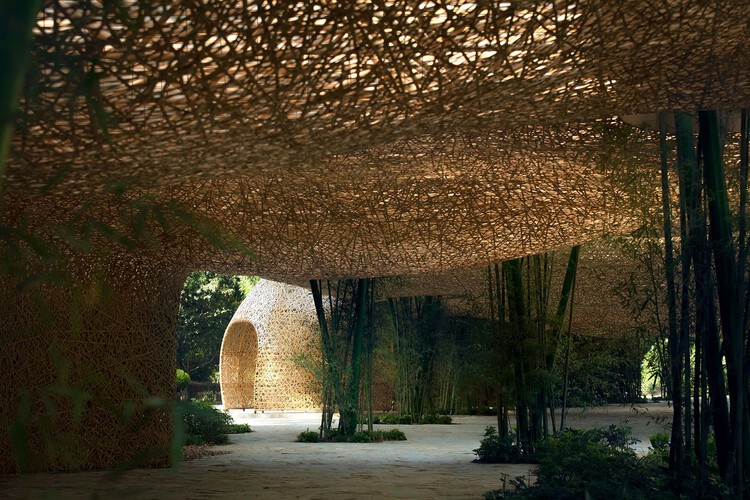
Bamboo is often praised before it is understood. It grows quickly, carries a long history of building cultures, and appears to offer architecture an immediate ecological language. In photographs, it can seem almost self-explanatory: light, natural, renewable, and already aligned with a more sustainable future. Yet this apparent clarity is also what makes bamboo difficult to discuss with precision. Once it becomes a symbol of environmental responsibility, the material itself can disappear behind the image it produces.
This is the risk of bamboo's contemporary revival. It can be imagined too easily as a green substitute for industrial materials, a regional atmosphere, or a softer alternative to the harder languages of steel and concrete. In each case, bamboo is admired before its conditions are understood. The more important question is not whether bamboo is sustainable in a general sense, but what kind of architectural culture it requires: what forms of knowledge, maintenance, regulation, labor, and time are needed for its sustainability to become real.


Bamboo is not simply a material waiting to be specified. It is a plant that architecture tries to turn into a product. Unlike standardized timber products, natural bamboo culms retain their biological irregularity. They taper along their length, vary in wall thickness, respond to moisture, and depend on careful timing in harvesting, drying, preservation, and assembly. Even after bamboo enters a building, it continues to respond to weather, insects, maintenance, and use. To work with it is therefore not only to select a structural or surface material. It is to accept a longer and less obedient life cycle, one that begins before construction and continues after the building appears complete.
Related Article
From Common Sight to Cultural Symbol: The Rise and Decline of Bamboo Scaffolding in Hong Kong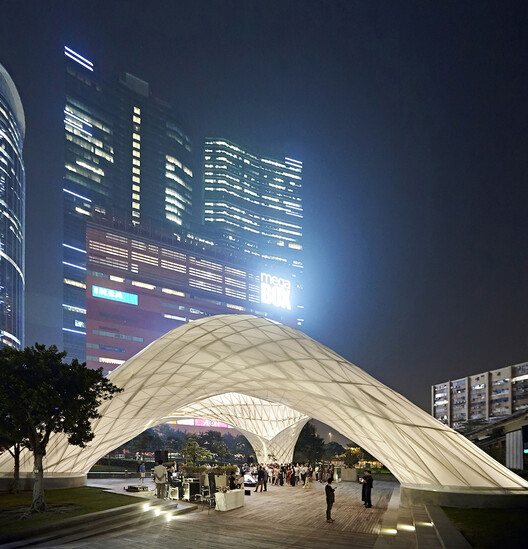
This is where bamboo speaks directly to the question of transspecies architecture and the life of materials. It sits between vernacular craft and industrial standardization, rural economies and contemporary carbon discourse, inherited knowledge and new forms of certification. It asks architecture to translate living matter into structural responsibility without pretending that the life of the material has disappeared. Bamboo is politically important not because it offers an easy alternative to modern construction, but because it reveals how difficult it is for architecture to work with materials that grow, vary, require care, and resist full control. Its politics is therefore not only a politics of sustainability, but a politics of knowledge, maintenance, and time.
From Plant to Product
Modern construction is built around materials that can be made predictable. Steel, concrete, glass, and aluminum are not simple materials, but they move through the building industry with a high degree of legibility. They can be ordered, calculated, transported, insured, and certified through systems that already know how to read them. By the time they arrive on site, they have already been translated into the language of contemporary construction.
Bamboo resists this translation. A natural culm cannot be treated as an abstract line in a structural diagram, because its behavior is inseparable from how it grew. Unlike standardized timber products, which have been extensively processed, graded, and absorbed into contemporary construction systems, bamboo often retains more of its biological irregularity. Even when engineered bamboo products are available, they do not yet occupy the same industrial or regulatory position as engineered wood. As a result, bamboo cannot simply be selected as a neutral material option. Its variability becomes part of the design problem itself.
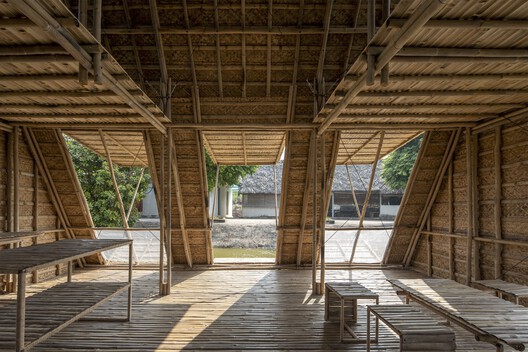
The difficulty is that contemporary architecture often recognizes material intelligence only after it has been made predictable. A material becomes easier to trust once it can be catalogued, specified, and inserted into familiar systems of procurement and calculation. Bamboo challenges this process because its architectural value depends partly on the differences that industrial systems usually try to remove. The issue is not that bamboo cannot be rigorous. It is that rigor has to be defined differently: less as the elimination of variation, and more as the discipline of understanding how to work with it.
This tension becomes visible in the difference between natural bamboo culms and engineered bamboo products. Laminated boards, panels, and structural members allow bamboo to enter the construction industry more easily because they behave more like familiar materials. Yet this legibility also comes with a transformation. Bamboo becomes less visibly a plant and more recognizably a product. Neither condition is inherently more authentic or more ecological. What matters is that each carries a different politics. Natural bamboo asks architecture to work with irregularity. Engineered bamboo asks a more uncomfortable question: how much processing, energy, and industrial correction must a plant undergo before the building industry is willing to trust it?
Between Craft and Code
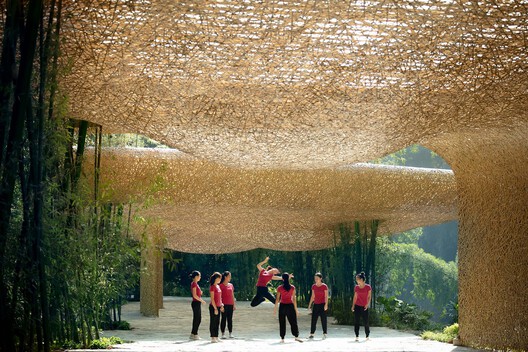
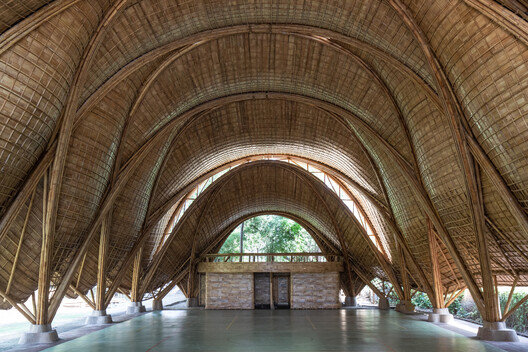
Bamboo also unsettles the usual hierarchy of construction knowledge. In many contemporary building systems, authority flows from drawings to specifications, and from specifications to contractors, suppliers, and site workers. The material is expected to arrive as described and perform as promised. Bamboo complicates this hierarchy because much of its knowledge sits close to the material itself. It belongs to those who have learned, through experience, how bamboo grows, splits, bends, ties, and fails. Because this knowledge is difficult to translate into a single formula or universally agreed method, bamboo practice is often treated as non-standardized or informal. Yet this does not make it less technical. It simply means that its intelligence is carried through judgment, repetition, and contact rather than calculation alone.
This also means that bamboo carries a different kind of risk. Without widely accepted parameters, standardized grading, and shared methods of verification, its performance depends more heavily on workmanship, inspection, and maintenance. Bamboo may offer more room for local adjustment, but also more room for human error. The point is not that bamboo is inherently safer or more dangerous than steel, but that its risks are organized differently. In temporary or repairable applications, its vulnerabilities often appear through loosening, splitting, displacement, or deterioration — signs that demand continuous attention rather than passive trust. Its politics of flexibility therefore cannot be separated from a politics of care.

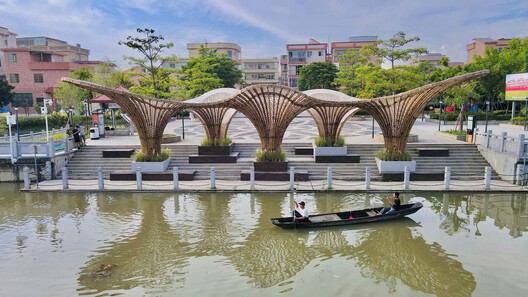
This is not an argument against steel, nor a romantic defense of informality. Predictability matters, especially where safety, scale, and public responsibility are involved. But bamboo helps reveal another construction ethic. It suggests that material intelligence does not have to belong only to the factory, the specification, or the calculation model. It can also belong to the farmer, the treatment specialist, the scaffold master, the carpenter, and the worker who understands the material through contact.
A more serious bamboo architecture has to move between inherited craft and contemporary regulation. It has to embrace engineering without allowing certification to become the only recognized form of intelligence. This is not a contradiction to be solved, but a condition to be worked through. Bamboo matters precisely because it forces architecture to confront the gap between what the building industry can easily measure and what construction knowledge actually requires.
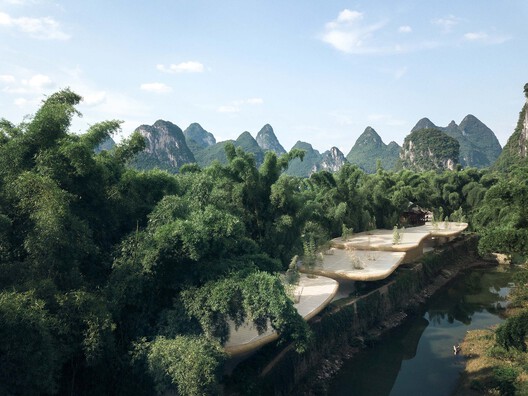
Carbon Turnover and the Politics of Time
If bamboo is less predictable than steel in structural terms, it may be more precise in another way: it understands that cities do not always move at the pace of permanence. Much of contemporary construction still borrows the language of durability, even when the programs it houses are temporary. Shops change, exhibitions move, interiors are renovated, and public spaces are reconfigured long before the carbon invested in them has been given enough time to be compensated. In this context, the politics of bamboo is also a politics of time. It asks whether every architectural problem should be answered with materials that assume a fixed and distant future.
Steel and concrete remain powerful because they promise duration, strength, and control. But when they are used for provisional or repeatedly reworked spaces, their material intensity can become disproportionate to their actual urban life. Bamboo suggests a different calibration between material commitment and architectural duration. Its strength-to-weight ratio, speed of growth, and relative lightness do not make it universally better, but they make it suited to structures that expect change: spaces that can be assembled, repaired, adapted, dismantled, and rebuilt without pretending that every need must become permanent infrastructure.
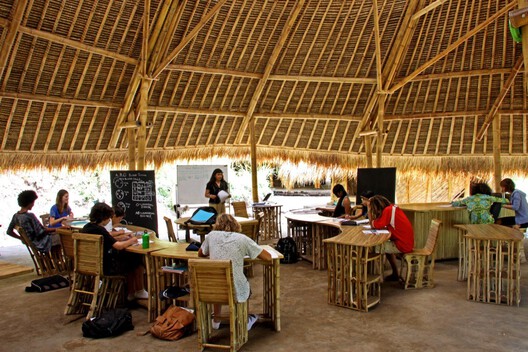
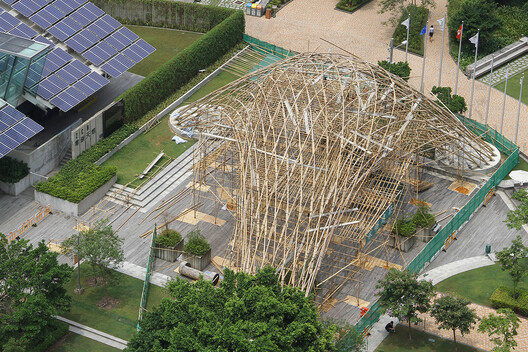
This also suggests a gap in the way building codes imagine time. In many regulatory systems, the distinction between permanent and temporary construction is treated mainly as a question of reduced duration or lighter requirements, rather than as a design category with its own architectural intelligence. Yet temporality should not mean informality or diminished safety. It should require a different kind of rigor: clear limits of use, inspection cycles, maintenance responsibilities, replaceable components, and protocols for dismantling or renewal. For bamboo, this distinction is crucial. Its value lies not in avoiding regulation, but in encouraging codes that can support safe forms of change.
The question, then, is not whether bamboo can replace steel or concrete. It cannot, and should not be asked to. The more important question is where architecture has been using permanent materials to solve temporary problems. Bamboo becomes important in these gaps because it offers a material logic closer to repair than finality. Its politics lies not only in how quickly it grows or how much carbon it stores, but in the different sense of time it asks architecture to accept: one in which building is not a single act of control, but a continuing relationship between material, maintenance, use, and renewal.
This article is part of the ArchDaily Topic: Transspecies Architecture: The Life of Materials, Ecological Alliances, and Nature's Agency. Every month we explore a topic in-depth through articles, interviews, news, and architecture projects. We invite you to learn more about our ArchDaily Topics. And, as always, at ArchDaily we welcome the contributions of our readers; if you want to submit an article or project, contact us.


