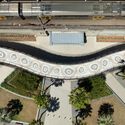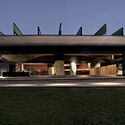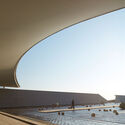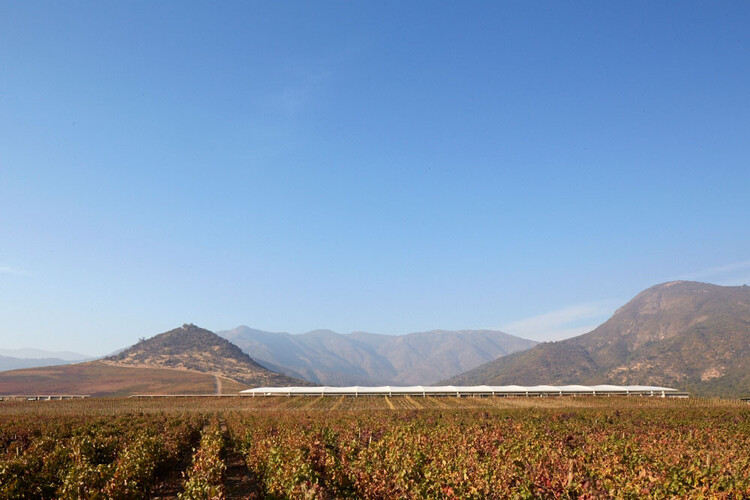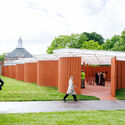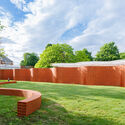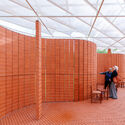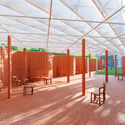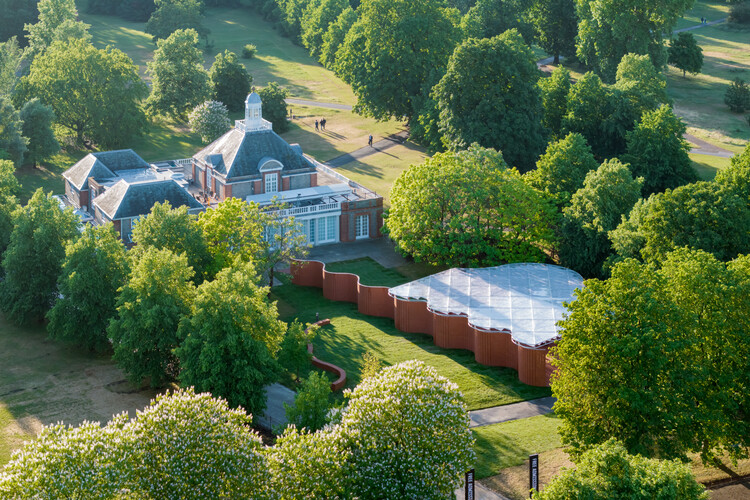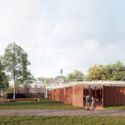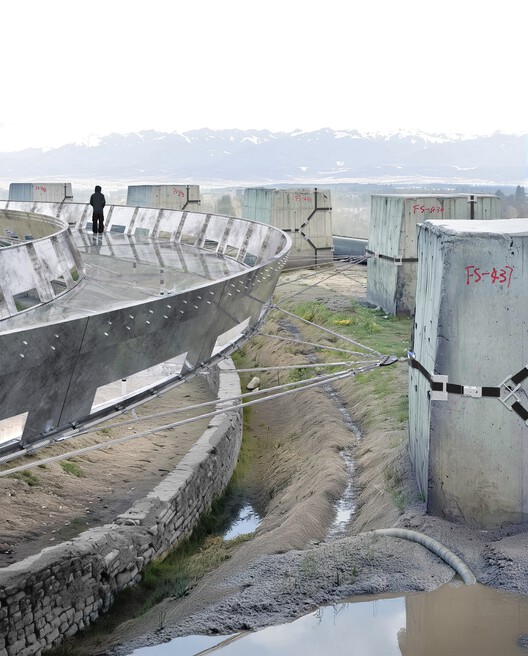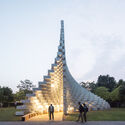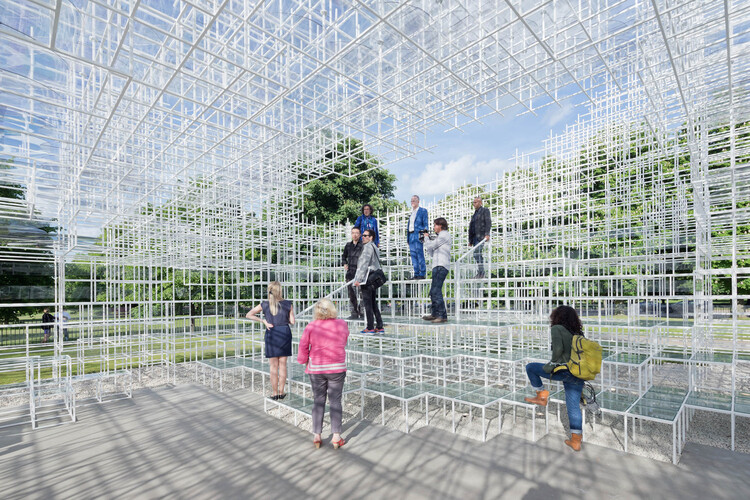
The 2026 Serpentine Pavilion, titled "a serpentine," designed by Mexico City-based architecture studio LANZA atelier, will open to the public on 6 June 2026 at Serpentine South in London. Newly released preview-days images show the completed structure ahead of its seasonal activation, which will run through 25 October 2026 and include Serpentine's annual programme of public events. Now in its 25th edition, the Serpentine Pavilion marks a milestone for the annual commission first launched in 2000 with Zaha Hadid's inaugural project. To commemorate the anniversary, Serpentine Galleries will also collaborate with the Zaha Hadid Foundation and the Architectural Association on a parallel programme reflecting on the Pavilion's legacy and its role in contemporary architectural discourse.
Mexican architecture practice LANZA atelier has unveiled new details for the 2026 Serpentine Pavilion, titled "a serpentine," which will open to the public on 6 June 2026 at Serpentine South. Designed by studio founders Isabel Abascal and Alessandro Arienzo, the project reinterprets the historic serpentine or crinkle-crankle wall through a lightweight brick structure integrated into the landscape of Hyde Park. Marking the 25th edition of the annual commission, the pavilion will remain on view through October 2026 and serve as a venue for Serpentine's public programme of performances, talks, screenings, and community events.
Daryan Knoblauch's work sits at the intersection of architecture and live cultural production, with a focus on how space is made legible through tension and atmosphere. Rather than treating temporary work as a lesser category of architecture, Knoblauch approaches installations, stages, and event architectures as full disciplinary problems—where enclosure, stability, light, and movement must be resolved with the same seriousness as any building, often under tighter constraints and faster timelines.
Across projects, a consistent thread is the productive tension between high-modern precision and an intentionally raw clarity of assembly. Membranes and lightweight systems are not deployed as surface effects, but as structural and spatial instruments—tuned to wind, load, and occupation, and calibrated to produce a sublimity that is felt as much as it is seen. Here, ephemerality is not simply a duration, but a design condition: temporality makes forces—weather, wear, performance—more visible, and demands an ethic of making that is both exacting and adaptable.
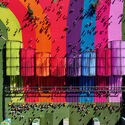
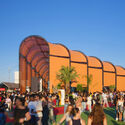
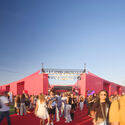
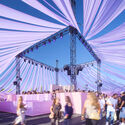
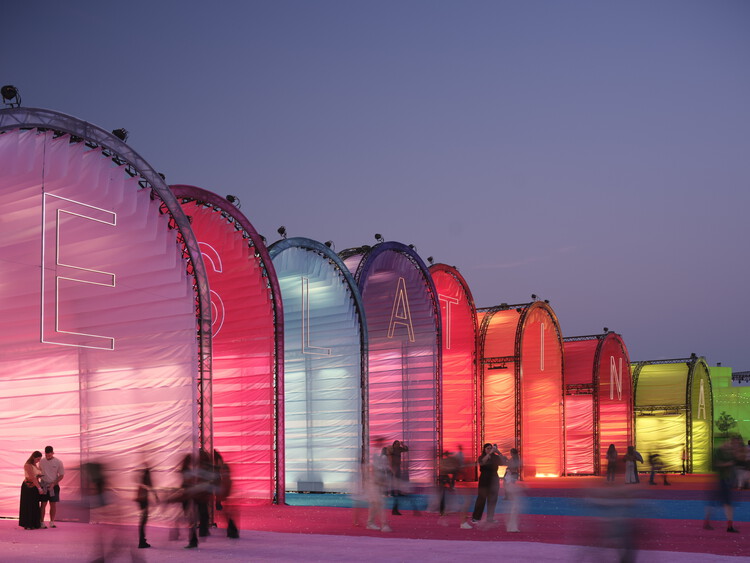
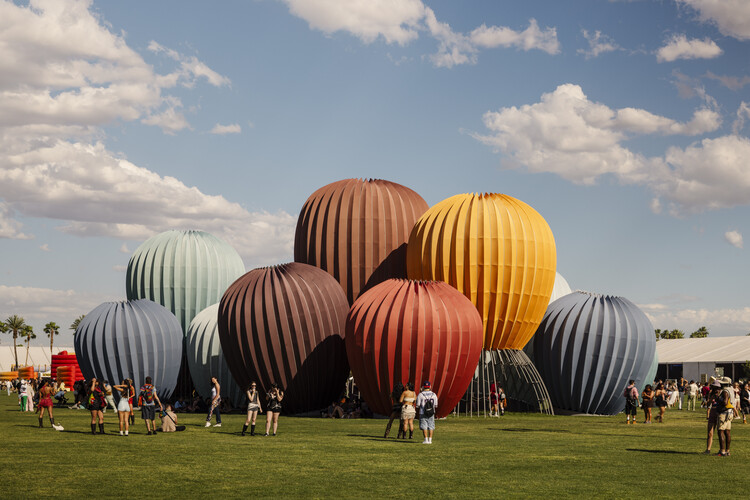
The 25th edition of the Coachella Valley Music and Arts Festival returns to the Empire Polo Club in Indio, California, from April 10 to 12 and April 17 to 19, 2026, bringing together more than 130 acts alongside an ambitious program of large-scale art installations. Presented by Public Art Company (PAC) and curated by founder Raffi Lehrer in collaboration with Goldenvoice Art Director Paul Clemente, this year's selection explores monumentality through luminance, transparency, and lightness of form. Set within Coachella's desert oasis, the installations invite visitors to engage physically and sensorially, responding to shifting daylight and the evolving atmosphere from sunrise to nightfall.
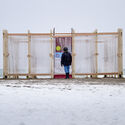
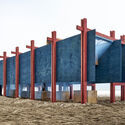
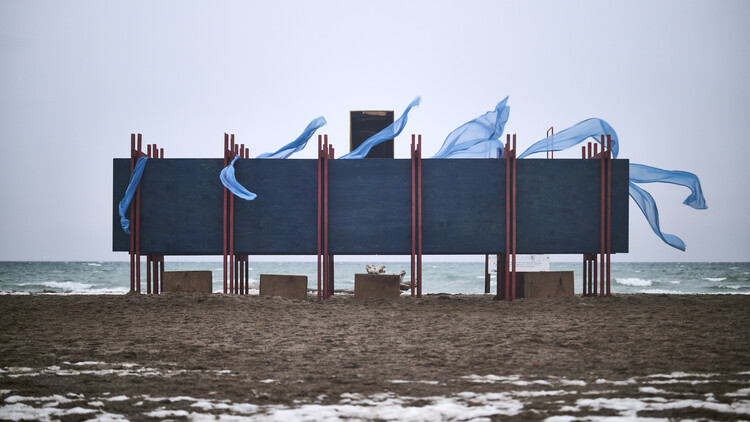
The annual Winter Stations design competition returns to Toronto for its twelfth edition, once again transforming the lifeguard stations of Woodbine Beach into temporary works of public art. On view from February 16 to March 30, 2026, this year's exhibition is organized under the theme Mirage, inviting participants to examine perception, illusion, and the shifting boundaries between what is seen and what is constructed. Selected from more than 300 international submissions, three winning proposals from Canada, the United States, and a Germany–Ukraine collaboration are presented alongside two installations developed by university teams. Installed along the frozen shoreline of Lake Ontario, the projects reinterpret seasonal infrastructure as platforms for spatial experimentation during the winter months.
A Gothic cathedral can take centuries to complete. A world exposition pavilion may stand for six months. A ritual structure in Kolkata rises and vanishes within five days. Yet each draws pilgrimage, shapes collective memory, and reorganizes urban life. If heritage has long been defined by what endures, architecture repeatedly shows that cultural authority can also belong to what gathers people.
For much of the twentieth century, conservation frameworks privileged permanence. The Venice Charter, adopted by the International Council on Monuments and Sites, focused on safeguarding monuments and their material authenticity. Cultural value was tied to physical fabric such as stone, brick, and timber. To protect heritage was to preserve what stood. The logic felt stable, even self-evident.
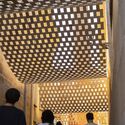
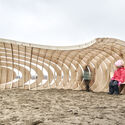
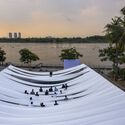
Crest’s waffled plywood shell creates a sheltered interior that frames views of the Lake Ontario shoreline at Woodbine Beach, inviting visitors to pause in shared reality.
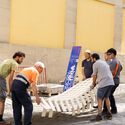
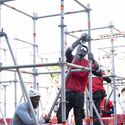
Crest is a student-led, design-build installation produced by F_RMlab at the University of Waterloo School of Architecture for Winter Stations 2026, an international competition transforming Toronto’s lifeguard stations into immersive works of public art. This year’s theme, Mirage, invited participants to address the “boundary of what is seen and what is real in the age of AI”, exploring art as a medium that disengages from the digital world by immersing audiences in shared, tactile experiences.
In recent years, food has taken on a renewed role within architecture, not simply as a program or typology, but as a shared spatial practice. Beyond restaurants or dining design, communal eating spaces are increasingly understood as environments where presence, ritual, and time intersect, allowing people to gather, stay, and coexist. In these settings, eating does not just happen within space; it actively shapes it, temporarily transforming ordinary, borrowed, or improvised environments into places of exchange.
This shift is visible across a wide range of built projects, installations, and community spaces that use shared meals as a way of bringing people together. Initiatives such as Fondo Supper Club frame dining as a social platform, using food to connect artists, designers, and local communities through conversation and collaboration. Similarly, sit.feast, presented during Milan Design Week 2024, approached the table as a spatial installation, one where sitting and eating together became the primary means of collectively producing space.
As the solstice marks the shortest day of the year in the Northern Hemisphere, it also draws attention to something architecture has long negotiated but often overlooked: time. Beyond form or function, buildings and spaces are continuously shaped by cycles of light and darkness, seasonal shifts, and environmental rhythms that affect how they are inhabited.
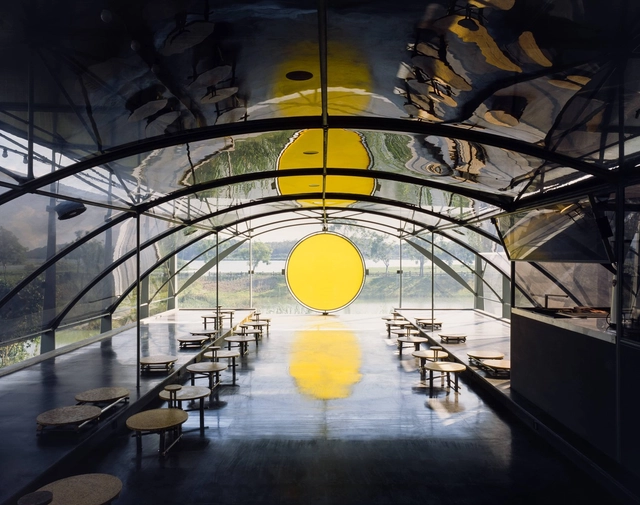
In recent years, a growing number of architectural projects have begun to work explicitly with these cycles. Rather than designing spaces to function in a single, fixed way, architects are creating environments that change throughout the day, across seasons, or in response to natural phenomena such as the sun's path, lunar phases, wind patterns, or circadian rhythms. These projects operate in dialogue with time, appearing, transforming, and activating differently depending on environmental conditions.
Every city carries, woven into its fabric, fissures that resist capture: ruins, vacant lots, leftover infrastructures, and gaps that persist at the margins of the official narrative. These are places that slip through the logics of planning, emerging as unexpected counter-scenes within a territory that seeks to present itself as coherent.
In the rush to organize and predict, we rarely pause to notice what emerges from such unforeseen conditions. Yet it is precisely in them that new forms of urban life begin to take shape. Free from pragmatic control or predetermined codes of conduct, these spaces reveal another layer of the city — one that, in its continual state of latency, opens room for new modes of appropriation.
Domestic workers in Hong Kong and Singapore are the city's quiet infrastructure. In Hong Kong alone, there are a total of roughly 300,000 domestic workers, serving a portion of the approximate 2.7 million households. Their care labor sustains dual-income family routines: childcare, eldercare, cooking, cleaning, and the everyday logistics that make professional life possible. Yet the people who hold this balance together remain largely invisible in policy—and, crucially, in space.
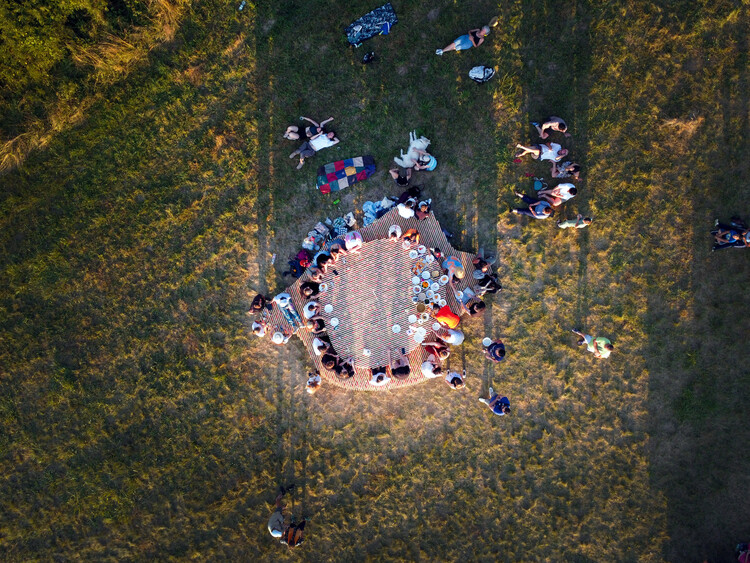
On Sundays in Hong Kong's financial district, that invisibility becomes visible. Elevated walkways and podium forecourts—underused on weekends—turn into ad-hoc commons. With cardboard mats, small tents, towels, food and water, and a music speaker or two, domestic workers assemble places to sit, rest, and socialize. These improvised rooms in the city are often their only chance to exercise spatial agency—something they rarely have in the homes they maintain or in formal public infrastructure. In the absence of sanctioned, serviced places for rest, quieter bridges and passages become practical stand-ins.
Urban policymakers and developers increasingly brand projects as temporary, piloting pop-up parks, art installations, and interim structures across global cities. Initiatives are often framed as experimental interventions that activate vacant sites. In practice, however, they frequently serve as provisional strategies to manage underutilized land until more profitable forms of development materialize. The temporary label functions as urban camouflage, obscuring permanent agendas behind provisional rhetoric.
As cities continue to develop, we are seeing ever more well-planned, thoroughly executed, and tightly regulated approaches to shaping urban centres and their surrounding spaces—for better and for worse. As codes, restrictions, and guidelines improve and tighten, urban environments become safer, more balanced, and less prone to surprise. Yet the flip side is that highly managed districts can drift toward over-order and sanitisation, shedding the messy, accretive character that once produced alleyways, residual spaces, and unexpected sequences of movement—conditions often born from ongoing community improvisation in the grey zones of regulation.
In response, a growing number of initiatives around the world are proposing short-term urban installations that test alternate futures for the city. These works aim to provoke dialogue between what the city is and what it could offer its communities through thoughtful, context-specific spatial practices. One notable example is Concéntrico, the international festival in Logroño, Spain, conceived as an urban innovation laboratory. Marking its tenth edition, the festival is about to publish Concéntrico: Urban Innovation Laboratory, a book that surveys a decade of urban design and collective transformation shaped through successive editions of the festival. Its launch is paired with an international tour designed to share a decade of insights on collective transformation and design.
Buildings are physical, static, and permanent. To imagine them otherwise often requires some creative thinking. The industry has operated with this strong association between structures and permanence, unknowingly constraining perspectives on building life cycles. Innovations in building materials have opened up avenues for cirular design that challenge the long-held notion that buildings must endure indefinitely. Emerging approaches promote architecture that ebbs and flows with nature.
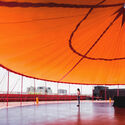
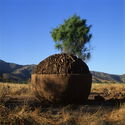
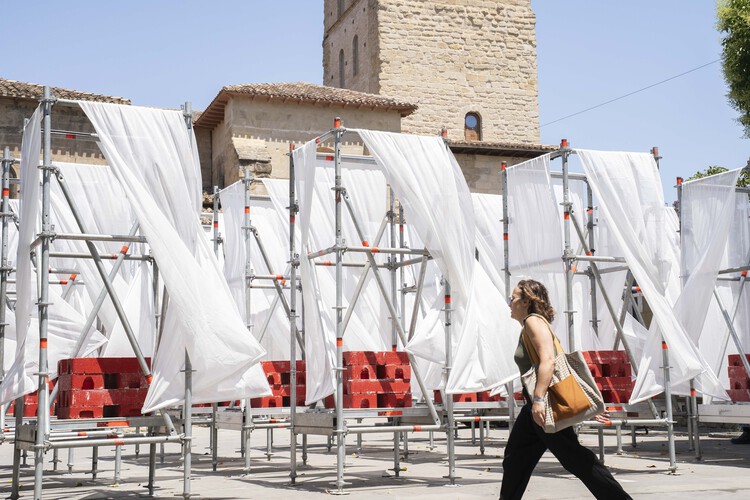
Every June, the Spanish city of Logroño transforms into a space of architectural dialogue, opening its streets, plazas, riverbanks, and traffic islands to temporary structures that redefine how cities are inhabited. For ten editions, Concéntrico has worked not as a specialized fair or an architecture biennale, but as a portable museum — a curatorial gesture that brings a dispersed collection of contemporary architecture into public space. Set in a city suspended between arid plains and distant mountains, far from the circuits of capital cities and cultural institutions, Concéntrico presents itself as a temporary promise. It's a reminder that even cities that are often overlooked can host architecture that is current, diverse, and speculative. In this sense, the festival is less about celebration and more about activation.
But beyond its curatorial logic, Concéntrico operates as a political structure. In the ancient sense of polis, it invites citizens, architects, and institutions to reassess what public space can be. The interventions offer speculative proposals for urban life that reveal what is missing, what is possible, and what should be questioned. A temporary pool over a fountain, a bathhouse in a roundabout, or a shared meal on a major avenue are not just spatial gestures — they are political statements, asking how urban infrastructure might be redirected from control to care, from efficiency to encounter. In that way, the festival becomes not just a reflection of the city, but an instrument for its transformation.
What if we imagined buildings as living systems, designed for assembly and disassembly with minimal impact? A form of open, modular, and adaptable architecture designed to evolve with its surroundings, responding to seasonal changes and on-demand needs instead of remaining static. At first glance, the idea seems paradoxical, as many buildings were constructed to last, designed to endure, resist the effects of time, and avoid demolition. Because of this, reversing or undoing could be seen as a setback. But what if that way of thinking no longer fits every scenario?
https://www.archdaily.com/1031388/built-to-not-last-how-reversible-architecture-is-redefining-the-way-we-buildEnrique Tovar
Every year, the Naomi Milgrom Foundation commissions an architect to design a temporary pavilion for the Queen Victoria Gardens, in the center of Melbourne's Southbank Arts Precinct. The pavilions are then transferred to the state of Victoria. The tenth edition of the MPavilion was designed by Pritzker Prize Laureate Tadao Ando as his first and only built work in Australia and the southern hemisphere. The pavilion opened on November 16, 2023, and its presence was extended until March 2025, hosting a wide-ranging program of cultural events over two summer seasons. After facing demolition, given the temporary nature of the initiative, a community-led program, "Preserve the Pavilion", was launched in hopes of preserving the building. The Naomi Milgrom Foundation has recently announced that the pavilion will remain in Queen Victoria Gardens until 2030, following a decision by the City of Melbourne.
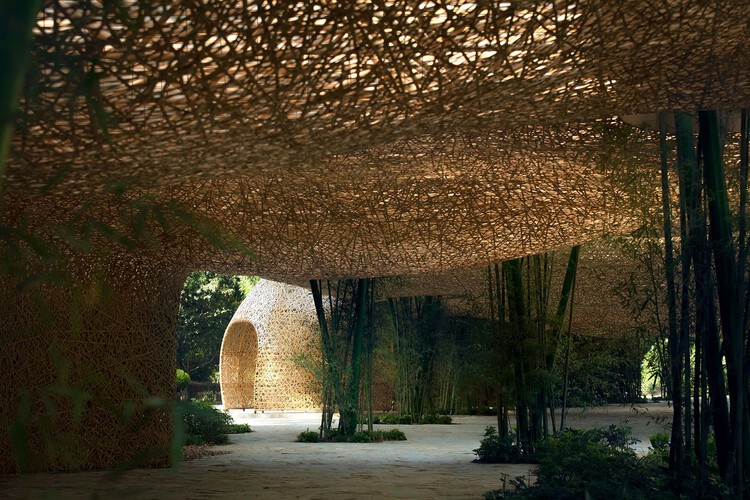
ESPARTAL Pavilion / ELE Arkitektura, GA Estudio, Florencia Galecio, and Juan Gubbins. Image Courtesy of TAC! Festival de Arquitectura Urbana
The TAC! Urban Architecture Festival is held annually in Spain with the aim of bringing contemporary architecture closer to the public through installations in various cities, including Granada, San Sebastián, Valencia, Vigo, and San Fernando. Organized by the Ministry of Housing and Urban Agenda in collaboration with Fundación Arquia, the festival seeks to promote experimentation in architecture by constructing temporary pavilions for cultural events and gatherings. The 2025 edition of the festival will take place in two locations: Casa Mediterráneo in Alicante and Plaza Stagno in Las Palmas de Gran Canaria. The pavilions are selected each year through an open call for young architects up to 45 years old. This year's winners have already been announced: the ESPARTAL project by ELE Arkitektura, GA Estudio, Florencia Galecio, and Juan Gubbins; and DE ROCA MADRE by Alejandro Carrasco Hidalgo, Eduardo Cilleruelo Terán, Alberto Martínez García, and Andrea Molina Cuadro.