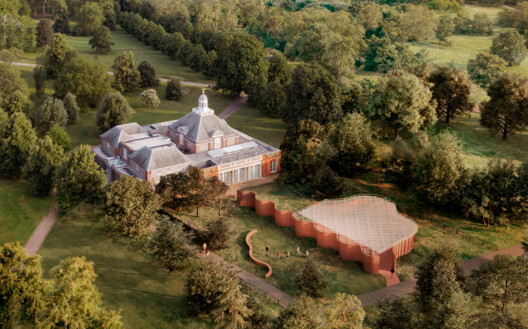
Mexican architecture practice LANZA atelier has unveiled new details for the 2026 Serpentine Pavilion, titled "a serpentine," which will open to the public on 6 June 2026 at Serpentine South. Designed by studio founders Isabel Abascal and Alessandro Arienzo, the project reinterprets the historic serpentine or crinkle-crankle wall through a lightweight brick structure integrated into the landscape of Hyde Park. Marking the 25th edition of the annual commission, the pavilion will remain on view through October 2026 and serve as a venue for Serpentine's public programme of performances, talks, screenings, and community events.




The design takes inspiration from the serpentine wall typology, historically used in English gardens and known for its alternating curves that provide structural stability while reducing material use. Although commonly associated with Suffolk, the construction method originates in ancient Egypt and was later introduced to England by Dutch engineers. LANZA atelier adapts this geometry into a contemporary pavilion that establishes both visual and spatial continuity with the nearby Serpentine lake and the existing brick architecture of the gallery.
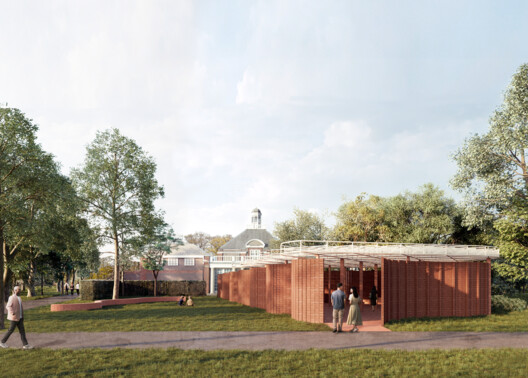
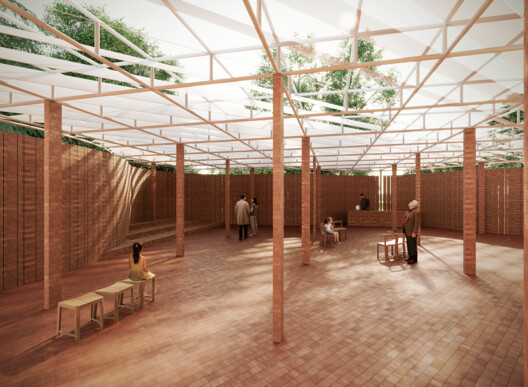
Organized along the northern edge of the site, the pavilion is composed of two primary walls that respond directly to the surrounding landscape. One traces a winding path through the site, while the other aligns with the existing tree canopy to preserve views and minimize disruption to the park. Resting above the structure, a translucent roof supported by slender brick columns filters natural light into the interior, creating an environment that remains open to air, light, and seasonal change.
Related Article
A Look at the Last 8 Editions of the Serpentine PavilionBrick was selected as the pavilion's primary material in reference to the masonry facade of the adjacent Serpentine South Gallery, originally built as a tea pavilion in the nineteenth century. Through a rhythmic arrangement of columns, the walls transition between solid and porous conditions, allowing the structure to function less as a boundary and more as a spatial filter. LANZA atelier also designed a series of chairs and stools fabricated locally from sapele hardwood, continuing the studio's interest in treating furniture and architecture as part of the same design process at different scales.
Inspired by the figure of the serpent as a generative and protective force, we draw a parallel with England's winding fruit walls, which are structures that temper climate, create shelter, and enable growth. From this idea emerges a pavilion built of simple clay brick, foregrounding vernacular craft and the elemental capacity of architecture to bring people together. The 2026 Pavilion proposes built forms that are permeable, shaped and held by a gentle geometry, and continually responsive to those who move through it. - LANZA atelier
The Pavilion selection was made by a committee including Bettina Korek, Hans Ulrich Obrist, Julie Burnell, Chris Bayley, Tamsin Hong, and Liz Stumpf, with Sou Fujimoto serving as advisor. To accompany the Pavilion, Serpentine will publish LANZA atelier's first monograph, designed by Estudio Herrera. The publication will include new contributions from architecture, art, and poetry, alongside an extended conversation between the architects and Hans Ulrich Obrist, and an essay by José Esparza Chong Cuy.
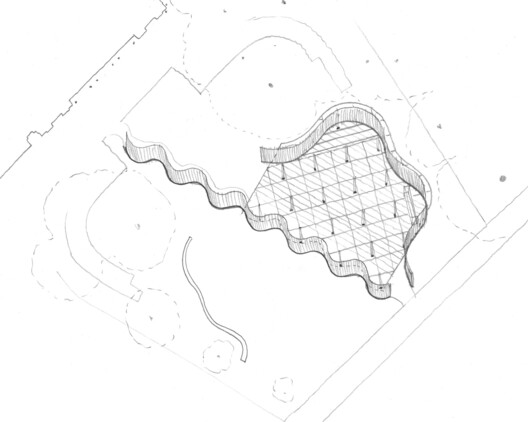
Founded in 2015, LANZA atelier has developed a multidisciplinary practice centered on material experimentation, craft traditions, and spatial experience. Working across architecture, furniture, and exhibition design, the studio frequently explores how construction methods can shape collective forms of inhabitation. The studio has previously been recognised with awards, including the Architectural League of New York's Emerging Voices Award in 2023 and the Young Architects Prize in 2017. Their work has been exhibited internationally, including at SFMOMA, the São Paulo Architecture Biennale, the Lisbon Triennale, and the Latin American Architecture Biennial. Upcoming projects include a solo exhibition of furniture designs in Mexico City and the design of the Republic of Kosovo Pavilion at the 61st Venice Art Biennale curated by José Esparza Chong Cuy. Their proposal for the Serpentine Pavilion extends this approach through a composition of curved brick walls and permeable thresholds that frame movement and interaction within the garden setting.

The 2026 edition coincides with the 25th anniversary of the Serpentine Pavilion programme, inaugurated in 2000 by Zaha Hadid. To mark the occasion, Serpentine will collaborate with the Zaha Hadid Foundation and the Architectural Association on a parallel series of architecture-focused events and conversations hosted at The Magazine at Serpentine North. Since its inception, the commission has become a platform for experimental architectural practice, featuring contributions from architects including Frida Escobedo, Diébédo Francis Kéré, Lina Ghotmeh, and Marina Tabassum.
Editor's Note: This article was originally published on January 20, 2026, and updated on May 18th, 2026.