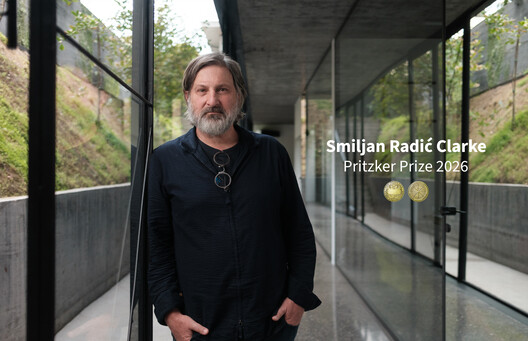
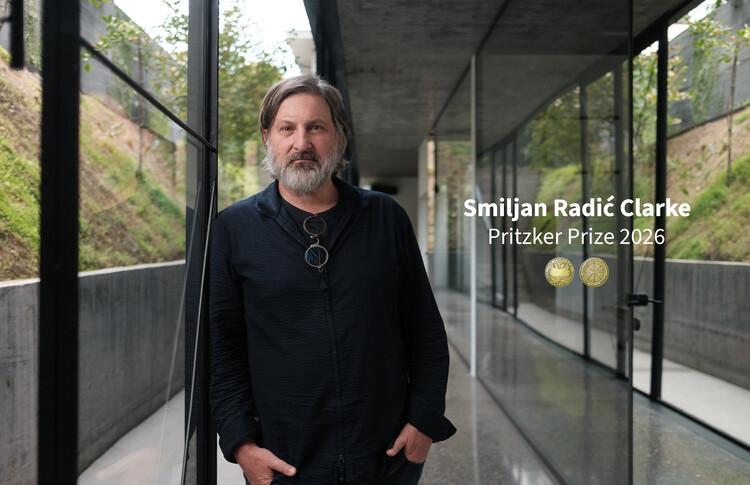
Chilean architect Smiljan Radić Clarke has been announced as the laureate of the 2026 Pritzker Architecture Prize, regarded as one of the highest honors in the field of architecture. The award recognizes Radić for a body of work that explores architecture through material experimentation, spatial perception, and a careful engagement with landscape and context. Born in Santiago, Chile, where he continues to live and work, Radić leads the practice Smiljan Radić Clarke, established in 1995. As the second Chilean to receive the prize, after Alejandro Aravena in 2016, he joins a distinguished list of previous laureates, including Liu Jiakun in 2025, Riken Yamamoto in 2024, David Chipperfield in 2023, and Diébédo Francis Kéré in 2022.
Radić's architecture operates within a territory where the phenomenological experience of space precedes explanation. His buildings often appear quiet, elemental, and resistant to easy verbal interpretation, encouraging visitors to experience them through movement, atmosphere, and perception rather than through formal expression.
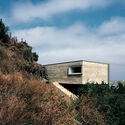
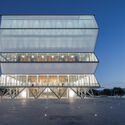
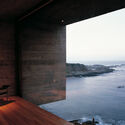
At the same time, his work demonstrates a sharp sensitivity to material presence, juxtaposing industrial components with raw or locally sourced elements to produce constructions that are both precise and tactile. Across his projects, structures frequently appear provisional, fragile, or lightly anchored to the ground, suggesting a deliberate embrace of uncertainty and impermanence. His architecture privileges embodied presence, material intelligence, and a subtle yet powerful sense of fragility.
We strive to create experiences that carry emotional presence, encouraging people to pause and reconsider a world that so often passes them by with indifference. — Smiljan Radić
Since establishing his studio in Santiago in 1995, Radić has maintained an intentionally compact practice, developing projects that range widely in scale while preserving a consistent commitment to experimentation and contextual specificity. His work includes private residences, cultural institutions, installations, and civic buildings, often characterized by their careful engagement with landscape, light, and structure. While many of his projects are located throughout Chile, Radić has also received international recognition through commissions and exhibitions abroad, including the 2014 Serpentine Gallery Pavilion in London. Over time, his practice has expanded to encompass installations, exhibitions, and collaborative projects that extend architectural inquiry beyond conventional building typologies. Despite growing global recognition, Radić has continued to work primarily from Santiago, sustaining a practice rooted in careful observation rather than large-scale institutional production.
Born in Santiago in 1965, Smiljan Radić grew up in a family shaped by migration and cultural displacement. His paternal grandparents emigrated from Brač, Croatia, while his mother's family came from the United Kingdom, creating a personal context in which belonging was understood as something constructed rather than inherited. Radić has often described this experience as formative, cultivating an awareness of identity as a process of assembly rather than a fixed condition.
He studied architecture at the Pontificia Universidad Católica de Chile, later traveling and studying at the Istituto Universitario di Architettura di Venezia, an experience he regards as fundamental to his intellectual development. During his early professional years, Radić began an ongoing exchange with sculptor Marcela Correa, whose work would influence his architectural thinking and with whom he has collaborated on several projects. Together, they built Casa Chica in Vilches in 1997, an early experiment that revealed Radić's interest in architecture as both physical construction and conceptual inquiry. These early influences—migration, artistic dialogue, and close observation of landscape—would continue to shape the direction of his practice.
Through a body of work positioned at the crossroads of an iconoclastic language, material exploration, and cultural memory, Smiljan Radić favours fragility over any unwarranted claim to certainty. — 2026 Pritzker Architecture Prize Jury
An Unspoken Architecture
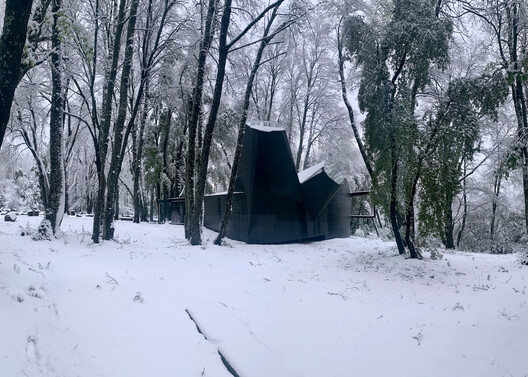
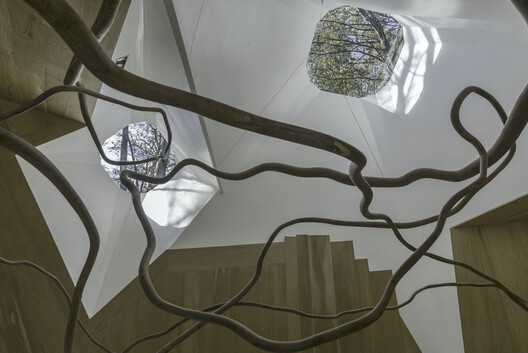
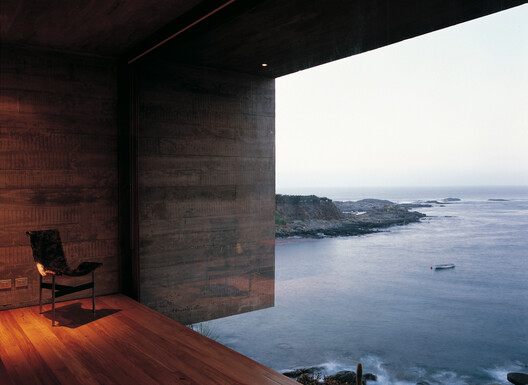
Radić's architecture often unfolds as a spatial experience that resists immediate verbalization. Rather than presenting a fixed formal language, his buildings invite interpretation through atmosphere, movement, and perception. The House for the Poem of the Right Angle in Vilches exemplifies this approach. Set within a forested landscape, the house organizes itself around thick walls and carefully positioned openings that capture shifting patterns of light and time, transforming dwelling into a contemplative act of observation.
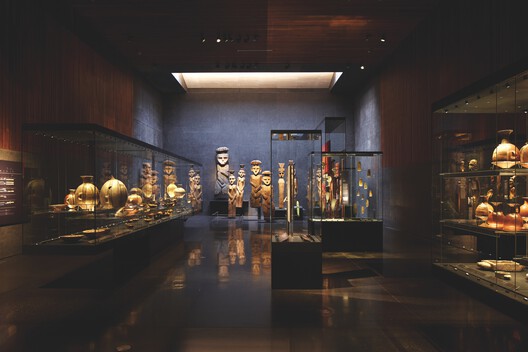
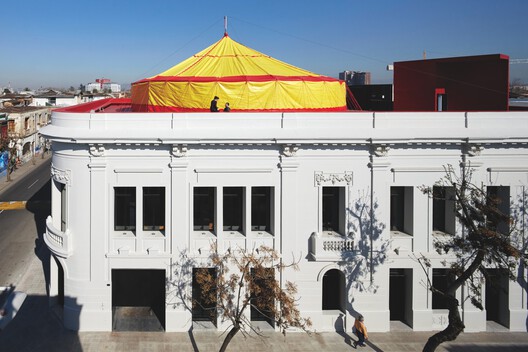
A similarly introspective condition appears in the expansion of the Chilean Museum of Pre-Columbian Art in Santiago, where Radić's intervention occurs largely beneath the existing colonial courtyard. By carving a subterranean gallery illuminated from above, the project allows artifacts and historical continuity to take precedence, demonstrating an architecture that withdraws to heighten spatial experience. At NAVE, a performing arts center created from a damaged early-twentieth-century residence, Radić retains the original structure while inserting new rehearsal and performance spaces within it. The resulting environment functions less as a finished object than as a flexible stage for artistic production and collective gathering.
Material Intelligence
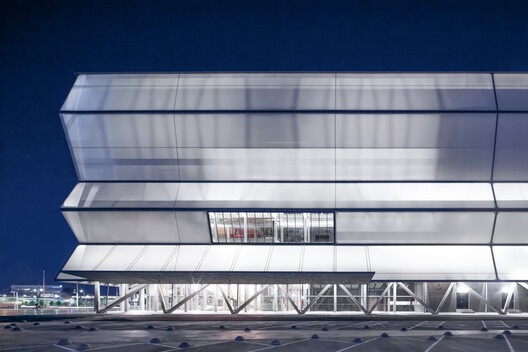
Material experimentation plays a central role in Radić's work, where construction often reveals unexpected relationships between industrial fabrication and raw matter. At the Teatro Regional del Bío-Bío in Concepción, a semi-translucent polycarbonate envelope mounted over a steel frame filters daylight while producing a luminous presence along the riverfront at night. The building demonstrates how civic architecture can achieve spatial intensity without relying on conventional monumentality.
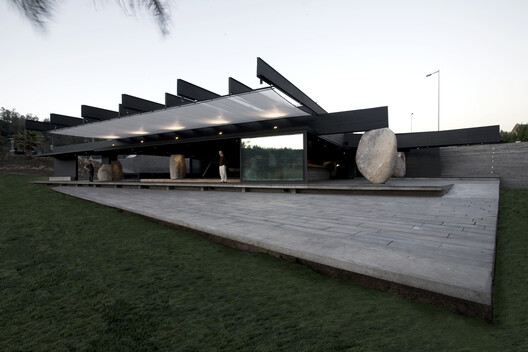
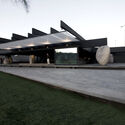
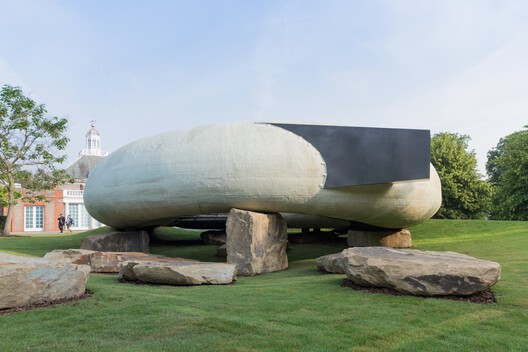
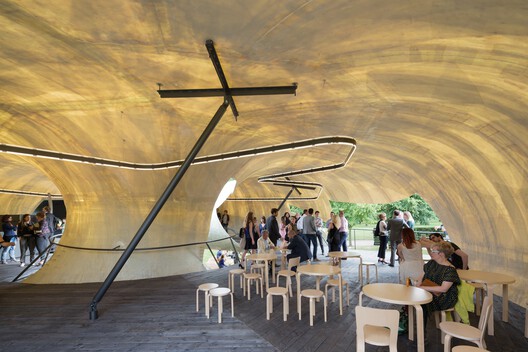
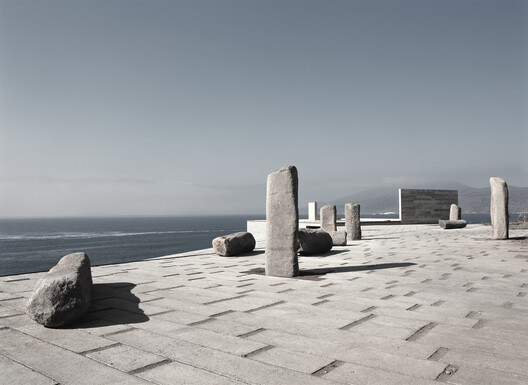
In Santiago's Bicentenario Park, Restaurant Mestizo explores a different material strategy. Here, a horizontal roof supported by massive quarry stones extends across the landscape, functioning simultaneously as shelter, horizon, and civic gesture. The juxtaposition of heavy stone and slender structural elements dissolves the boundary between architecture and terrain. Radić's Serpentine Gallery Pavilion in London further expands this dialogue between materials. A translucent fiberglass shell appears to hover above the lawn of Kensington Gardens, improbably resting on a ring of large load-bearing stones. The project combines geological weight with industrial lightness, producing a structure that feels at once ancient and provisional.
Fragility and Provisional Monumentality
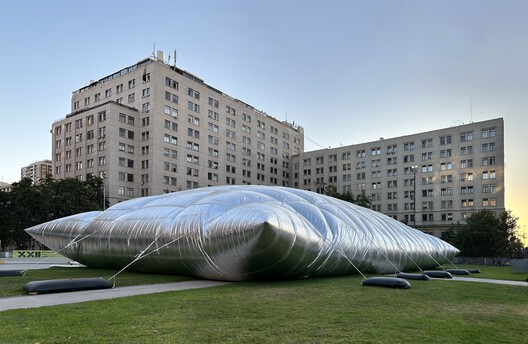
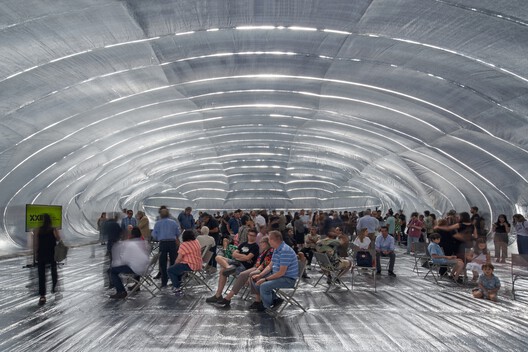
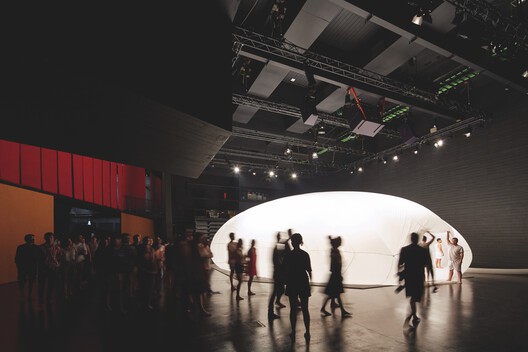
Across many of Radić's projects, architecture appears intentionally unstable or temporary, embracing fragility as a spatial condition rather than concealing it. The installation Guatero, created for the XXII Chilean Architecture Biennial in Santiago, embodies this approach through a pneumatic structure defined by air pressure. Its translucent membrane transforms a seemingly delicate form into an immersive environment where light, sound, and movement continually reshape the interior atmosphere.
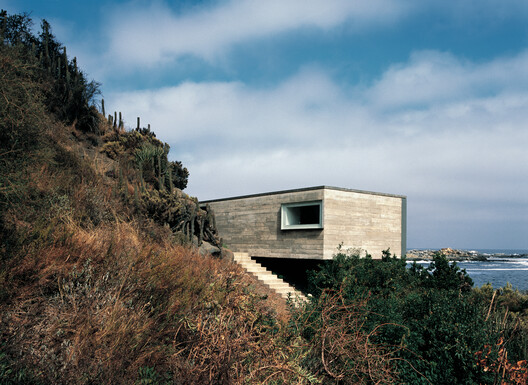
Earlier works already hinted at this sensibility. Carbonero House in Melipilla, constructed from timber and blackened mesh, allows wind, shadow, and sound to pass through its porous envelope, dissolving the boundaries between building and landscape. At Pite House on Chile's central coast, architecture is embedded within rocky terrain, organized through terraces and retaining walls that frame the vast horizon of the Pacific Ocean. In each case, Radić demonstrates how architecture can transform exposure into intimacy, producing spaces that feel simultaneously protective and provisional.
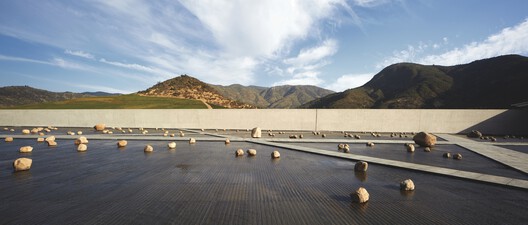
Radić's broader body of work further illustrates the diversity of his architectural investigations. The Vik Millahue Winery in the O'Higgins region extends horizontally across the valley landscape, integrating production facilities and public spaces within a sequence of concrete retaining walls that stabilize the surrounding terrain. House for the Poem of the Right Angle (2013) in Vilches, Chile, offers a contrasting domestic scale, organizing the act of dwelling through thick walls and carefully oriented openings that frame light, silence, and the surrounding forest. Temporary installations, such as the transparent dome created for Alexander McQueen's Spring/Summer 2022 fashion show in London and Guatero, examine the atmospheric potential of inflatable structures, transforming air pressure and light into spatial experience. These projects demonstrate Radić's consistent interest in architecture as a framework that mediates between landscape, climate, and human occupation.
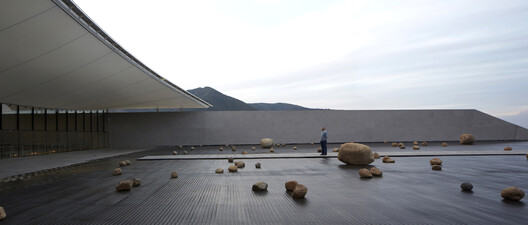

Beyond his built work, Radić's practice extends into exhibitions and collaborations with artists and cultural institutions. His projects have been presented in international exhibitions, including Global Ends at Gallery Ma (Tokyo, Japan, 2010); Un Ruido Naranjo at Museum of Contemporary Art, (Hiroshima, Japan, 2012); The Wardrobe and the Mattress, Hermès Gallery, Tokyo, with Marcela Correa (Tokyo, Japan, 2013); and Bus Stop for Krumbach at Kunsthaus Bregenz (Bregenz, Austria, 2013); Smiljan Radić: BESTIARY at TOTO Gallery Ma (Tokyo, Japan, 2016). His work has been recognized with numerous international honors, including being named Best Architect Under 35 by the Colegio de Arquitectos de Chile (Chile, 2001), the Oris Award (Croatia, 2015), the Arnold W. Brunner Memorial Prize from the American Academy of Arts and Letters (United States, 2018), and the Grand Prize at the Pan-American Architecture Biennial of Quito (Ecuador, 2022). He has been an Honorary Member of the American Institute of Architects and an Honorary Fellow of the Croatian Academy of Sciences and Arts since 2009 and 2020, respectively.
The 2026 Pritzker Architecture Prize jury recognized Radić for an architectural practice that expands the discipline through experimentation, material exploration, and profound attention to the emotional dimensions of space. The jury is chaired by Alejandro Aravena and includes Barry Bergdoll, Deborah Berke, Stephen Breyer, André Corrêa do Lago, Anne Lacaton, Hashim Sarkis, Kazuyo Sejima, and Manuela Lucá-Dazio as Executive Director.
2026 Pritzker Architecture Prize Jury Citation
The Pritzker Architecture Prize is awarded in recognition of exceptional talent, vision, and commitment that, over time, have given rise to profound and enduring contributions to humanity and the built environment through the art of architecture. Smiljan Radić's body of work embodies these values in their most radical and essential form.
To render the qualities of his architectural work in spoken language is intrinsically difficult, for in his designs he works with dimensions of experience that are immediately palpable but escape verbalization—like the perception of time itself: immediately recognizable, yet conceptually evasive.
His buildings are not conceived simply as visual artifacts; rather, they demand embodied presence. A first fundamental paradox of Smiljan Radić's architecture is in that it establishes a personal, almost introspective point of entry, without culminating in withdrawal. On the contrary, what begins as an individual encounter expands into a broader, collective resonance. This is, perhaps, the nature of true art: it addresses each of us as singular beings, one to one, and yet propels us towards a shared origin—an atavistic place beyond race, gender, or culture. Such a capacity acquires particular relevance in times of polarisation and dehumanisation, and may well constitute the true value of an architect whose work can be described, without hesitation, as profoundly original: the art of architecture practiced as a sustained attempt to reconnect all individuals with a deeper origin. Importantly, this should not be mistaken for nostalgia or historical revivalism. His stripping away of the surface is grounded in radical experimentation and an unrelenting interrogation of convention, precedent, and the well-trodden path. Herein lies a further paradox: his unorthodox approach to design may initially appear unusual, unexpected—even rebellious—yet far from producing alienation or estrangement, his anti-canonical stance feels fresh and unprecedented. It conveys the unmistakable sensation of encountering something new.
Through unobvious connections and patterns of circulation, Radić's buildings offer a multiplicity of stages for users to act, interact, and even change the narratives that unfold within them. The masterful composition of volumes and the precise calibration of scales lend a sense of monumentality to the everyday life, whether experienced at an individual or public level. In Radić's architecture, monumental presence is reworked through fragility, lightness and apparent instability, achieved not through scale alone, but through atmosphere, material tension and spatial intensity. This allows everyday actions—walking, waiting, gathering—to acquire significance without being subordinated to a grand ideological narrative. Through his deeply democratic approach, the monumental is thus returned to common experience rather than reserved for exceptional moments.
Through a body of work positioned at the crossroads of an iconoclast language, material exploration and cultural memory, Smiljan Radić favours fragility over any unwarranted claim to certainty. His buildings may appear temporary, unstable, or deliberately unfinished—almost on the point of disappearance—yet they provide a structured, optimistic and quietly joyful shelter, embracing vulnerability as an intrinsic condition of lived experience.
They are not firmly anchored to the ground; rather, they are delicately placed upon it, often hovering slightly above the surface and only occasionally making contact. Any lasting alteration to the site is carefully avoided, as though they could be removed at any moment and the ground restored to its original state. Inspired by the powerful and yet seismic Chilean environmental context and shifting from the logic—often implicit in construction—of domination and ownership towards coexistence, Radić presents architecture as a guest rather than a master of the site, acknowledging the primacy of the landscape and, by extension, of collective memory and shared territory over individual authorship.
This sense of architectural impermanence is frequently expressed through the choice of materials. While varying from one project to another, these are always carefully considered, contextually responsive and informed by local availability.
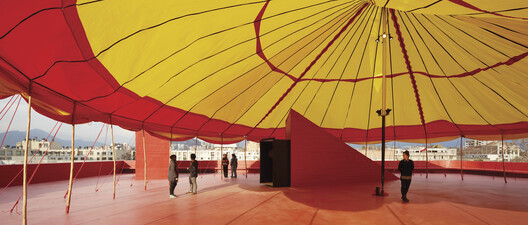
Reinforcing the democratic ethos of his work, Radić employs materials—whether industrial or natural, refined or traditionally regarded as marginal—in ways that are neither nostalgic nor merely pragmatic. Instead, they unsettle established hierarchies of value: high and low, refined and crude, permanent and provisional coexist without clear distinction. This material equivalence mirrors the social openness of his spaces, in which no user is privileged over another. The circus tent coronating the roof of NAVE in Santiago, the white membrane enveloping the Teatro Regional del Bío-Bío in Concepción—glowing with a warm, welcoming light at dusk—and the monumental Guatero inflatable pavilion designed for the Santiago Architecture Biennale all become structurally sophisticated yet playful stages, in which unexpected textures and colours engage with volumes of equally unexpected form.

If architecture gives shape to the ways in which people live, Radić's work produces spatial experiences that feel at once surprising and entirely natural. They are surprising in their flexible capacity to combine, question and dismantle established typologies; natural in the way they emerge both from his personal history and from that of those who will ultimately inhabit his buildings. While fully responsive to its function, each project contains an element of unexpectedness: to experience Smiljan Radić's buildings is to have one's curiosity provoked and sustained. He pushes coherent spatial strategies to their limits, developing them with rigour in order to actively engage the user: no specialised knowledge is required to "understand" the space, because understanding is never complete. His work defies the constraints of a single concept: the spaces he creates are often ambiguous, at times even unsettling, never pre-defined. They resist complete comprehension through a single viewpoint, and it is precisely this resistance that restores depth and complexity to architecture. Giant boulders set upright—like at the Mestizo Restaurant in Santiago, buildings that appear barely to touch the ground—like Casa Pite in Papudo, and the frequent rejection of the conventional Cartesian coordinate axes—the House for the Poem of the Right Angle in Vilches—all invite interpretation, rather than consumption.
For reminding us that architecture is an art, in that it touches the very core of the human condition; for allowing the discipline to embrace imperfection and fragility, offering quiet shelters in a world shaped by uncertainty, without the need to be louder or more spectacular in order to matter; for creating buildings whose hybrid nature reflects the contemporary blurring of disciplinary boundaries, and which do not speak on behalf of people but instead allow people to find their own voice through them, Smiljan Radić Clarke is named the 2026 Pritzker Prize Laureate.
We invite you to check out ArchDaily's comprehensive coverage of the Pritzker Prize.