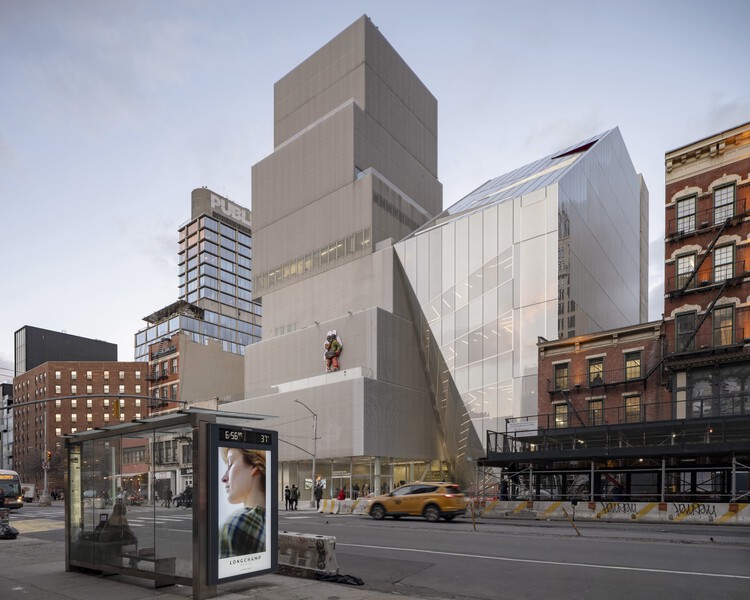
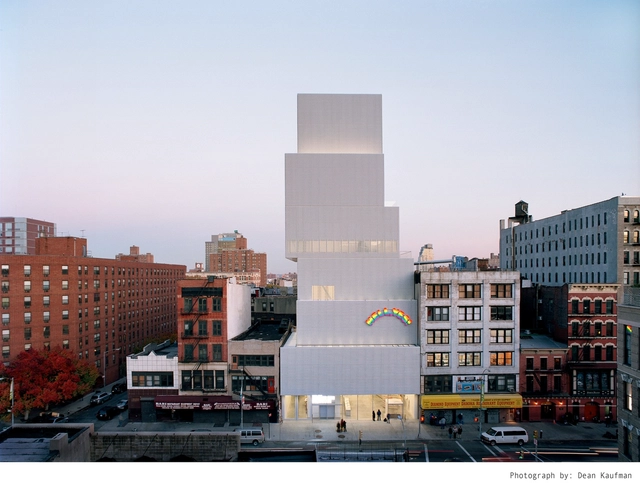
When the New Museum's original SANAA-designed building, a stack of shifted opaque boxes wrapped in a metal mesh skin, opened in 2007, it already seemed destined for some form of expansion to relieve the vertical pressure created by its constrained circulation and limited footprint. In March, the museum unveiled its long-anticipated addition, designed by OMA's Shohei Shigematsu and Rem Koolhaas. The angular and slightly set-back companion building doubles the museum's exhibition capacity while reshaping the institution's relationship to the city and to the original SANAA structure by Kazuyo Sejima and Ryue Nishizawa.
At the building's press opening, Koolhaas described the project "not simply as an extension but as a complement or counterpart." Shigematsu later elaborated: "We thought about designing a pair composed of two distinct and yet highly connected buildings. One is more vertical and introverted. The other is more horizontal and extraverted."
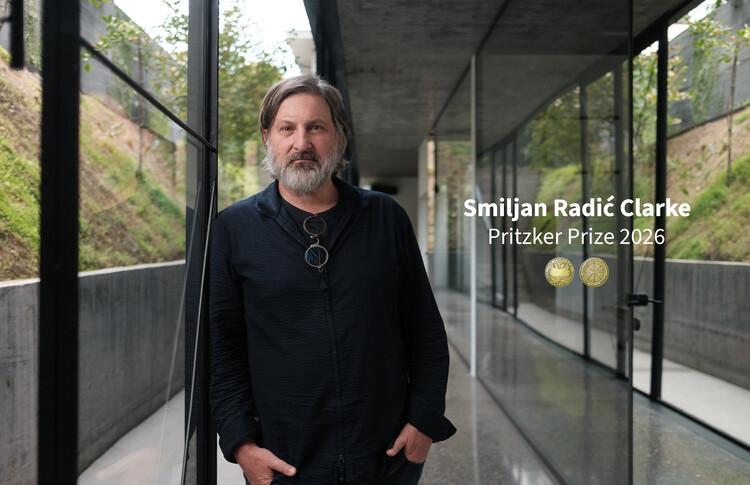
Courtesy of Tom Welsh for The Pritzker Architecture Prize
Chilean architect Smiljan Radić Clarke has been announced as the laureate of the 2026 Pritzker Architecture Prize, regarded as one of the highest honors in the field of architecture. The award recognizes Radić for a body of work that explores architecture through material experimentation, spatial perception, and a careful engagement with landscape and context. Born in Santiago, Chile, where he continues to live and work, Radić leads the practice Smiljan Radić Clarke, established in 1995. As the second Chilean to receive the prize, after Alejandro Aravena in 2016, he joins a distinguished list of previous laureates, including Liu Jiakun in 2025, Riken Yamamoto in 2024, David Chipperfield in 2023, and Diébédo Francis Kéré in 2022.
Radić's architecture operates within a territory where the phenomenological experience of space precedes explanation. His buildings often appear quiet, elemental, and resistant to easy verbal interpretation, encouraging visitors to experience them through movement, atmosphere, and perception rather than through formal expression.
Suzhou Museum of Imperial Kiln Brick. Image Cortesía de Jiakun Architects
The Pritzker Prize is the most important award in the field of architecture, awarded to a living architect whose built work "has produced consistent and significant contributions to humanity through the art of architecture." The Prize rewards individuals, not offices, as happened in 2000 (when the jury selected Rem Koolhaas instead of his firm OMA) or in 2016 (with Alejandro Aravena selected instead of ELEMENTAL); however, the Prize can also be awarded to multiple individuals working together, as was the case in 2001 (Herzog & de Meuron), 2010 (Kazuyo Sejima and Ryue Nishizawa from SANAA), and 2017 (Rafael Aranda, Carme Pigem, and Ramon Vilalta from RCR Arquitectes).
Overprovision can be seen as an architecture strategy through the lens of resilience—making spaces adaptable to changes, reinterpretations, and future needs. However, could overprovision also offer a productive lens for rethinking spatial design? Are there parallels in architectural theory or practice that align with this concept, as explored by notable figures in the discourse on space?
This question becomes particularly relevant in residential design, especially in regions like Hong Kong or Tokyo, where the demand to maximize space is a cultural and practical norm. Designers are frequently tasked with "making use of every inch" for storage or function, reflecting a tendency among residents to accumulate belongings disproportionate to their living spaces.
Tokyo is never-ending. It is a city made up of many cities, where everything is superlative and encounters with overwhelming scale are constant. For those visiting for the first time, the cultural shock is striking. Everything is extremely clean despite the absence of public trash bins, there's a strong impression of zero violence, and society seems to follow strict disciplinary codes to the letter. There’s a sense that human relationships and individual feelings are set aside in favor of the collective, with all the benefits and drawbacks that this way of life may bring.
The Royal Institute of British Architects (RIBA) has announced that Japanese architects Kazuyo Sejima and Ryue Nishizawa, founders of the practice SANAA, will receive the 2025 Royal Gold Medal for architecture. Awarded on behalf of His Majesty the King, the medal is one of the highest honors in the field, recognizing what RIBA describes as SANAA's contribution to shaping contemporary architecture through simplicity, light, and refined design.
Beka & Lemoine’s Film Tokyo Ride Features Pritzker Prize Winner Ryue Nishizawa . Image Courtesy of Beka & Lemoine
Kazuyo Sejima and Ryue Nishizawa, founders of the renowned architecture firm SANAA, have been announced as the recipients of the 2025 Le Prix Charlotte Perriand by the Créateurs Design Awards. Announced today in Paris, France, the award honors exceptional contributions to modern architecture and design. Sejima and Nishizawa, known for their minimalist designs that integrate form, function, and the environment, continue to be recognized as innovators in the field, having been previously recognized with the prestigious Pritzker Architecture Prize in 2010. Sejima and Nishizawa will accept Le Prix Charlotte Perriand at the Créateurs Design Awards ceremony in Paris on January 18, 2025.
Last week, Japanese architect and social advocate Riken Yamamoto was announced as the 2024 Pritzker Architecture Prize Laureate, becoming the 9th Japanese architect honored with the profession's most prestigious award. Throughout the 45-year history of the Pritzker Prize, Japan stands out as the nation with the highest number of laureates. While geography is not a criterion in the selection of the laureates, Japanese architecture consistently impresses with its interplay of light and shadow, the careful composition of spaces, soft transitions between interior and exterior, and attention to detail and materiality. An ingrained culture of building also celebrates diverse designs and encourages global dialogue and the exchange of ideas and best practices. Read on to rediscover the 9 Japanese Pritzker laureates and glimpse into their body of work.
"The taste of the apple lies in the contact of the fruit with the palate, not in the fruit itself," Jorge Luis Borges once said. The taste is not something inherent in itself; its experience is the result of an encounter. Similarly, emotions are not contained within architecture, but are only felt through the encounter of the body with the space, when it becomes a place. How does the environment affect how we feel? This is the question that drives the duo of artists and filmmakers Ila Bêka and Louise Lemoine in their latest endeavor, the book "The Emotional Power of Space," which will be released on May 17th in an event preceding the opening of the Venice Architecture Biennale 2023.
SANAA co-founder Kazuyo Sejima and influential Canadian architect Phyllis Lambert have been awarded the Jane Drew and Ada Louise Huxtable prizes, respectively, as a recognition of their work and commitment to design excellence and for raising the profile of women in architecture. The Jane Drew Prize for Architecture commends Kazuyo Sejima for her achievements as an architect, while the Ada Louise Huxtable Prize recognizes Phyllis Lamber’s contribution to the wider architectural industry. The two awards are presented by UK-based publications Architects’ Journal and The Architectural Review.
One of the world's leading metropolises, Tokyo is home to extraordinary architecture that fascinates through its blend of traditional values and high-tech expression. The 1923 earthquake and the bombardments of World War II dramatically influenced the image of the city and its architecture, giving rise to modern urban environments with complex infrastructure.
The Japanese capital constitutes the most populated metropolitan area in the world, housing 33 million inhabitants. Divided into 23 wards and numerous neighbourhoods, the city features a diverse blend of atmospheres and urban fabrics that support an amalgamation of architectural typologies.
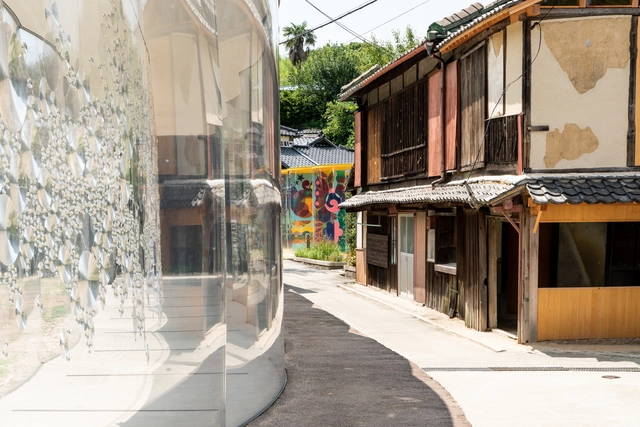
A new exhibition at the Japan House in London explores the large-scale art and architecture project driving the transformation of the Japanese island of Inujima for the past 13 years. Titled Symbiosis: Living Island, the show co-curated by the project's artistic director Yūko Hasegawa and architect Kazuyo Sejima showcases how the innovative scheme of accessible art, pavilions and creative projects brought together artists and locals in the effort to revitalize and secure a future for this island in the Seto Inland Sea confronted with diminishing population. Running from 21 May to 4 September 2022, the exhibition takes visitors on a journey around the island that illustrates the transformative impact of the Inujima' Art House Project' through architectural models, photography, videos and testimonies of the residents.
The Pritzker Architecture Prize released a special ceremony video honouring the 2021 laureates Anne Lacaton and Jean-Philippe Vassal. Previously held in person, each time at a different architecturally significant venue around the world, this year’s ceremony is the second pre-filmed event in the history of the Prize, following the one in 2020. The ceremony features filmed remarks from various speakers, among which are several jury members, Jury Chair Alejandro Aravena, the 2020 Prize recipients Shelley McNamara and Yvonne Farrell, as well as this year’s Laureates themselves. The video also pays tribute to the achievements of Lacaton and Vassal through footage of their built work.
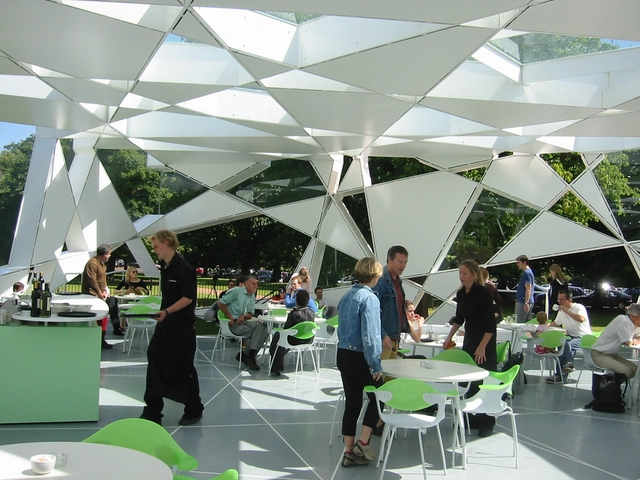
Serpentine Gallery Pavilion. Image Courtesy of Toyo Ito & Associates, Architects
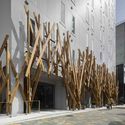
Examining the work of Tokyo architect Toyo Ito (b. 1941) – particularly his now seminal Sendai Mediatheque (1995-2001), Serpentine Gallery (London, 2002, with Cecil Balmond), TOD's Omotesando Building (Tokyo, 2004), Tama Art University Library (Tokyo, 2007), and National Taichung Theater (2009-16) – will immediately become apparent these buildings’ structural innovations and spatial, non-hierarchical organizations. Although these structures all seem to be quite diverse, there is one unifying theme – the architect’s consistent commitment to erasing fixed boundaries between inside and outside and relaxing spatial divisions between various programs within. There is continuity in how these buildings are explored. They are conceived as systems rather than objects and they never really end; one could imagine their formations and patterns to continue to evolve and expand pretty much endlessly.
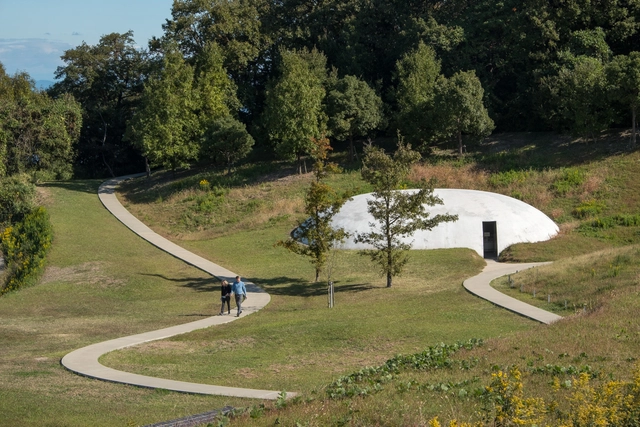
Naoshima, Teshima, and Inujima are the three main islands of an archipelago in Japan's Seto Inland Sea. What sets them apart from the many other Japanese islands is the large number of exceptional architectural works designed by some of the greatest architects and artists in the world. These projects are part of the Benesse Art Site Naoshima, an art complex idealized by billionaire businessman Soichiro Fukutake in the 1980s, composed of eighteen museums, galleries, and open-air installations.
Kazuyo Sejima - Photo by Aiko Suzuki . Image Courtesy of La Biennale Architettura 2021
The Board of Directors of the 2021 Venice Biennale has appointed Kazuyo Sejima as president of the international jury, in charge of awarding mainly the Golden Lion for Best National Participation, the Golden Lion for the Best participant, and the Silver Lion for a promising young participant. In addition, they have also selected four other jury members from Peru, Lebanon, Ghana-Scotland, and Italy. The Awards Ceremony will take place in Venice on Monday, August 30th, 2021.
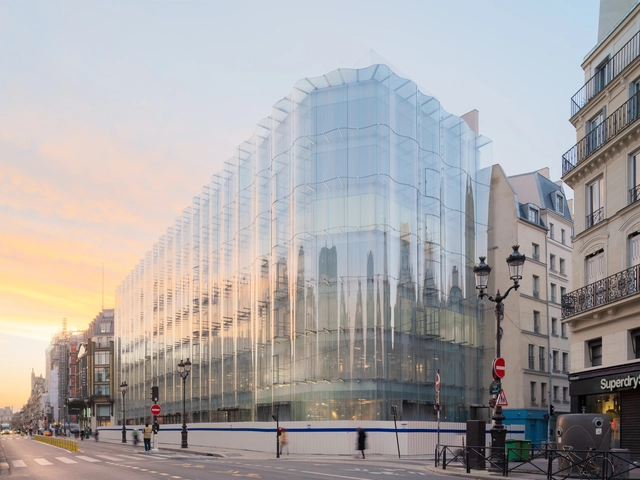
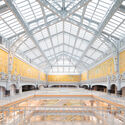
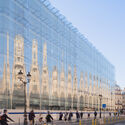
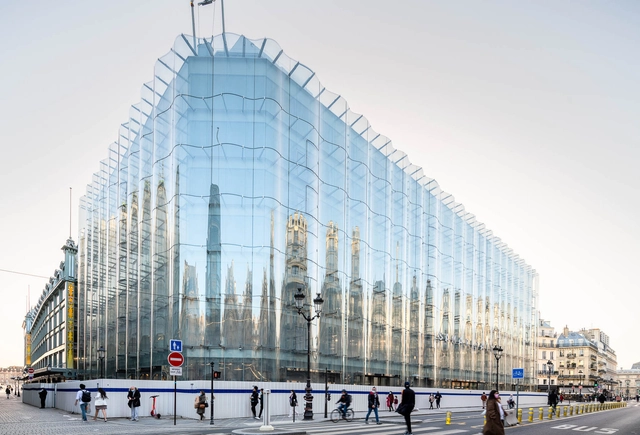
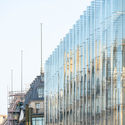
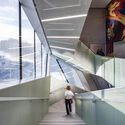
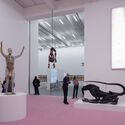
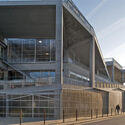
After surpassing many hurdles, SANAA's renovation of La Samaritaine Department Store is set to open its doors to the public. The redesign of the Parisian retail institution reinstates its historical value while bringing a contemporary contribution to its architecture.

















.jpg?1582576434 "© Iwan Baan")
.jpg?1650190677 "© Daici Ano")









Nacasa___Partners.jpg?1629103408 "Tod's Omotesando Building_interior. Image © Nacasa & Partners")


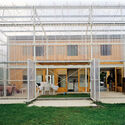
Kai_Nakamura.jpg?1629103497 "'Minna no Mori' Gifu Media Cosmos. Image © Kai Nakamura")