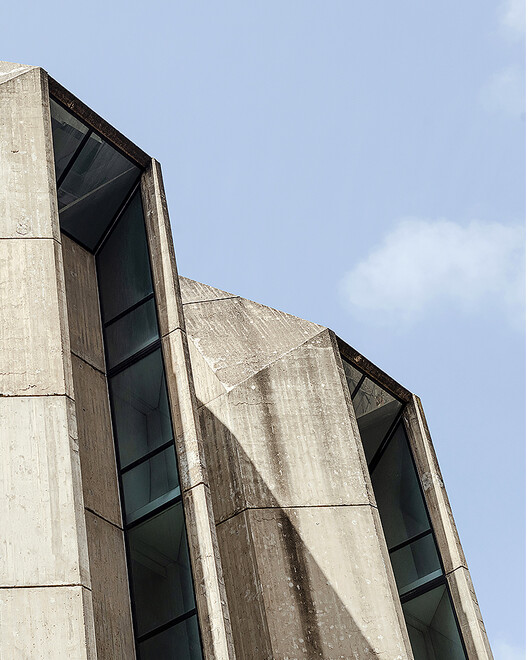
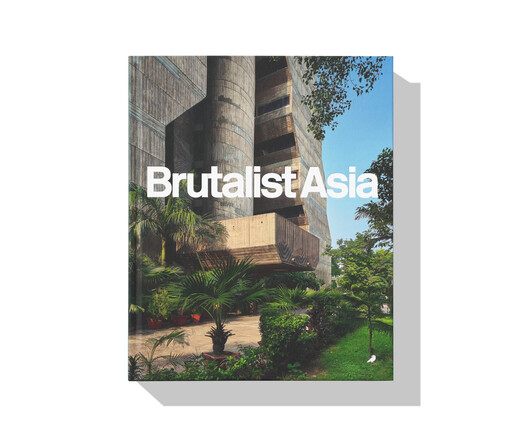
The history of Brutalism has largely been written from a Western perspective. Brutalist Asia by Blue Crow Media offers a different view, examining how architects across Asia adopted, questioned, and transformed the architectural language associated with the movement in response to radically different political, climatic, and cultural conditions. Spanning 28 countries, from Japan and Southeast Asia through South and Central Asia to the Middle East, Iran, and Lebanon, the book brings together 140 buildings and more than 150 photographs, placing internationally recognized works by architects including Kenzo Tange, Paul Rudolph, Balkrishna V. Doshi, Raj Rewal, Charles Correa, Kim Swoo Geun, Leandro V. Locsin, and Le Corbusier alongside important but lesser-known works that expand our understanding of post-war architecture across the continent.
Within this broader geography, one particular history unfolds in Lebanon, where the ambitions of Modernism became inseparable from a country undergoing profound social, political, and urban transformation. Read on for an excerpt from ArchDaily Editor-in-Chief Christele Harrouk's chapter in Brutalist Asia, tracing the rise of Brutalism in Lebanon, the architects and buildings that gave it a particular local expression, and the rupture that left this Modernist project unfinished.
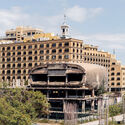
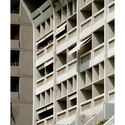
Khalil Khoury's Interdesign Building and Brutalism in Lebanon
Long before I knew what Brutalism was, I was drawn, as a child, to the immovable concrete brutes that surrounded me. Often overlooked, they stood apart, not only for their massing, but for their poetic composition and sculptural presence. They carried an intricate, almost vulnerable truth. They revealed an unexpected lyrical dimension. And ultimately, they paradoxically invited me to engage with their surfaces, to touch, explore and discover.
Brutalism in Lebanon
Emerging in the mid-20th century through the works of Le Corbusier and Alison and Peter Smithson, Brutalism spread globally, reaching its peak in the mid-1970s. From Europe to India, Japan, the United States and Latin America, it evolved into diverse contextual interpretations, becoming more than a European export. Through this shared architectural language, different regions negotiated their own paths towards modernity, development, governance and identity. In the Arab world in particular, this architectural evolution was inseparable from its political context, closely aligned with the ambitions of newly formed states and processes of nation-building.
In Lebanon, this Modernist landscape was shaped by local architects and engineers, grounded in practical responses to the local built environment. It became especially visible in the 1960s, an era often described as the golden age of the nation-state project. Architecture at the time was largely institutional, socially engaged and politically driven, embodying a collective vision of modernization. Brutalism emerged within this context, relatively later than elsewhere. Inspired by Le Corbusier and the Brazilian Modernist movement, Lebanese architects such as Joseph Philippe Karam, Khalil Khoury, Georges Khoury, Antoine Romanos and Grégoire Serof adopted exposed concrete as a medium for new architectural expression, transforming it from structure into a symbol of progress and modernity.
Introduced earlier during the French Mandate in the 1920s through engineers and urban planning initiatives, reinforced concrete gradually replaced traditional stone construction. By the 1950s and 1960s, amid rapid urban growth, it had become the dominant building material. Architects like Jacques Liger-Belair reframed it as a continuation of local tradition. He famously stated that 'concrete is our equivalent of stone' and often described it as a kind of 'liquid stone'.
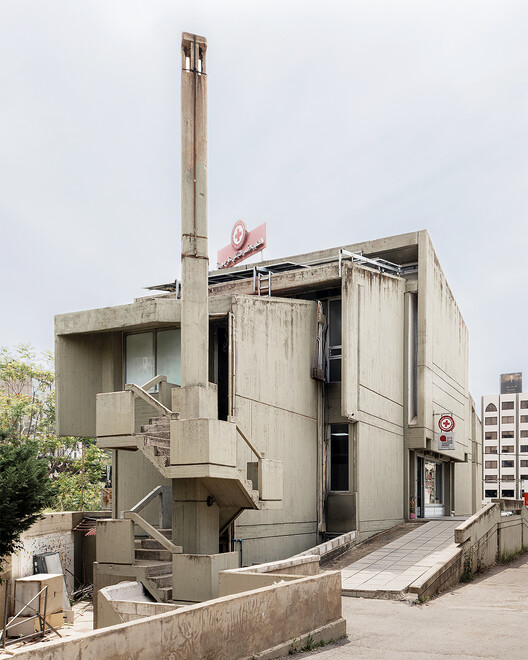
Taking on a more hybrid character, Brutalism in Lebanon combines Modernist ideals with regional identity, climate responsiveness and a deeply expressive, sculptural approach to form. It was not simply an imported style, but a localized evolution shaped by cultural, climatic and political conditions.
This trajectory, however, was abruptly interrupted. The outbreak of the Lebanese Civil War in 1975 marked the collapse of the nation-state project and, with it, the decline of the Modernist movement that had accompanied it. Within a few years, this rupture became visible in the built environment. Today, Beirut stands as a city of contrasts, its skyline marked by bullet-ridden structures, Ottoman and French colonial remnants, post-war developments, and, in between, monolithic concrete buildings dating back to an earlier era. These Brutalist structures remain as fragments of a moment of cultural ambition, revealing both the ambitions of modernity and their eventual unravelling.
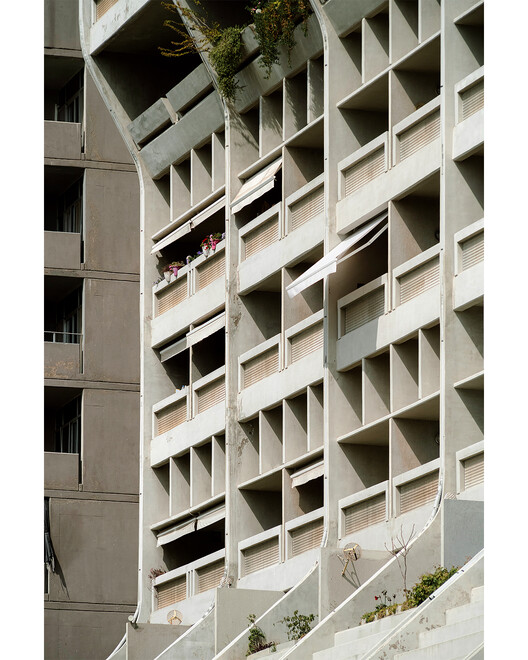
The Interdesign building
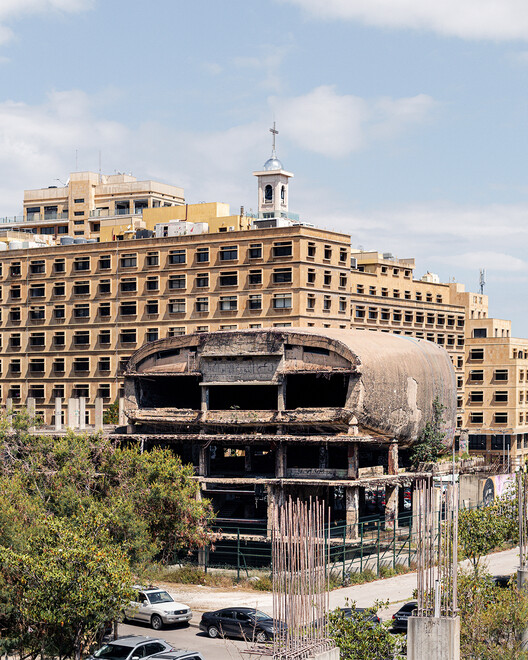
One cannot speak of Brutalism in Lebanon without addressing the Interdesign Building. Exemplifying many of the movement's defining characteristics, it was conceived by Khalil Khoury in 1973. In 2024, during Bernard Khoury's exhibition dedicated to his father's work, I had the opportunity to speak with him about this enigmatic project, and its story proved as fascinating as the building itself.
While often situated within the broader Modernist movement, the Interdesign Building can be understood as distinctly Brutalist in its material presence and spatial organization. Whether Khalil Khoury himself would have embraced this label, or any label, remains uncertain, yet its use of exposed concrete, monumental massing and uncompromising structural clarity aligns it closely with the core principles of Brutalism. Its strong geometric composition and repetitive structural rhythm reinforce this reading, allowing the building to be understood through its own logic of construction. Its inward, almost defensive configuration, absence of ornament and emphasis on raw material further reinforce this interpretation. It asserts itself as a singular, monolithic object, embodying the tension between function, form and material that defines Brutalist architecture.
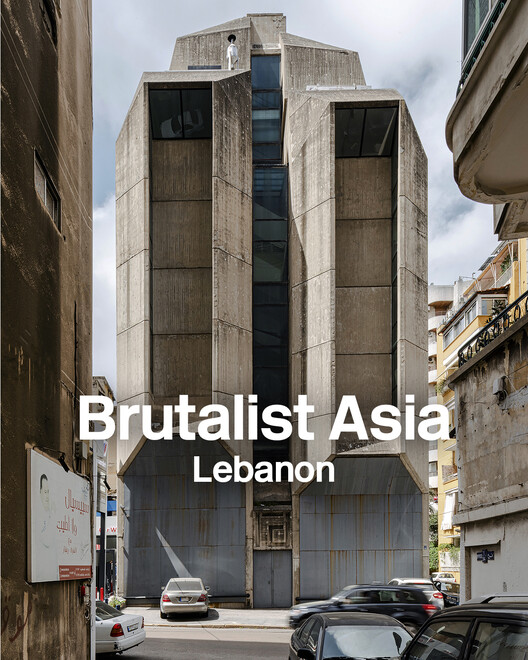
The Interdesign Building was conceived at the peak of Khalil Khoury's career, at a time when he was both an architect and a successful industrialist. By the 1960s, he had developed one of the region's most advanced furniture production industries, designing, manufacturing and distributing modern pieces locally, expanding access beyond elite markets. As the company grew, so did its technical sophistication: when imported machinery proved insufficient, Khoury began developing his own technologies, producing custom equipment to bend wood in-house. Within this context, the Interdesign Building emerged as the culmination of an integrated system, a showroom for furniture created and manufactured in Lebanon. Khoury was, in effect, shaping the final stage of a process in which architecture, design and industry converged, embodying the optimism of a time when Lebanon saw itself as a center of production, innovation and export.
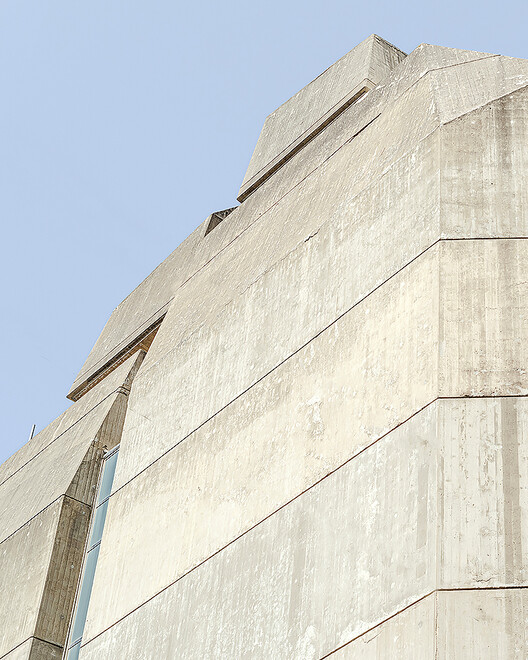
Construction began in 1974, but by April 1975, as the project had just reached ground level, the Civil War erupted and brought everything to a halt. Attempts to resume construction during the war were unsuccessful, leaving the building suspended for years. When the war ended in the early 1990s, the context that had given rise to the project had fundamentally changed. Beirut's economy had shifted away from production towards banking, tourism and speculation, making the idea of a large-scale furniture showroom increasingly irrelevant.
Despite financial difficulties and the collapse of his industrial enterprise, Khoury chose to complete the building. By the late 1990s, it was finished but unused, a structure conceived for a reality that no longer existed. In the years that followed, it was seized by banks, briefly repurposed and then abandoned for decades. Its rigid spatial configuration and lack of adaptability made it difficult to occupy. Today, the Interdesign Building stands as more than just an object in the city; it is a physical manifestation of an interrupted modern project. Its story mirrors both Khoury's personal trajectory and the broader transformation of Lebanon.
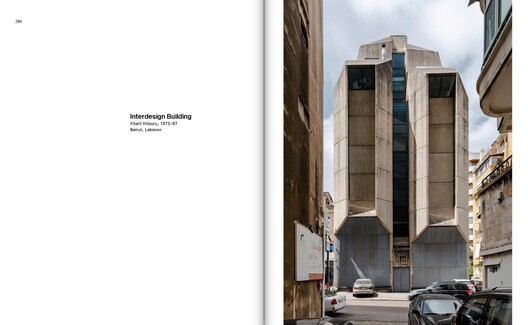
Explore the wider story in Brutalist Asia, bringing together 140 buildings across 28 countries, more than 150 photographs, and 8 original essays by Bob Pang, John Barr, Bhawna Dandona, Christele Harrouk, Kyung Taek Lee, Caryn Paredes-Santillan, Pinai Sirikiatikul, Soroush Mohajery, and Amirhosein Rad. Together, they trace how Brutalism was interpreted and transformed across distinct political, climatic, and cultural contexts throughout Asia.


