Some of India's most convincing architectural worlds have never existed outside a film set. Courtyards, palaces, streets and even entire neighbourhoods have been constructed, lit and framed for the camera, then dismantled when filming ends. Their images remain. For millions of viewers, these spaces become references for how cities look, how wealth is displayed and how particular neighbourhoods or versions of India are remembered. Cinema constructs spatial worlds, compressing complex histories into images that audiences can recognise almost instantly. Those images can later shape how physical places are understood.
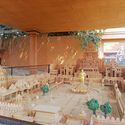


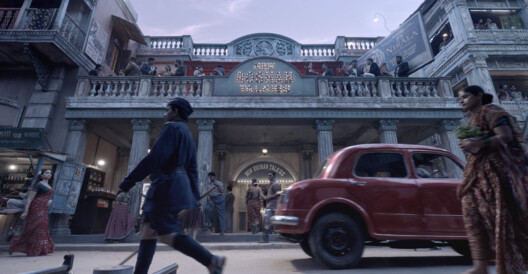
For Gangubai Kathiawadi, production designers Amit Ray and Subrata Chakraborty created a five-acre version of Kamathipura at Mumbai's Film City. The set took weeks to build and involved a large workforce, drawing on photographs, conversations and architectural references from historic Bombay and elsewhere. The team built more than camera-facing façades: the set included a café, bar and hospital, giving the neighbourhood an internal geography beyond what appears in individual shots. The set had to work as a believable version of Bombay, with spaces that allowed the actors and cameras to move through it as they would through a real neighbourhood.
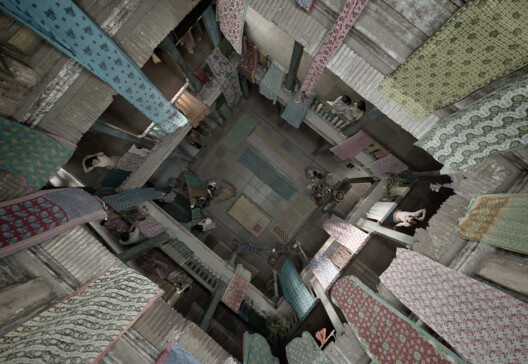
The work starts to resemble architecture in its attention to scale, circulation and spatial relationships. A film set has to account for materials, thresholds and movement while anticipating where actors and cameras will go. The difference is that cinema has to communicate these decisions within seconds of a shot. A street width, façade, signboard or threshold may have to tell the audience where they are, when they are and who belongs there. Research on Hindi film production design has also examined how art departments construct realistic environments rather than simply decorate existing ones.
Related Article
Jacinta Leong on Architecture in Movies: "Films Can Tell Us How Things Are and How Things Can Be"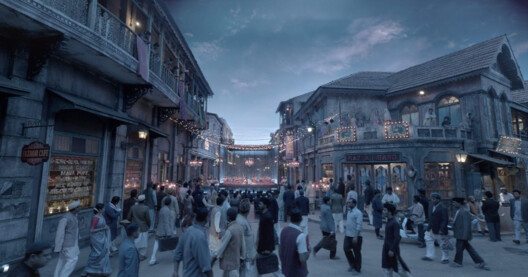
The designers were not attempting a literal reconstruction of Kamathipura. They were interpreting it. Photographs, memories and architectural references were assembled into an image of the neighbourhood in the 1950s and 1960s. The historical place that appears on screen is selective. It draws from research and memory, but also from what the film needs the neighbourhood to be. The camera makes that selective version feel complete by controlling what is seen, from which direction and for how long.
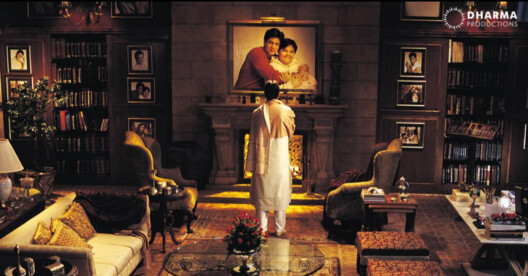
The same logic appears in films that use architecture to stage aspiration. In Kabhi Khushi Kabhie Gham, architecture makes social position visible. The Raichand residence communicates wealth through its monumental entrance, expansive interiors and carefully controlled movement through the house. Elsewhere, the film's London environments present glass, malls and consumer landscapes as visual markers of a globalised lifestyle. The architecture establishes the social hierarchy before the characters do. Through the house and its interiors, the film establishes who belongs where and what kind of life is desirable.
Cinema teaches audiences more than what places look like. It can teach them what places are supposed to mean. A palace can become associated with inherited power, while a courtyard can suggest intimacy or tradition. A dense urban street may be read through ideas of community, disorder or nostalgia; a glass tower can become shorthand for aspiration. Through repetition, these associations can become more familiar than the architectural realities they originate from.
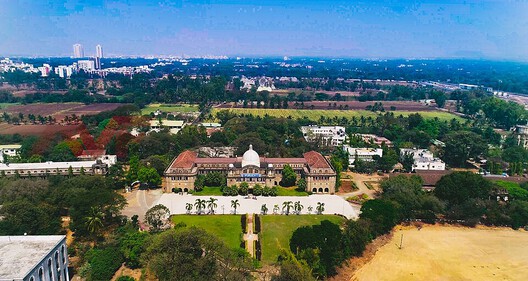
The effect is different when cinema begins with a building that already exists. At the College of Agriculture in Pune, cinema has become part of the building's identity. The 1907 institution, whose main Indo-Saracenic building was completed in 1911, has been used as a filming location for decades. After its appearance in Munna Bhai M.B.B.S., filming activity increased, and the site was eventually branded officially as a filming location. A 2025 study published in Built Heritage found that film associations had altered how students, staff, visitors and heritage-walk participants understood the building. Stories about the films had entered the building's heritage narrative, with particular spaces increasingly remembered through the characters and scenes associated with them.
The building existed before the film, but the film created another version of it. Visitors may now encounter its entrance hall both as part of a historic educational institution and as the place where a particular character once walked. Cinema has added another layer of spatial memory.
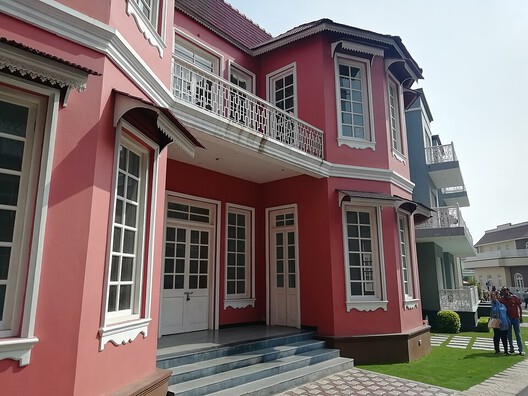
That association can bring visitors, generate pride, and draw renewed attention to a building. The same research, however, points to a more complicated outcome: the cinematic identity can begin to overshadow the architectural one. At the College of Agriculture, some spaces have received selective maintenance because of their usefulness for filming, while their historical significance has received less attention. The building becomes valuable partly because it can perform convincingly as a cinematic setting. Cinema is therefore influencing how the building is represented, valued and maintained.
At Ramoji Film City in Hyderabad, the relationship between cinema and architecture becomes physical. Spread across approximately 2,000 acres, the complex was conceived as an integrated filmmaking facility but has also become a major tourism destination, attracting around 1.5 million visitors annually. Its backlots contain environments ranging from railway stations and airports to hospitals, marketplaces, havelis and foreign streets.
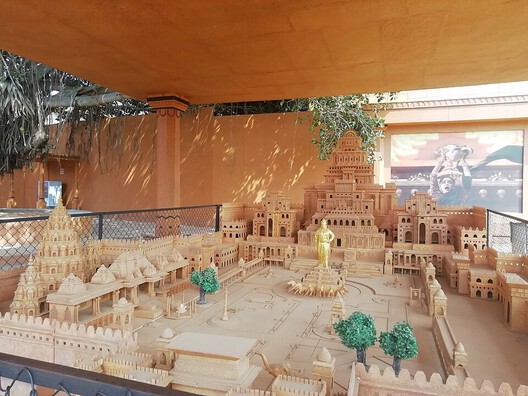
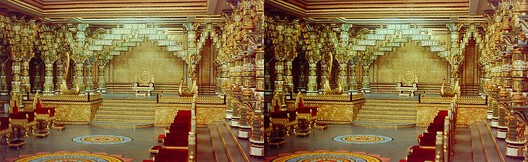
Here, the set no longer disappears when filming ends. It acquires an afterlife as a place that visitors can enter, photograph and experience. Visitors can walk through environments originally constructed to be seen through a camera. The Baahubali sets make the shift particularly clear. Mahishmati was created for the film, yet its sets now function as a physical attraction that visitors can enter and photograph. Ramoji actively markets the set as part of its visitor experience, turning cinematic world-building into tourism infrastructure.
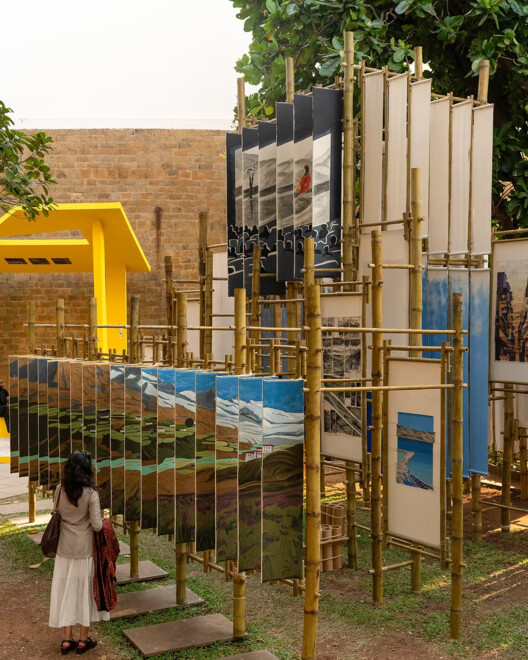
The sequence has changed. Architecture once provided the setting for cinema; cinema now provides the reason to visit architecture. Field Architects' The Script, created for ADFF Mumbai 2017, examines how cinema shapes architectural desire through a pavilion that places Mumbai's cinematic imagination alongside the landscapes of Ladakh. Built as a bamboo framework layered with reused textiles, the pavilion is experienced through fragments, thresholds and changing views rather than as a single fixed image. The architects describe it as a "spatial transcript", using fragments, thresholds and views to explore how cinematic images shape people's expectations of place.
The project also points to cinema's influence beyond film production. Mumbai exists simultaneously as a physical city and as a city repeatedly reconstructed through cinema. Ladakh, similarly, is a lived landscape that has also been turned into an imagined escape through repeated images. The pavilion makes visible how images of place can begin to influence the way physical landscapes are experienced.
Cinema's architectural influence may therefore have less to do with accuracy than with memorability. It only needs to make a particular spatial idea memorable. What cinema produces, then, is a collection of remembered images beyond a single fictional India: streets that feel familiar before we have visited them, houses that have taught us how wealth should look, and landscapes that arrive already loaded with expectations. Some fictional places acquire enough cultural weight to become destinations themselves.
Cinema simply operates at a different speed and scale. A set can be constructed in weeks, seen by millions within days, and remembered long after it has been dismantled. That memory can alter how real places are subsequently seen, valued and experienced. The relationship between cinema and architecture therefore runs in both directions: buildings provide material for images, while images can return to shape the places and expectations from which they came.
This article is part of the ArchDaily Topic: The Lure of Escapism in Architecture and Alternative Worlds. Every month we explore a topic in-depth through articles, interviews, news, and architecture projects. We invite you to learn more about our ArchDaily Topics. And, as always, at ArchDaily we welcome the contributions of our readers; if you want to submit an article or project, contact us.