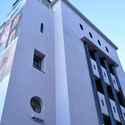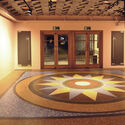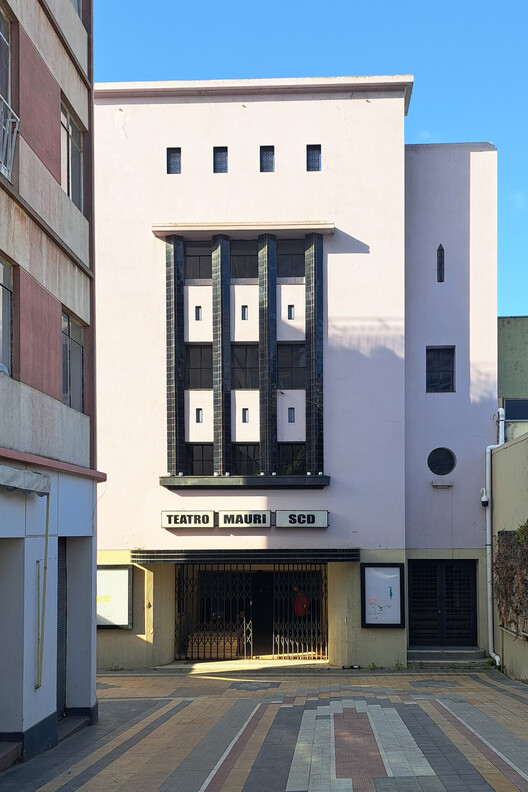
In June 2026, the refurbished Teatro Mauri reopened its doors on Cerro Bellavista in Valparaíso, formerly Chile's main port. The building forms part of Latin America's modernist legacy and stands adjacent to La Sebastiana, one of the renowned residences of the poet Pablo Neruda. It was designed by architect Alfredo Vargas Stoller, author of other icons of modern architecture in Valparaíso, such as the Edificio Cooperativa Vitalicia and the Conjunto de Viviendas Vargas in Viña del Mar. Teatro Mauri opened in 1951 as a venue for performances and cinema. Following a fire in the early 1990s, it fell into disrepair, serving only sporadically as a venue for local parties and events. In 2015, it was purchased by the Sociedad Chilena de Autores e Intérpretes (SCD), which commissioned its restoration from architects Laura Garrido and Gregorio Garretón.
The Teatro Mauri building was originally an initiative of the Spanish-born businessman Sebastián Collado Mauri, who also built La Sebastiana, the residence later acquired by Pablo Neruda in 1959. Collado founded Chile's oldest tile factory, named "El Sol," which remains in operation in the country's Valparaíso Region. Collado tiles can still be found in Valparaíso's traditional houses, as well as in public spaces such as Plaza Victoria, and now in the recently reopened Teatro Mauri. The SCD's initiative forms part of the process of consolidating Valparaíso's status as a musical city, following its 2019 designation by UNESCO as a Creative City of Music. Its reopening comes at a particularly significant moment for asserting the relationship between quality of life and the arts, amid a national political context of budget cuts to cultural activities of all kinds.
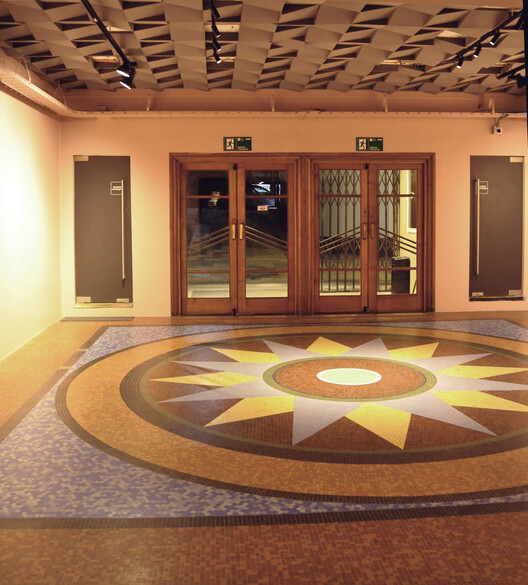
Over nearly seven decades, the building underwent multiple interventions that gradually altered its original spatiality and materiality. A first phase of restoration between 2017 and 2020 allowed for a partial opening, with a 70-seat hall provisionally installed in the original foyer. A second project, led by architects Laura Garrido and Gregorio Garretón, began in 2016 to restore the entire building, following a positive structural assessment. The construction system of concrete blocks confined between reinforced concrete columns, beams, and slabs was found to have only superficial damage. The main challenges in restoring the building to Vargas Stoller's original single-volume design were the removal of a provisional roof installed in 1991 and the numerous piecemeal modifications made for later occasional uses. Construction on the new project took place between 2024 and 2026, with technical site supervision by architect Alonso Pizarro. The lighting design was developed in collaboration with Constanza Valdebenito.
The full restoration project aimed to recover the modern building's original purpose as a performance space, this time in line with contemporary technology and acoustics. The intervention focused on the 1,200-square-metre interior, without altering the building's well-known Art Deco facade. General intervention criteria prioritised nationally sourced materials, including black-veil panels and glass wool, pine battens, as well as minimal impact on neighbouring interventions to preserve views, in keeping with Valparaíso tradition. A new steel roof with lattice beams was incorporated, along with carbon-fibre structural reinforcement on columns and walls. One of the main interventions involved excavating beneath the original building to accommodate dressing rooms, bathrooms, technical rooms, and underground storage.
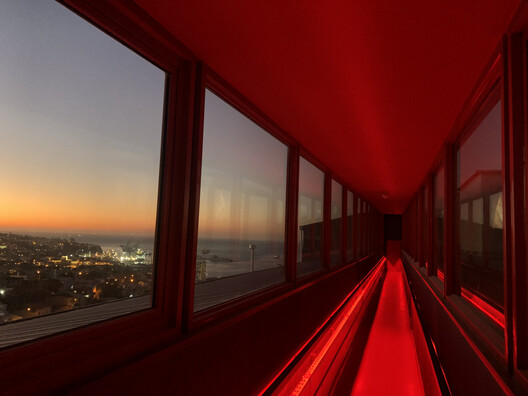
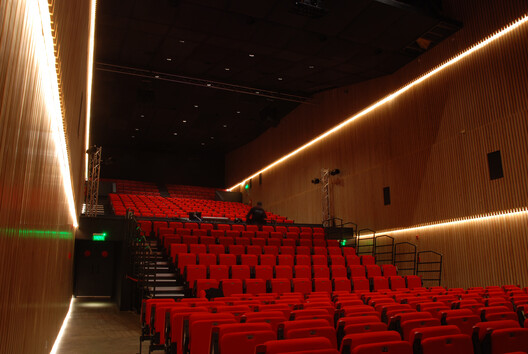
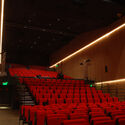
For the new staging setup, the stage was renewed with a motorised beam system, a technical mezzanine separating the two stalls sections, and acoustic cladding. The concert hall has a flexible capacity, with 80 retractable seats using the same mechanism as the NAVE cultural centre, allowing for between 195 and 780 people, including 514 standing on the main floor. Originally a cinema, in its contemporary version, Teatro Mauri has been designed exclusively for musical performances, conceived to accommodate any type of sound. The SCD's initiative prevented the modernist building's conversion into a supermarket warehouse, having received 10 per cent state support in 2015. The cultural project is focused on promoting Chilean music, with an open call for artists and a programme schedule designed to coexist with the area's characteristic urban, nightlife and tourist activity.
Other recent news regarding cultural architecture around the world includes the announcement of the winning project in the international competition to design the new National Museum of Ecuador (MUNA) in Quito, designed by Studio Campo Baeza, based in Madrid, together with Quito-based Maoda. Mexican architects Palma + Taller TO were recently selected to design the new Museum of Contemporary Art of Panama (MAC Panamá), described as "a new cultural infrastructure open to the city, conceived from the identity, climate, and landscape of Panama." Major cultural projects advancing worldwide include Snøhetta's Shanghai Grand Opera House, Frank Gehry's Dar al Funoon Abu Dhabi Performing Arts Centre, and RCR Arquitectes' "Large" cultural institution on Paris' Île Seguin.