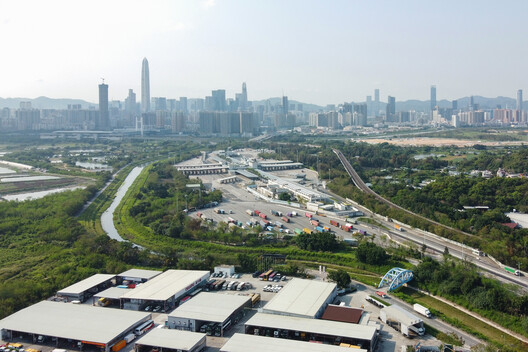
For most children, the journey to school is an everyday geography of street life and traffic, repeated so often that it becomes almost invisible, folded into the background of childhood and growing up. Yet for cross-boundary students who live in Shenzhen and attend school in Hong Kong, the school day begins much earlier, and much farther from the classroom. It begins at the border.
Their commute is not simply a matter of distance. It is shaped by two legal systems, two administrative cultures, and a set of infrastructures designed to make daily crossing a little bit more feasible for individuals under 18. On a typical morning, the route to school may pass through a boundary control point before it reaches a classroom. It may involve a government-approved school coach, a restricted access road, an immigration hall, a fingerprint scanner, or a clearance procedure that takes place while the child remains seated on the bus. What appears from a distance as a school commute is, in spatial terms, a carefully managed architectural corridor between two cities.


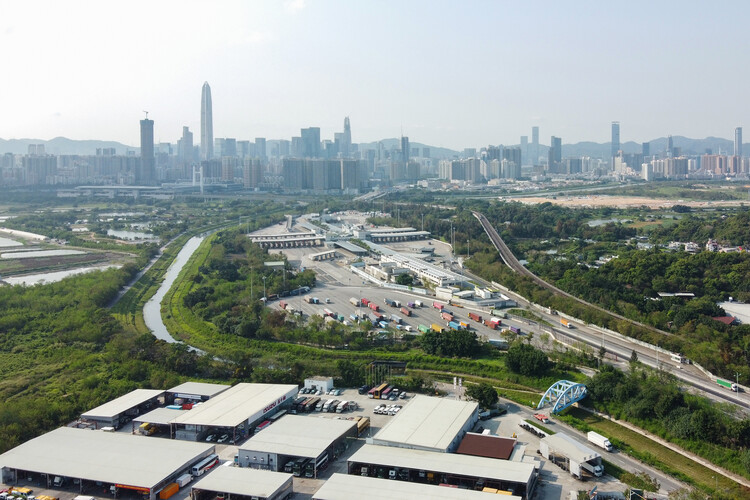
This condition asks us to reconsider where architecture begins. It is not only in the school's physical building, the classroom, or the playground. Here, architecture operates through the entire system that allows education to happen across a border. It appears in the design of movement, the management of waiting, the choreography of supervision, and the administrative thresholds that determine who may pass, when, and under what conditions. For these students, the educational environment begins long before the school gate. The commute itself becomes architecture; the border becomes a corridor; and education becomes a spatial negotiation between systems.
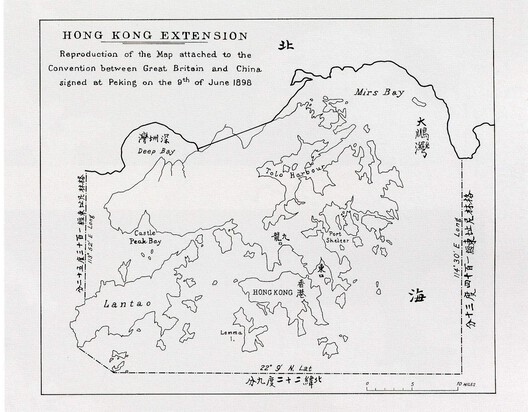
The Border as School Corridor
The Hong Kong Education Bureau treats cross-boundary students as a distinct group requiring specific transport and immigration arrangements. With young students' safety in mind, additional facilitation measures have been introduced, including government quotas for cross-boundary school coaches, Closed Area Permits for certain local school vehicle arrangements, student e-Channels — designated electronic immigration gates for cross-boundary students — and on-board clearance at selected control points.
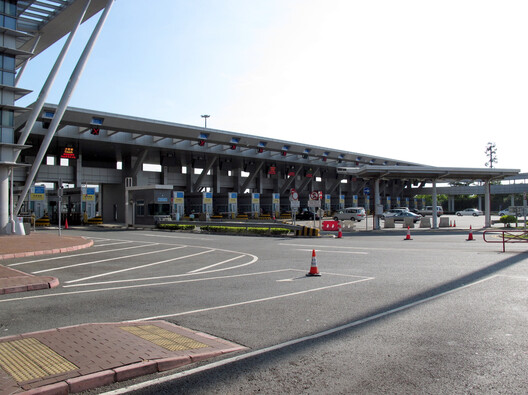
In architectural terms, this means that a border normally understood through sovereignty, security, trade, and passenger flow has also been adapted into a school corridor. The cross-boundary school coach is central to this transformation. Unlike an ordinary school bus, its operation depends on government approval, annual review, and access to designated boundary control points such as Man Kam To, Heung Yuen Wai, Shenzhen Bay Port, and Lok Ma Chau/Huanggang. The bus therefore becomes more than transport. It becomes an extension of the border system, carrying children through a route shaped by permission as much as by geography. In doing so, the journey itself becomes part of their education, quietly teaching the routines through which borders are encountered, negotiated, and internalized.
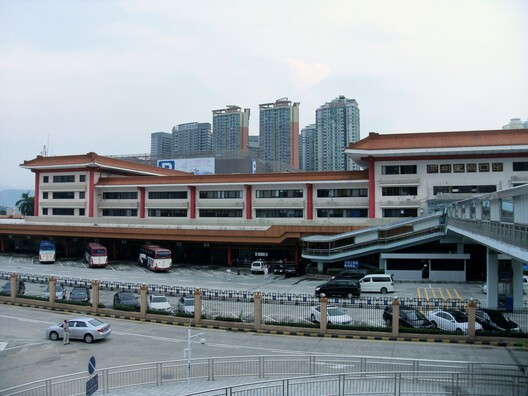
Within these in-between conditions, the border is no longer only a building, a line, or a hall of inspection. It becomes a procedure that can move, pause, and reappear along the route to school. The physical limits of the border also shape the journey. Bus frequency, vehicular access, station capacity, road width, emergency routes, and waiting areas all determine how smoothly this corridor can function. These details matter because they show that policy is never abstract. A child's route to school is shaped by the capacity of physical spaces to absorb vehicular traffic, waiting bodies, and the repeated pressures of daily passage.
The Hidden Curriculum of Crossing
Compared with an ordinary school commute, this produces a very different experience of childhood space. For many students, the journey to school teaches the rhythms of a neighborhood: where the traffic slows, which shop opens early, when the bus arrives, and how long it takes to reach the classroom after the bell rings. For cross-boundary students, the journey also teaches the rhythms of jurisdiction. They learn how one system gives way to another, how documents alter space, and how identity is read differently on different sides of a threshold. Before entering the classroom, they have already rehearsed a form of institutional literacy, learning the social norms and spatial codes of two cities through the repeated acts of waiting, moving, presenting, passing, and arriving.
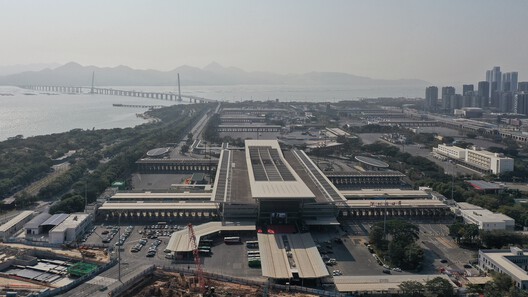
This is the hidden curriculum of the border. A student who sleeps in Shenzhen, studies in Hong Kong, and passes through immigration control twice a day may develop a sense of place that is neither contained by home nor completed by school. This architectural corridor can be both empowering and disorienting: it teaches children to move between systems with unusual fluency, while also reminding them that their presence is continually categorized, permitted, and inspected. Over time, they learn that the border is real, but also that it can be crossed; that systems differ, but that daily life can still pass between them. Belonging is stretched across the corridor, practiced through crossing rather than secured by staying in one place. In this quiet sense, education begins before the lesson. It begins with the journey.
Care, Control, and the Architecture of the In-Between
It would be too simple to describe this infrastructure, functioning as the border, only as control. The same border that inspects and categorizes also provides forms of care. Special school-coach arrangements, student clearance procedures, adult supervision, and port-based support exist because young students are vulnerable travellers moving through a highly regulated environment. This duality is what makes the Shenzhen–Hong Kong school commute architecturally significant. The border is both hard and soft. It separates legal systems, but it also produces a mechanism for daily passage. It controls movement, but it also protects movement. It marks difference, but it also forces repeated contact. Through the ordinary act of going to school, the border becomes not only a point of separation, but a lived environment of transition.
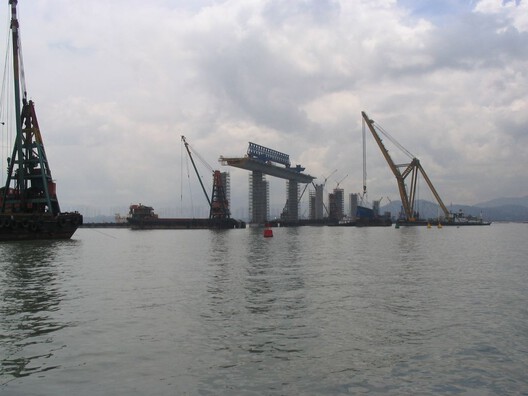
For this reason, the school should not be understood only as a destination. For cross-boundary students, the school is part of a larger spatial apparatus that begins before the classroom and extends back across the border at the end of the day. The educational environment includes the corridor of movement that makes attendance possible. The child learns in class, but also learns through the route: how systems touch, how authority is encountered, how movement is negotiated, and how one city can be entered from another.
This does not mean that the border disappears. Nor should the argument be that such a border can simply be removed overnight. Where legal, educational, economic, and social systems remain different, abrupt erasure may produce confusion rather than freedom. But architecture offers another way to think about borders. It can show how difference is not only enforced, but also mediated. It can reveal how separation is softened through routine, and how thresholds are renegotiated through repeated use.
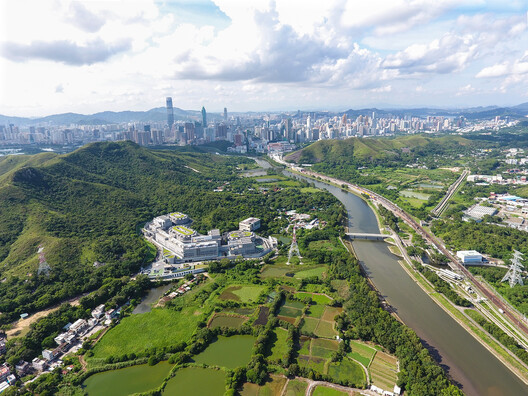
The daily school corridor between Shenzhen and Hong Kong is one such zone. It does not abolish the border. It inhabits it. Through the repeated movement of children between home and school, the border becomes less like a line and more like a thickened space of translation. Its authority remains, but it is constantly being passed through, adjusted to, and made ordinary. Perhaps this is where architecture's role becomes most subtle. Not in declaring the border unnecessary, nor in celebrating mobility as freedom, but in asking how spaces of difference can be negotiated, made livable, and be part of our everyday life. Between home and school, the border becomes more than a checkpoint. It becomes an educational landscape of care and control, as well as a slow spatial experiment in belonging.
This article is part of the ArchDaily Topic: Architectures of Movement: Land, Borders, and the Politics of Belonging. Every month we explore a topic in-depth through articles, interviews, news, and architecture projects. We invite you to learn more about our ArchDaily Topics. And, as always, at ArchDaily we welcome the contributions of our readers; if you want to submit an article or project, contact us.


