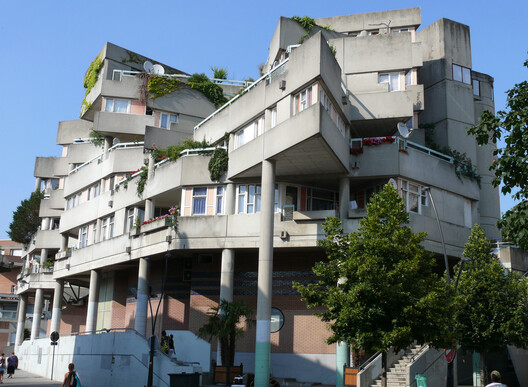
Saint-Denis is a commune in the northern suburbs of Paris, France, known for the Gothic Basilica of Saint-Denis and the Stade de France. At one corner of Place Jean-Jaurès in its historic center, adjacent to the Basilica, stands the Îlot 8 housing complex, a Brutalist landmark designed by architect Renée Gailhoustet. Built between 1975 and 1986 to provide workers' housing in the city center, countering the trend of relegating social housing to peripheral areas, the project is now at the center of a controversial redevelopment plan. Often referred to as "residentialization" and restructuring, the proposal involves the demolition of significant parts of its original design. This reconversion is part of the French Nouveau Programme National de Renouvellement Urbain (NPNRU) and is justified by concerns over structural deficiencies, safety, and maintenance.
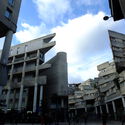
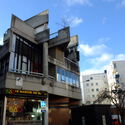
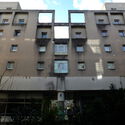
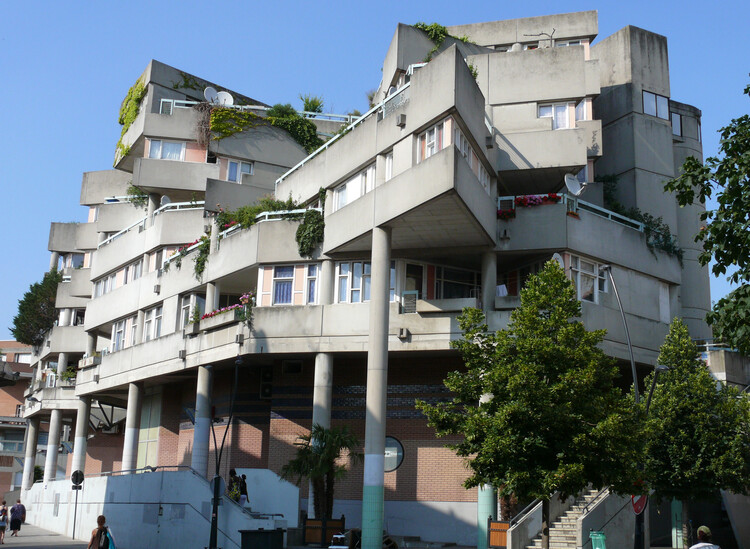
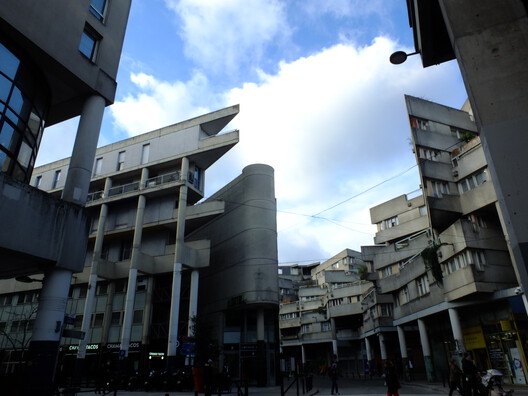
Îlot 8 was constructed on a site previously classified as unsanitary in 1945, labeled a slum by 1965, and cleared of all structures by 1974. The area was subsequently designated a Zone d'Aménagement Concerté (ZAC), intended to accommodate shops and 182 housing units. The project's commercial program connects directly to the Saint-Denis market, housed in a renovated 1893 hall and considered one of the busiest in France. The modernist complex draws from this context through its commercial galleries. The apartments are arranged in an interlocking configuration, ensuring that, as residents often note, "no two are alike." The complex embodies Gailhoustet's signature approach and has been described as "her most accomplished collective housing project," integrating typological variation, functional diversity, clustered dwellings, green terraces, pedestrian pathways, and spatial complexity, strategies previously explored in her projects in Ivry-sur-Seine and Aubervilliers.
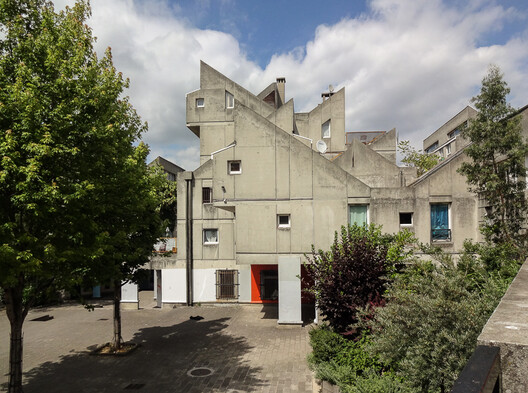
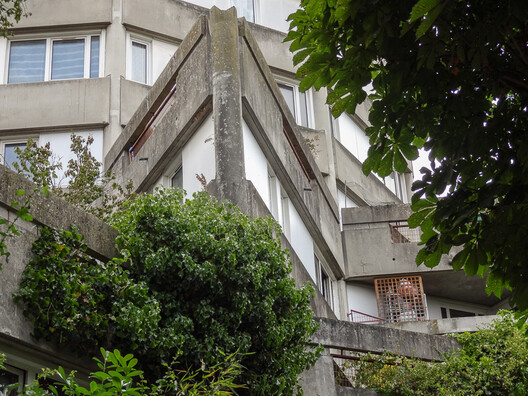
The building has been under scrutiny since 2010, with concrete plans for partial demolition emerging in 2025. One of the main arguments for intervention is that Îlot 8, composed entirely of rental housing, has not kept pace with the broader transformation of its urban context. As Christophe Catsaros observed, the complex appeared as early as the 1990s to be "an island of modernity," situated within the increasingly gentrified and economically strained core of the city. Today, the atypical housing units show clear signs of neglect. In response, the municipality commissioned architects Nicolas Trentesaux and Serge Renaudie of the firm Agence RVA to assess the building and propose measures to halt its deterioration and adapt it to contemporary conditions.
According to the architects, several issues require urgent attention. Structurally, the concrete slab no longer performs as originally intended, circulation routes and staircases present challenges, and overall energy performance is inadequate. Contextual concerns also weigh heavily, particularly safety issues, with claims that the complex's porous spatial layout facilitates illicit activities. The proposed plan, therefore, calls for the demolition of selected elements and the transformation of the complex into an exclusively residential building. It also includes the addition of elevators, currently absent, to improve accessibility and comfort for residents.
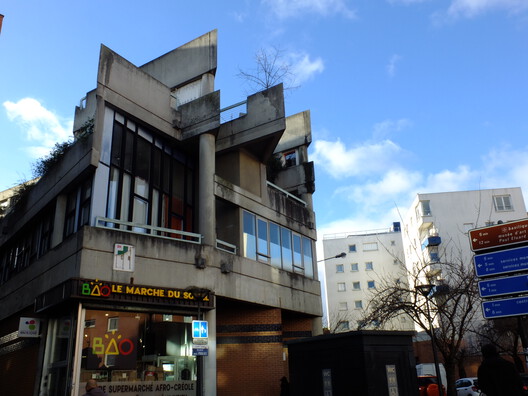
Opponents of the intervention, including the residents' group Le Collectif Ilot 8, as well as architects, urbanists, and students, argue that the proposed demolitions would undermine the building's architectural integrity. They contend that "residentialization" would erase the project's defining spatial qualities, notably its porous, labyrinthine configuration. Planned changes include the removal of several staircases and the alteration of public squares, which are essential to the complex's urban and social character. Converting the mixed-use structure into a purely residential development would effectively privatize it, requiring major alterations to its circulation system and eliminating connections between blocks. As a result, both its Brutalist identity and its experimental spatial logic would be significantly compromised.
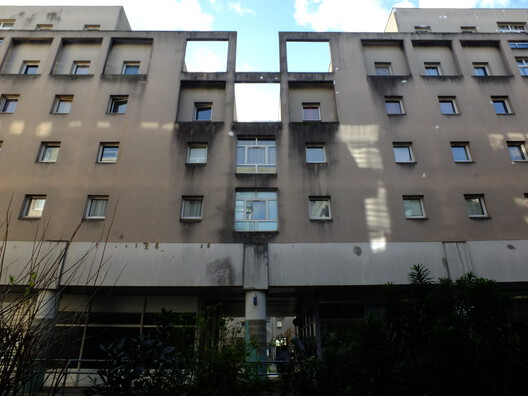
Following a recent political shift after the March municipal elections in France, the future of Îlot 8 may be reconsidered. The newly elected mayor of Saint-Denis has expressed support for preserving the building in a way that respects its original character and purpose, aligning with residents and advocacy groups seeking to protect Gailhoustet's design. However, funding for the redevelopment was allocated by the French National Agency for Urban Renewal in 2016, and despite ongoing efforts, the building continues to deteriorate. Preservation advocates have launched petitions and fundraising initiatives to support alternative interventions, yet no definitive measures have been announced to suspend or revise the current redevelopment plans.
In recent months, similar debates have emerged worldwide regarding the preservation of modern architectural heritage. In London, Studio Egret West was appointed to continue the regeneration of Battersea Power Station, while the Southbank Centre was granted Grade II listed status after a 35-year campaign for its protection. In Qatar, Frida Escobedo Studio has been selected to design the new headquarters for the Ministry of Foreign Affairs, incorporating the adaptive reuse of the modernist General Post Office. In the United States, the Getty Foundation's Conserving Black Modernism initiative recently expanded its scope by selecting five additional buildings to receive preservation support, extending its impact to new communities.


