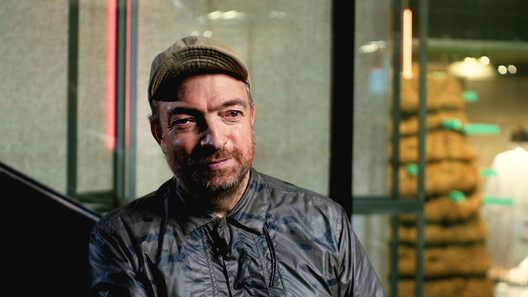
Australian artist, director, and BAFTA-nominated producer Liam Young creates imaginary worlds as a way of thinking through the futures we fear, desire, and are already making. As a creator and designer of atmospheres, he proposes speculative landscapes reflecting the possibilities of a world to come, whether ideal or truthfully unsettling. In his worldbuilding practice across the film, television, and video game industries, fiction becomes a tool for navigating the environmental urgencies of the present. He is considered a "futurist" working across design strategies, technological scenarios, and collective imaginations, grounded in his academic research yet reaching a wider audience in exhibitions such as "In Other Worlds" at the Barbican Centre in London and "Age of Nature" at the Danish Architecture Center in Copenhagen. In February 2026, he was interviewed by Marc-Christoph Wagner for Louisiana Channel, where he shares his visions of our future: from architecture consolidating as a boutique industry to the need for a new kind of planetary punk at the scale of the climate crisis.

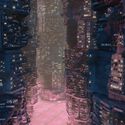

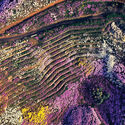
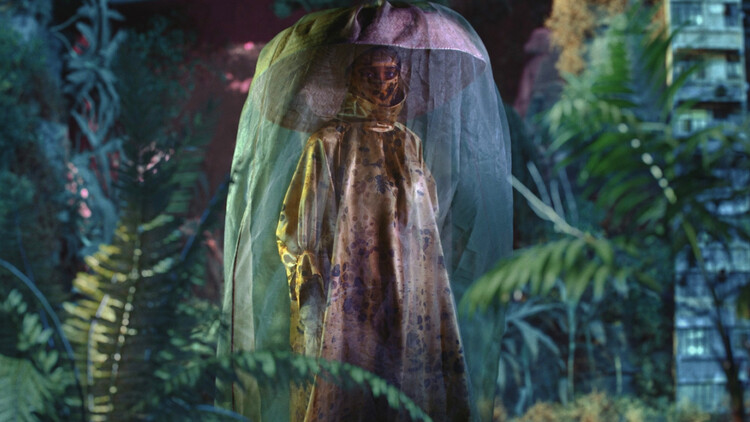
Young left architecture out of frustration with the gap between the breadth of the discipline and the narrowness of its traditional practice. Architecture, he argues, is uniquely positioned in the contemporary world because it inhabits the space between culture and technology. Yet that advantage is increasingly lost on a profession he describes as "an increasingly marginalized luxury and boutique industry available to only those with capital and power." The architect has been sidelined from its historic role in shaping cities and public life, displaced by forces that operate at a different speed and scale. Where built space once conditioned how people related to one another, platforms and networks now define public discourse, governed, as Young puts it, by "a dude in a hoodie and sneakers setting their own rules for public discourse, deciding what's allowed, what's not allowed, and what can be monetized." For the artist, this calls for a redefinition of architectural practice.
The idea of making trophies for despots, icons for the mega-rich, doesn't seem like the best use of a set of skills that are so valuable in the age of the polycrisis.
Related Article
"Nature is an Incredible Teacher": Jenny Sabin on the Fusion of the Digital, Biological and Physical in Louisiana Channel InterviewIn response to this contradiction, Young turns to film as a rehearsal space, a medium fast and fluid enough to test the futures that architecture, in its traditional slowness, cannot. At the heart of his practice is the conviction that imagined futures tend to become lived ones, and that the absence of shared, aspirational visions of collective life is itself a crisis. Where technology advances faster than culture can absorb it, fiction becomes a tool for getting ahead: a way to bring emerging realities into the imaginarium before they arrive unexamined. Science fiction, for him as creator, is less about prediction than about holding up a mirror to the present, exploring what technologies might mean at a human and planetary scale.
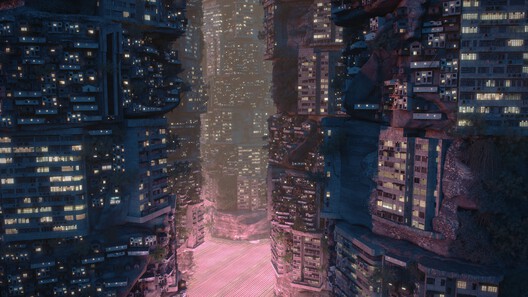
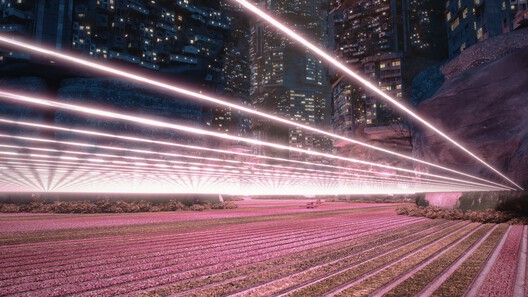
His films, therefore, draw on documentary fieldwork, traveling to the sources of extraction, waste, and energy systems that underpin the world's largest technological transformations, and translate them into what he calls "contingent landscapes." He designs speculative scenarios that can turn out to be unsettling due to their closeness to the present. The scale of the crises he engages with is deliberately planetary, reflecting a world in which nothing occurs at a single point on a map and no solution fits within the boundaries of a nation-state. What he calls for is a new cultural response to match that scale: a planetary punk adequate to the climate crisis. "The future ahead of us is a dark, shadowed, and unknown territory," he says, "and every story, every film, every narrative that we might construct or talk about that future through is like a tiny little torch beam illuminating a little sliver of that landscape ahead of us. And the more stories we tell, positive, negative, utopian, dystopian, the more of that landscape becomes illuminated."
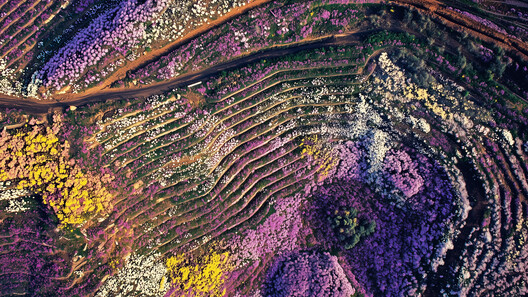
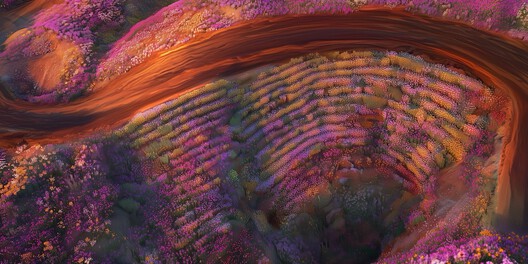
We desperately need a planetary scale form of action, but in popular culture, images of planetary change or projects that work at planetary scale are, for the most part, dystopian. They're the work of the Bond villain or the evil sci-fi mega corporation. So what I classify my work as is creating new planetary imaginaries, which is to say I'm trying to create a new aesthetic language for our future that is scaled to the planetary crisis that we call home.
Louisiana Channel is a series of video interviews on art, literature, architecture, design, and music produced by the Louisiana Museum of Modern Art. Among the latest interviews with architects are Japanese architect Tsuyoshi Tane on architecture as a discipline of observation and thought rooted in memory; Chinese architect Xu Tiantian on moving beyond starchitecture and questioning the common concept of beauty in buildings; and Chinese architect Zhu Pei on architectural practice as cultural and sensory exploration rather than purely technical production. Renowned architects such as Gabriela Carrillo, Søren Pihlmann, and Riken Yamamoto have also reflected on contemporary public space, the relationship between the building and its context, and material realities and reuse.


