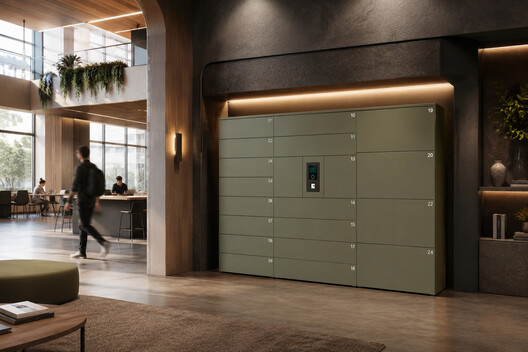
How can the most structured elements in architecture give rise to unplanned forms of everyday life? "Spontaneous order" describes how structured systems can generate unplanned but coherent patterns of behavior. In urban discourse, it is often used to describe cities: frameworks of streets, plots, and buildings that are designed, while everyday life is not. Movement, encounters, routines, and informal uses emerge from simple spatial rules rather than explicit programming. In cities, this is visible in how sidewalks, stations, and thresholds operate. The structure is fixed, but the social order is fluid, setting conditions for behavior rather than defining it.
A similar logic can be observed in architectural micro-infrastructures such as locker systems. Like cities, lockers rely on structured frameworks that do not prescribe how life unfolds within them. A locker system is highly controlled in architectural terms: repetitive modules, strict grids, standardized dimensions, controlled access. Yet once in use, it produces spontaneous behaviors. People pause in corridors, return at irregular times, linger near locker zones, or briefly interact with others doing the same. What appears to be a strictly infrastructural storage system begins to generate informal social and spatial behavior.
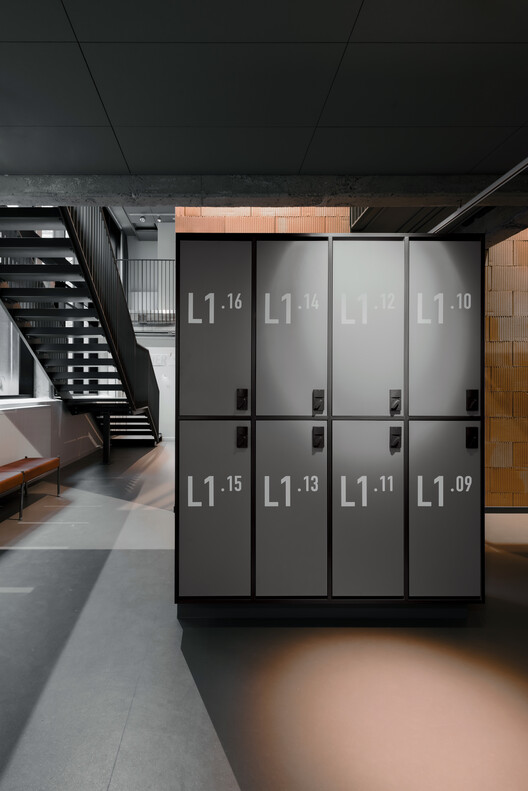
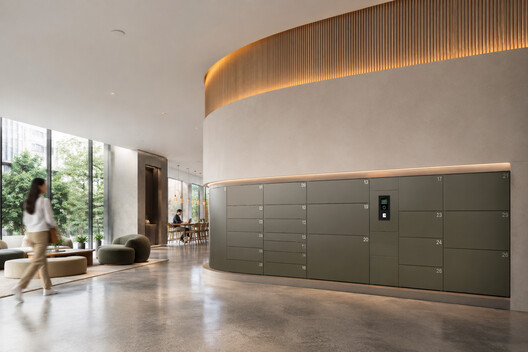
Lockers as Adaptive Infrastructure
Where once lockers were concealed in schools or gym changing rooms, they now appear in residential buildings, coworking spaces, universities, retail environments, transport hubs, and leisure facilities. Their expansion reflects a broader condition of access to modern work, life, and play, in which multiple activities unfold within a single day across different locations, and buildings operate as systems of circulation and exchange. In this sense, lockers function as small infrastructural points of mobility and temporary safe storage.
As a result, companies like Gantner and Salto provide the underlying infrastructure that enables these contemporary locker systems. These smart lock systems connect storage to broader building operations. They support movement through urban environments without requiring users to carry all belongings at once, a relevant condition in contexts defined by high mobility, shifting patterns of work, leisure, and transit, and a reduced reliance on the private car as a storage space.
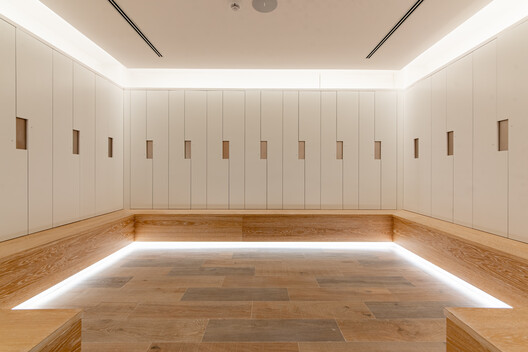
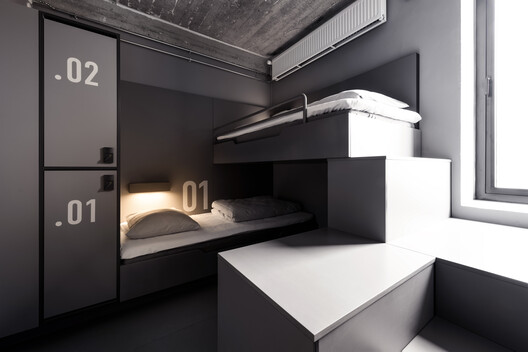
This logic becomes clearer in everyday spatial situations, particularly in environments defined by flexibility. At train stations, lockers allow travelers to move through cities unburdened by luggage. In gyms and swimming pools, they support seamless movement between changing, training, and social spaces. In coworking environments, they replace fixed desks as storage points for hybrid work models. In universities, they enable movement between studios, libraries, and lecture spaces. In retail and logistics environments, they operate as pickup and drop-off points that merge digital ordering with physical movement through the city.
Smart Locker Systems and Digital Access
At the same time, the technology behind lockers has evolved. Mechanical keys, coin systems, and fixed assignments are less suited to environments defined by fluid patterns of use. Smart locker systems, like those of Gantner and Salto, allow access to be dynamically assigned, monitored, and adjusted, integrating storage into broader building infrastructure.
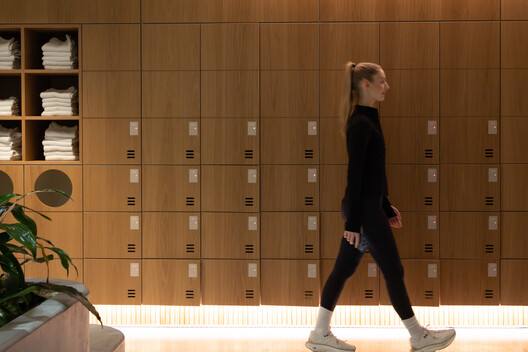
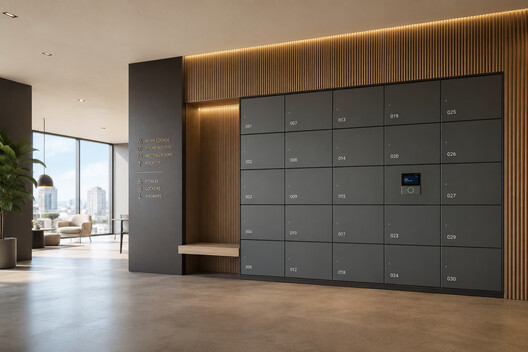
Networked systems enable electronic locking via RFID- and NFC-based access, combined with centralized software for authorization, monitoring, and usage control. These systems are particularly suited to large workplaces, universities, healthcare facilities, and transport environments, where access must be coordinated across multiple users, departments, or time schedules. In parallel, retrofit-oriented solutions enable battery-powered operation with RFID- and PIN-based entry, reducing the need for drilling, cabling, or other structural intervention. This makes them especially applicable within adaptive reuse projects or heritage buildings, where integrating new infrastructure into existing construction may be technically or spatially restrictive.
More integrated configurations support connections to central terminal infrastructure or third-party systems, allowing lockers to operate as part of wider building management and access-control networks. At the same time, concealed locking mechanisms and flush-mounted systems minimize their visual presence within architectural surfaces, making them suitable for environments that prioritize clean lines. Features such as wireless communication, event logging, and system status tracking further extend lockers beyond storage to become responsive infrastructural systems embedded in everyday spatial use. Across these variations, smart locker systems connect access control, identification, cashless payment, and digital management into a unified infrastructure.
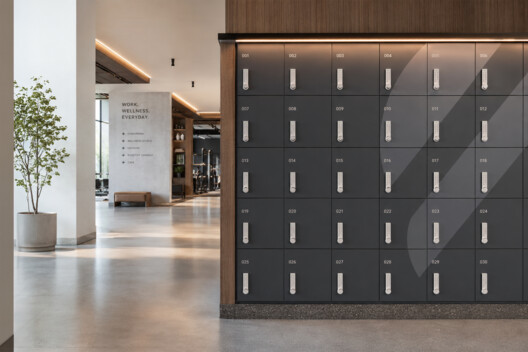
Across these settings, lockers support a shared condition: access replaces ownership. Buildings are not organized solely around the fixed possession of space, but also around temporary use and movement. As buildings outlast the behaviors for which they were originally designed, this adaptability becomes critical. Lockers, then, do not simply store objects. They reveal how architecture can support spontaneous order: structured systems that enable flexible, unplanned, and evolving forms of everyday life and a sense of safety within shared space.