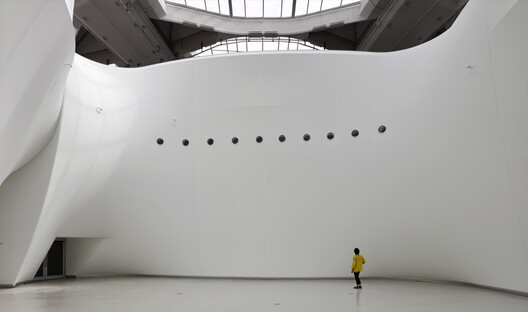
What can a textile do that glass, wood, concrete, or metal cannot? Architectural composite fabrics don't replace conventional building materials. Instead, they can complement them and often add another layer of performance to the building envelope. Their application changes with context. A composite membrane can become an exterior shading system for a tropical conservatory, an interior skin that shapes acoustics and spatial experience in a museum, or part of a facade strategy that improves the environmental performance of an existing building.
What happens when architecture is asked to create a room without boundaries? Convention halls, stadiums, factories, and logistics centers all begin with the same architectural challenge: creating large, uninterrupted interiors that can accommodate movement, visibility, and changing uses. The larger the span, the greater the structural demands, and the greater the architectural possibilities.
Long-span architecture is not a recent ambition. For centuries, architects have sought ways to enclose large public spaces, from the monumental dome of the Pantheon to the iron-and-glass halls of London's Crystal Palace. Each breakthrough expanded the possibilities of architecture, replacing thicker walls and denser structural systems with lighter, more efficient ways of spanning distance. Today, steel continues that evolution, making it possible to span distances that would be difficult to achieve with conventional structural systems while keeping large public spaces open, flexible, and adaptable. Steel's high strength-to-weight ratio makes longer spans possible with fewer columns and lighter structural systems, while prefabricated components simplify construction and reduce on-site work.
Videos
Dornbracht Atelier Edition The Knot in collaboration with AB Concept. Image Courtesy of Dornbracht
Symbols have always traveled through architecture. They appear in carved stone, woven textiles, painted ceilings and walls, door hardware, and everyday objects, carrying the beliefs, rituals, and histories of the cultures that first created them. Across contemporary interiors, designers continue this dialogue with place by revisiting historical symbols and translating them through new materials, manufacturing techniques, and architectural forms.
The Ruyi knot is one such example. For centuries, the interwoven motif has been part of the Chinese knotting tradition, symbolizing continuity, harmony, and good wishes. Its gently looping geometry has appeared across decorative objects and ceremonial crafts, demonstrating how cultural references can become part of a design vocabulary that extends far beyond ornament.
Di.Big pivot security door. Image Courtesy of Porte Blindate
What transforms a space of living into a home? Beyond ownership or shelter, a home is tied to a quieter sense of certainty: the feeling that one can retreat, rest, and momentarily step away from the world's unpredictability. Homes are where routines accumulate, memories settle into spaces and objects, and where personal identity takes physical form through occupation and everyday rituals. Yet this sense of belonging depends on another condition that often goes unnoticed until disrupted: security. To feel "at home" implies a condition of comfort and stability. When domestic environments fail to provide this, spaces designed for rest become sources of unease, subtly affecting routines and well-being.
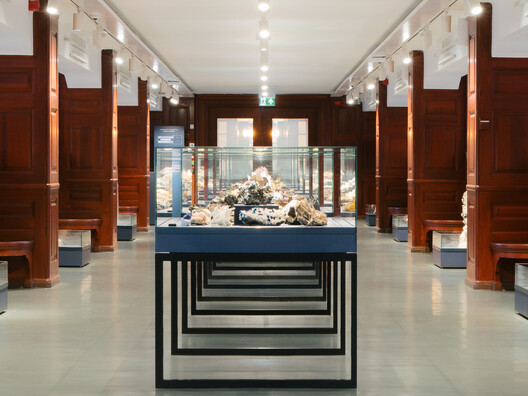
Designing a museum interior means negotiating between the needs of the collection and those of the visitor: objects must be protected and carefully displayed, while spaces need to remain accessible, legible, and engaging. Scale, circulation, security, lighting, structure, and technology all become part of the design, often working quietly in the background so that the exhibits remain the focus. So, how do you fit 4.5 billion years of Earth's history into a museum interior? The renovation of the Natural History Museum Oslo, home to one of the largest geological and anthropological exhibitions in the Nordic countries, offers a clear example of how these demands can come together within an existing architectural framework.
The ceiling is one of the largest continuous surfaces in a space, yet why is it rarely the first architectural element people notice? Often perceived as the plane that conceals structure and building services, it quietly recedes into the background while facades, materials, structural systems, and furniture define a building's architectural identity. Yet few architectural elements influence the experience of a space as consistently as this one. The ceiling shapes how sound travels, how light is reflected, how air moves through a room, and ultimately how architecture is experienced, bringing together technical performance and architectural expression through a single continuous surface.
Danish architectural theorist Steen Eiler Rasmussen observed in his book Experiencing Architecture that ceilings shape the character of a room through rhythm, proportion, light, and atmosphere. Rather than simply enclosing space, they help organize it, defining areas and guiding movement without the need for additional walls. As buildings became larger, more open, and more dependent on integrated building services, architecture began asking more of this overlooked surface. The ceiling gradually shifted from a concealed building component into an active architectural system in which acoustics, lighting, ventilation, thermal comfort, and technical infrastructure could converge on a single plane.
What defines the quality of a bathroom beyond its basic functions? As one of the most private spaces within the home, the bathroom is closely connected to everyday rituals and moments of pause. While fixtures, circulation, and technical requirements establish the practical foundation, the atmosphere emerges through a combination of spatial decisions: how furniture meets the floor or deliberately avoids it, how materials interact with light, how storage is integrated, and how form and proportion shape perception.
MTM—Made to Measure designed by Herzog & de Meuron for UniFor, Creative Direction by Studio Klass . Image Courtesy of UniFor
What allows a single architectural principle to generate many different outcomes? The answer lies in the systems that organize architecture: geometry, proportion, structure, and construction. Together, these can establish a set of rules that can accommodate different programs, contexts, and spatial conditions while maintaining a coherent identity. A structural grid, for example, can organize a variety of uses, just as a single construction detail can be repeated throughout an entire building without producing identical spaces. Can the same way of thinking be translated into furniture design without losing its identity? MTM—Made to Measure, developed by Herzog & de Meuron for UniFor, explores this question. Instead of designing each piece independently, the collection grows from a single structural principle that can be extended, adapted, and repeated across different functions while maintaining its internal coherence.
Architecture project information does not live only in CAD or BIM software. Design briefs, drawing PDFs, contracts, quotations, site reports, approval files, and project specifications are often the documents that teams open, revise, send, and confirm every day.
When these files are scattered across emails, chat tools, scanned copies, and different devices, version mistakes, approval delays, and missing information can easily happen. For architects and small studios, this not only slows down communication. It can also affect project accuracy, client trust, and delivery timelines.
Gokce Gemile Private Bay, Turkey. Image Courtesy of Gokce Gemile Private Bay
Coastal landscapes often determine far more than views. Steep slopes, fragmented rock formations, dense vegetation, hidden coves, and limited accessibility can shape how privacy, movement, and occupation unfold before architecture enters the site. Their proximity to water and climate make coastal territories highly desirable for habitation, yet their ecological sensitivity and limited geography often place pressure on how development takes shape. Unlike cities, where density can support walkability, infrastructure, and collective urban life, coastal territories operate through more fragile relationships between land, vegetation, and water.
Along many coastlines, development tends to prioritize visibility and proximity to the sea, organizing land through concentrated occupation and expanded circulation networks. Yet certain sites can guide another approach in which geography itself becomes the primary organizing force. How can architecture occupy a landscape without dissolving the qualities that make the site distinct? Located on a secluded peninsula along the Mediterranean coast of Turkey, Gokce Gemile Private Bay explores this question through a low-density architectural approach shaped by geography, controlled access, and spatial distance.
Sunlight House / HEIN-TROY Architects. Image Courtesy of VELUX
Can architecture shape comfort before mechanical systems enter the equation? As buildings account for nearly 40% of global energy consumption and people spend close to 90% of their time indoors, thermal performance has become one of architecture's most urgent concerns. Yet despite often being associated with insulation values, energy ratings, or mechanical systems, thermal performance begins with spatial decisions made long before technical equipment is introduced. Orientation, airflow, daylight, and the placement of openings all influence how a building absorbs, retains, and releases heat throughout the day.
Thermal performance is not only about reducing energy demand but also about maintaining comfortable indoor conditions in response to climate. Closely tied to thermal comfort—the way occupants experience temperature, airflow, humidity, and radiant heat—it influences health, well-being, and productivity as much as it does operational efficiency. Research suggests that healthy indoor environments can improve learning ability and productivity by up to 15%, reinforcing the growing relationship among environmental performance, resilience, and space quality.
Dornbracht's Coya series designed by Sieger Design. Image Courtesy of Dornbracht
When is a form still circular or rectangular? In twentieth-century modernism, this question was largely absent. Architecture was built on clarity, reduction, and formal purity. Influenced by architects such as Le Corbusier and Ludwig Mies van der Rohe, modernist design established a visual order based on rational geometry, industrial materials, and the rejection of ornament. Circle and square, function and expression, were kept strictly apart—a logic that dictated the rigid, modular layouts of traditional bathrooms for decades.
How can the most structured elements in architecture give rise to unplanned forms of everyday life? "Spontaneous order" describes how structured systems can generate unplanned but coherent patterns of behavior. In urban discourse, it is often used to describe cities: frameworks of streets, plots, and buildings that are designed, while everyday life is not. Movement, encounters, routines, and informal uses emerge from simple spatial rules rather than explicit programming. In cities, this is visible in how sidewalks, stations, and thresholds operate. The structure is fixed, but the social order is fluid, setting conditions for behavior rather than defining it.
A similar logic can be observed in architectural micro-infrastructures such as locker systems. Like cities, lockers rely on structured frameworks that do not prescribe how life unfolds within them. A locker system is highly controlled in architectural terms: repetitive modules, strict grids, standardized dimensions, controlled access. Yet once in use, it produces spontaneous behaviors. People pause in corridors, return at irregular times, linger near locker zones, or briefly interact with others doing the same. What appears to be a strictly infrastructural storage system begins to generate informal social and spatial behavior.
Fired clay has been used in construction for over 9,000 years, evolving from vernacular craft into one of the most widely applied materials in the built environment. Its durability, water resistance, thermal performance, and adaptability have made it a staple for facades, sanitaryware, flooring, architectural surfaces, and structural systems. Today, new manufacturing technologies are extending these possibilities as architects and manufacturers confront the environmental implications of material extraction and production.
What defines the atmosphere of a home? Beyond material palettes and natural light, sound plays a defining role in how spaces are perceived and inhabited. The reverberation of footsteps across stone, the muted calm of a textile-lined room, or the way music carries through an open-plan interior all shape the sensory identity of domestic space. Architecture is experienced not only visually, but acoustically.
The concept of the "soundscape" describes this relationship between people, sound, and the built environment. In residential architecture, sound is more than background noise or technical performance; it influences privacy, concentration, rest, and emotional comfort. Geometry and materiality act as the primary acoustic conductors: while concrete, glass, and stone reflect and amplify, timber and upholstery soften and absorb. Ceiling heights, circulation paths, and room proportions further shape how sound travels and settles across a space.
Waterway bathroom concept by Haihua Zhang and the bathroom collection AXOR Archivio by Barber Osgerby. Image Courtesy of AXOR
Water has always occupied a unique position in architecture: elemental yet elusive, functional yet symbolic. It is both a material and a medium that shapes cities, structures rituals, and influences how space is perceived. Across cultures, water is understood not only as a source of life but as a carrier of meaning, associated with purification, renewal, and continuity. Its presence in the built environment often extends beyond utility, becoming a device through which architecture engages the senses and constructs atmosphere.
Bolete Lounge BIO® by Andreu World x Patricia Urquiola. Image Courtesy of Andreu World
When walking into a large living space, a hotel lobby, or an open-plan workplace, the first thing that can be noticed is not what divides the space, but what holds it together. There are rarely clear boundaries, no obvious rooms, no strict partitions, yet the space still feels organized. Some areas invite a pause; others dictate movement; others foster community. The transitions are subtle, but legible.
At the same time, these interiors are expected to do more. They must accommodate constant change, withstand intensive use, and respond to environmental pressures by reducing waste, extending lifespans, and avoiding frequent replacement. The question is not only how a space looks, but how it performs over time. What is actually doing the heavy lifting?