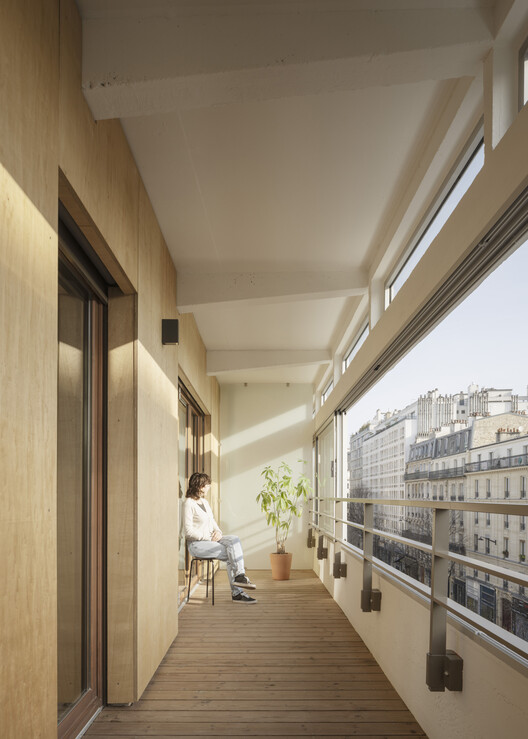
As cities struggle to provide adequate and affordable housing, examining built examples of collective housing can help inform decisions about what to build and how. These projects offer opportunities to assess solutions, understand their limitations, and consider what might be applied elsewhere. In Paris, two recent examples combine apartments of different sizes with access to gardens, courtyards, and other outdoor spaces, working with structures already in place.
Seaside House / Koistinen Hellborg Architects. Image Courtesy of Randers Tegl
Brick and wood can establish a dialogue between architectural permanence and the textures of coastal environments. In Höllviken, on the southern coast of Sweden, Seaside House by Koistinen Hellborg Architects explores how materiality, light, and spatial organization can shape a home in relationship with its natural surroundings. Located among sandy terrain, heathland, moss, and pine trees, and within walking distance of the sea, the house responds to a landscape defined by subtle color variations, seasonal changes, and a strong connection to the outdoors.
IFC Model / KUBUS360. Image Courtesy of Vectorworks
Building Information Modeling has made it possible to attach an enormous amount of information to each element of a design. A wall can carry its fire resistance class and its cost group, and later even the maintenance information a facility manager will need. That possibility creates a temptation: if the model can hold more data, it should. In the process, an important question of efficiency can get lost: does the project actually need this information, and does it need it now?
For architects, BIM is often described as a "single source of truth." Every additional property, however, adds work, coordination, and maintenance, and information entered too early or without a clear purpose can quickly become outdated. What matters is having the right information for the decisions being made at each stage of the project. The Stuttgart-based firm KUBUS360 made that question central to its work on an administrative complex in Baden-Württemberg (Germany).
Selecting a material during the design process involves more than defining an appearance. Its behavior in response to light, sound, touch, and the passage of time can transform how a space is perceived and used. At the same time, factors such as durability, strength, recyclability, and the environmental impact associated with its production introduce new variables into architectural decision-making. For Stephanie Forsythe and Todd MacAllen, cofounders of Vancouver-based design and production studio molo, these considerations have led to an exploration of paper and its potential to shape flexible, sensory spaces.
Architect: Tina Hočevar. Image Courtesy of VELUX Group
What happens to the space beneath a roof? In many houses, the answer is simple: it becomes an attic, a storage space, or a largely unused volume between the upper floor and the roof. Yet the same space can become a bedroom, home office, playroom, or additional living area if the roof and the room beneath it are considered together.
This potential matters in both existing buildings and residential architecture. Converting an attic can add usable space without extending the building's footprint, while designing a new house with a usable roof space in mind can make it more adaptable over time. The question is therefore not only how to convert an attic, but how to recognize the architectural potential of underused space created by a sloped roof.
Breidablikk Gården / Asplan Viak and Facade Cladding by SolarLab. Image Courtesy of SolarLab
Solar panels are often treated as equipment added to a building. What happens when they become part of the architecture itself? Once integrated into the envelope, photovoltaics can generate energy while also influencing the building's form, construction, and environmental performance.
Roofs are often the most obvious location for photovoltaic panels, yet other parts of the building can generate power while performing additional architectural functions. Facades can provide shading, louvers can control sunlight, and ventilated rainscreens can combine weather protection with energy generation. Their orientation, position, and integration into the building envelope therefore become part of the architectural design rather than a separate technical decision.
Laab Is More / Sifah Studio. Thailand. Image Courtesy of NS BlueScope
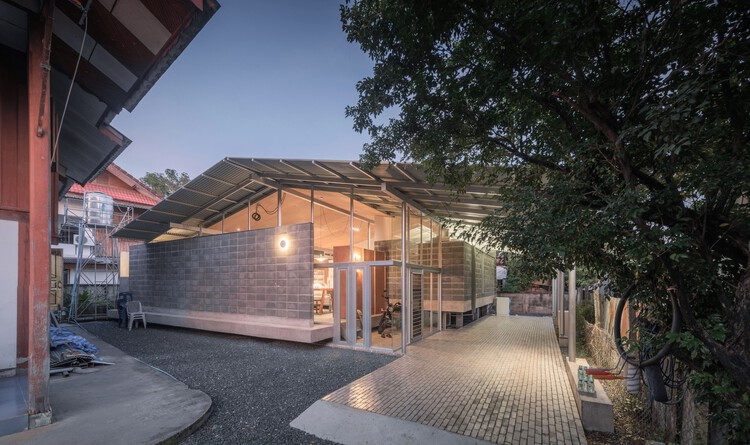
While architecture often responds to a specific program of uses, taking into account areas, contexts, and various economic and technical conditions, buildings rarely remain the same throughout their lifespan. Programs, spatial dynamics, and users' needs change, as do environmental, economic, and technological conditions, requiring interventions that were likely not anticipated at the beginning of a project. Steel structures make it possible to envision architecture capable of growing, transforming, being disassembled, and reassembled. Their dimensional precision, industrialized components, and potential for mechanical connections enable the design of open systems prepared for future interventions.
Beijing Taikang Yanyuan Health & Wellness Center. Image Courtesy of Serge Ferrari
In the story of the Three Little Pigs, the choice of material determines the fate of each house. The wolf's breath brings down the structures made of straw and wood, while the brick house remains standing. The moral is that the more solid the construction, the greater its ability to resist. A building, however, has to respond to much less straightforward questions. Remaining standing is still essential, but heat, light, air, and sound are not forces that necessarily need to be blocked. Sometimes sunlight needs to be kept out; at other times, daylight needs to be let in. Retaining heat may be desirable in winter and counterproductive in summer. Air needs to circulate, sound may need to be absorbed, and the conditions that determine these responses change throughout the day, across seasons, and over the life of the building itself. More material does not necessarily mean better performance. In some cases, it can simply add complexity without improving how the building responds.
Videos
Smart Ergonomic Chair HBADA X7. Image Courtesy of HBADA
The office chair has evolved alongside changing workplaces over time. In each office era, the chair has reflected the way people work. Early office seating was built for clerical work: fixed wooden chairs arranged in rows across large administrative offices, where paperwork followed standardized routines. By the 1980s, computers began changing how people occupied a desk, and office furniture followed. Designers approached seating through ergonomics and biomechanics, refining adjustable height, lumbar support, synchronized recline, and the relationship between the body and the workstation. Later designers combined ergonomic research with new materials such as breathable suspension mesh instead of conventional foam upholstery.
Unlike buildings, which are anchored to foundations and respond to climate from a fixed position, yachts are designed for constant movement and change. Interiors sway with the vessel, light changes by the minute, humidity is a permanent design condition, and every kilogram influences performance. Designing for the sea therefore requires architects, naval architects, engineers, and interior designers to solve questions that rarely exist on land: how can space remain calm while everything around it is in motion?
Despite being among architecture's oldest structural forms, domes continue to offer possibilities for creating large, column-free spaces and working with circular or free-form geometries beyond conventional rectangular building types. Their evolution has been closely tied to changes in materials, construction methods, and design tools. Today, digital platforms are adding another layer to this process, allowing some of the decisions traditionally developed later in a project to be explored much earlier.
Masonry is often perceived through its weight, depth, texture, and sense of permanence. Yet these physical qualities also have several implications for the performance of a building envelope. From the thickness of the mortar joint to the weight of the material, every masonry decision is connected to considerations of durability, stability, and long-term performance, while preserving the material character associated with solidity and permanence.At Summer Street Apartments, thin brick offered a way to retain these qualities while accommodating the insulation and envelope requirements of an all-electric, net-zero energy building. Just as importantly, it helped give the project the residential character the architects were looking for.
What can a textile do that glass, wood, concrete, or metal cannot? Architectural composite fabrics don't replace conventional building materials. Instead, they can complement them and often add another layer of performance to the building envelope. Their application changes with context. A composite membrane can become an exterior shading system for a tropical conservatory, an interior skin that shapes acoustics and spatial experience in a museum, or part of a facade strategy that improves the environmental performance of an existing building.
What happens when architecture is asked to create a room without boundaries? Convention halls, stadiums, factories, and logistics centers all begin with the same architectural challenge: creating large, uninterrupted interiors that can accommodate movement, visibility, and changing uses. The larger the span, the greater the structural demands, and the greater the architectural possibilities.
Long-span architecture is not a recent ambition. For centuries, architects have sought ways to enclose large public spaces, from the monumental dome of the Pantheon to the iron-and-glass halls of London's Crystal Palace. Each breakthrough expanded the possibilities of architecture, replacing thicker walls and denser structural systems with lighter, more efficient ways of spanning distance. Today, steel continues that evolution, making it possible to span distances that would be difficult to achieve with conventional structural systems while keeping large public spaces open, flexible, and adaptable. Steel's high strength-to-weight ratio makes longer spans possible with fewer columns and lighter structural systems, while prefabricated components simplify construction and reduce on-site work.
Videos
Dornbracht Atelier Edition The Knot in collaboration with AB Concept. Image Courtesy of Dornbracht
Symbols have always traveled through architecture. They appear in carved stone, woven textiles, painted ceilings and walls, door hardware, and everyday objects, carrying the beliefs, rituals, and histories of the cultures that first created them. Across contemporary interiors, designers continue this dialogue with place by revisiting historical symbols and translating them through new materials, manufacturing techniques, and architectural forms.
The Ruyi knot is one such example. For centuries, the interwoven motif has been part of the Chinese knotting tradition, symbolizing continuity, harmony, and good wishes. Its gently looping geometry has appeared across decorative objects and ceremonial crafts, demonstrating how cultural references can become part of a design vocabulary that extends far beyond ornament.
Di.Big pivot security door. Image Courtesy of Porte Blindate
What transforms a space of living into a home? Beyond ownership or shelter, a home is tied to a quieter sense of certainty: the feeling that one can retreat, rest, and momentarily step away from the world's unpredictability. Homes are where routines accumulate, memories settle into spaces and objects, and where personal identity takes physical form through occupation and everyday rituals. Yet this sense of belonging depends on another condition that often goes unnoticed until disrupted: security. To feel "at home" implies a condition of comfort and stability. When domestic environments fail to provide this, spaces designed for rest become sources of unease, subtly affecting routines and well-being.
The original promise of BIM (Building Information Modeling) went far beyond the three-dimensional representation of a building. Its ambition was to turn the model into a coordinated information structure, in which geometry, components, systems, and data remained connected as the project evolved. Changes to one element could be reflected across corresponding plans, sections, elevations, and quantities; clashes between different disciplines could be identified before construction; and information associated with building components could follow the project through different stages of its life cycle.
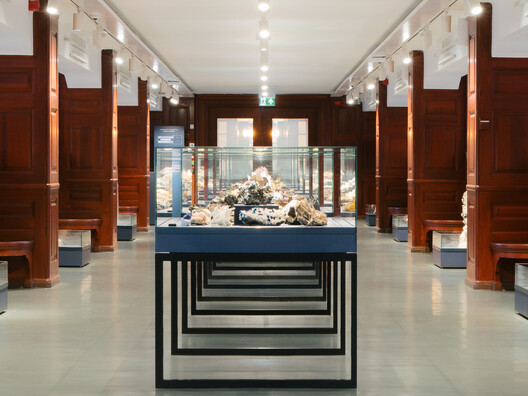
Designing a museum interior means negotiating between the needs of the collection and those of the visitor: objects must be protected and carefully displayed, while spaces need to remain accessible, legible, and engaging. Scale, circulation, security, lighting, structure, and technology all become part of the design, often working quietly in the background so that the exhibits remain the focus. So, how do you fit 4.5 billion years of Earth's history into a museum interior? The renovation of the Natural History Museum Oslo, home to one of the largest geological and anthropological exhibitions in the Nordic countries, offers a clear example of how these demands can come together within an existing architectural framework.