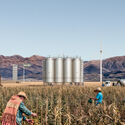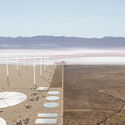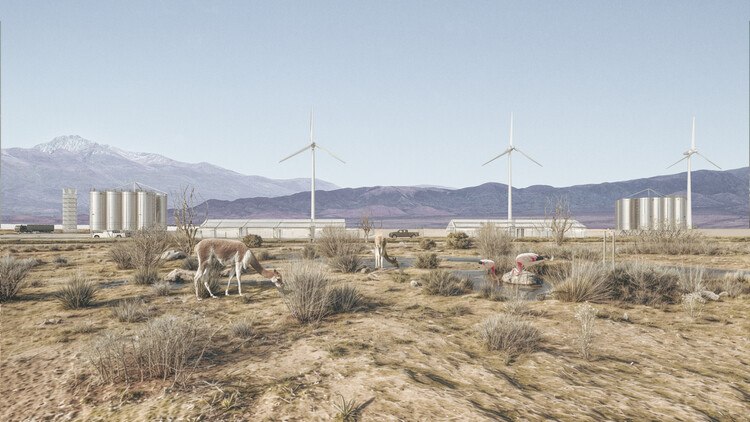
When people think of Argentina, they often picture landmarks like the Obelisk of Buenos Aires. Yet the country spans over 2,780,400 km², making it one of the largest in South America and home to a wide range of landscapes and realities that frequently go unnoticed. In fact, the province of Jujuy in northern Argentina lies within the Lithium Triangle: a high-altitude region shared with Bolivia and Chile that contains roughly 54% of the world's lithium reserves. Within this territory sits the Olaroz Salt Flat, a site where today two competing dynamics converge: the expansion of industrial lithium extraction and the preservation of ancestral culture and lands inhabited by Kolla and Atacama communities, creating a clash of high-capacity industrial extraction and traditional, low-impact agrarian practices.
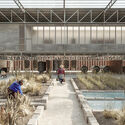
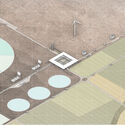
In light of this problem, one of the winning teams of the ArchDaily Student Project Awards, made up of Ezequiel Lopez, Maria Victoria Echegaray, and Agustina Durandez, decided to look into the issue. This was done as part of their thesis project for the Bachelor's in Architecture program at the National University of Córdoba. Their work stems from an interest in engaging with territories that remain peripheral to architectural discourse, using the thesis as an opportunity for sustained, in-depth research. This allowed them to formulate informed design responses grounded in both territorial and socio-economic realities. Rejecting the binary between extraction and preservation, the project approaches the territory as a system where both can coexist through spatial and technical mediation.