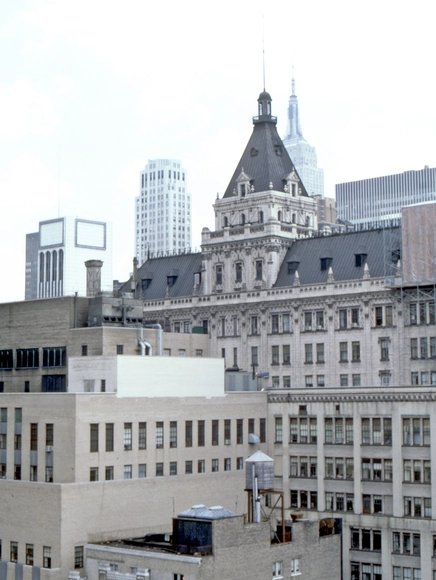
This file is licensed under the Creative Commons Attribution-Share Alike 3.0 Unported license.The New York Times Building, 1984. Image via Wikimedia
The hosts and producers of the Uncertain Things podcast, Adaam James Levin-Areddy, and Vanessa M. Quirk, conduct interviews with experts with a variety of experiences to answer the question, “Now what? How did we get here and what is next?”. In this episode with Michael Kimmelman, they touch upon many interesting subjects, namely, The New York Times institution and its evolution, Kimmelman’s new book the Intimate City, and our overall understanding of communities in cities.
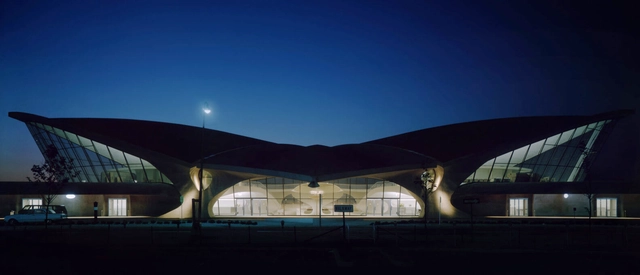
Writer Eva Hagberg and I have known each other for a long time. Way back, in a year I can’t remember, I assigned her one of her first magazine assignments. Literally, dozens of other assignments followed. So it was with some anticipation, and a bit of surprise, that I received her new book When Eero Met His Match: Aline Louchheim Saarinen and the Making of an Architect (Princeton University Press), an intriguing hybrid text, one-part Aline and Eero biography, one part memoir of Hagberg’s experiences as a design writer and publicist. (I am briefly mentioned in the book.) The book’s main argument is that Aline Saarinen largely invented the role of the architectural publicist. Recently I traveled out to the Brooklyn Navy Yard to talk to a very pregnant Eva about the impetus for her new book, its dual structure, and the journalistic ethics of Aline Saarinen.
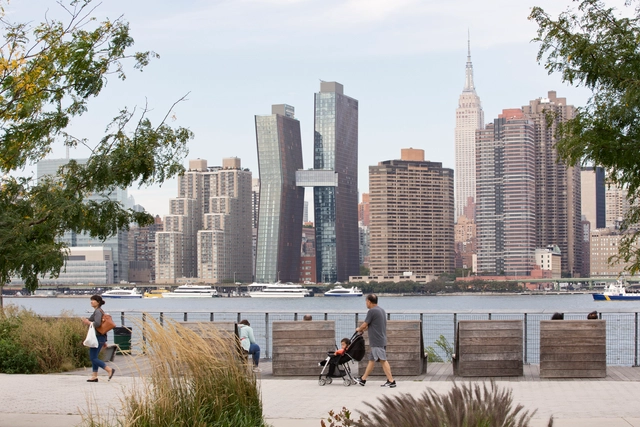
American Copper Buildings. Image Courtesy of SHoP Architects
The first and only formal architecture union in the American private sector was just formed by Bernheimer Architecture's employees after two years of the union campaign. The Union aims to reframe the discipline and profession and create an established sector of better labor rights standards and work conditions. The BA Union will be associated with the International Association of Machinists and Aerospace Workers to reshape the industry at a large scale and work on Industrywide problems like long hours and low pay.
The early stages of practicing architecture are often met with what many explain as "the slippery slope of being an architect", where expectations do not at all meet reality of the profession and gets worse as the experience progresses. With constant burnouts as a result of working overtime and on weekends on the account of “gaining experience”, extraordinary expectations, low wages, and physical and mental strains, the prestige of being an architect has evidently vanished with modern-day work conditions. So how can architects fight for their labor rights after years of exploitation and what is currently being done to ensure them?
Since its founding in 1851, The New York Times has published thousands of obituaries listing the lives and legacies of some of the world’s most influential people. However, by their own admission, the listings have historically been dominated by white men. In order to address this, The Times launched its “Overlooked” series in 2018, telling the stories of women such as Sylvia Plath and Emma Gatewood.
In a recent article in the New York Times, writer Allison Arieff poses the echoed question that the architectural community keeps asking itself, "Where are all the female architects?" No longer an issue of uneven gender ratios in architectural schooling, the persistence of dwindling numbers of women principals at the top of firms simply does not resonate. She postulates, that perhaps more significant than the statistics, the real problem lies in the definition of success.
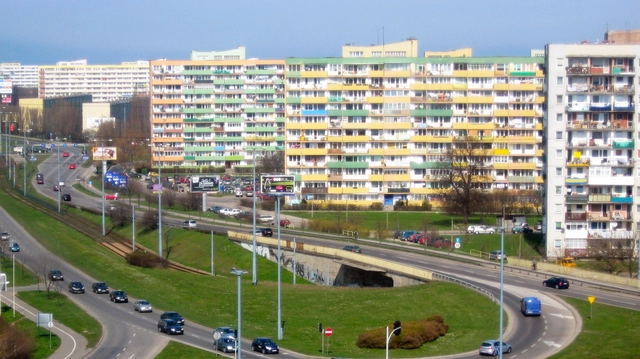
To strip a city of its architecture is to erase its history altogether. Despite a widespread public distaste for Brutalism, the brutalist era in architecture often went hand in hand with political movements promising an egalitarian vision in post-Stalinist Poland. What may now be considered austere and overbearing was originally intended to be anything but; the buildings today carry both an appreciation for their legacy and the burden of unwanted memories.
In a recent article in the New York Times, writer Akash Kapur documents his visit to Poland, bringing readers into his experiences and observations of this complex response to Polish architecture. From sharing its history to short anecdotes from interviews, the piece postulates whether these relics can become alive again.
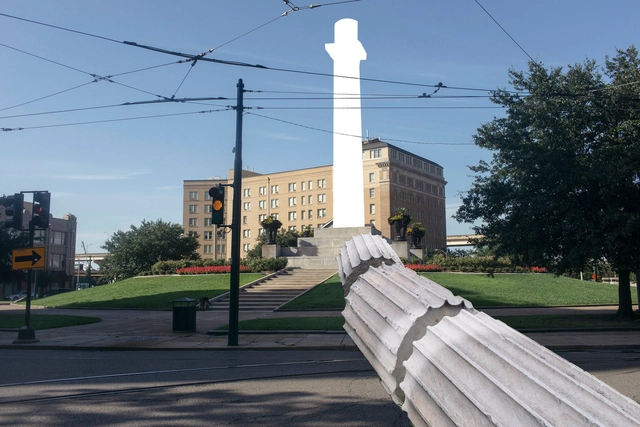
Image via The New York Times. Artwork by Dread Scott; Photograph by Annie Flanagan for The New York Times
In response to the question of how the United States should treat the monuments to Civil War Confederate figures which are dotted throughout the country, The New York Times commissioned six artists to re-imagine what could replace the controversial statues.
The issue of Confederate statues, which many regard as a glorification of those who fought to preserve slavery, has been brought into sharp public focus as of late due to the white nationalist rally in Charlottesville, Virginia in 2017 which resulted in the killing of counter-protester Heather Heyer.
https://www.archdaily.com/900498/six-artistic-visons-for-replacing-confederate-monumentsNiall Patrick Walsh
Willow Village will form part of Facebook's OMA-designed Willow Campus. Image Courtesy of OMA
“Do people love tech companies so much that they would live inside them?” This is the question posed by The New York Times in an article reflecting on Facebook’s plans for Willow Village, a 59-acre urban district located at the company’s Menlo Park headquarters in San Francisco, California.
https://www.archdaily.com/891145/zucktown-usa-will-facebook-design-your-future-cityNiall Patrick Walsh
As part of their "Daily 360," The New York Times has released a series of immersive videos exploring the New Seven Wonders of the World, offering viewers the experience of visiting the architectural marvels themselves without having to fly 5000 miles. Back in 2007, the seven monuments were announced after a seven-year poll that included votes by 100 million people who recognized the structural and innovative significance of these masterpieces across the planet.
The Daily 360 is a collection of videos by The New York Times; rather than a 2d moving image, they give a real understanding of space, transporting you to the place. Over the last year, their videos have included the Guggenheim, Art Deco masterpieces and memorial architecture from different cultures. Experience the New Seven Wonders of the World for yourself below:
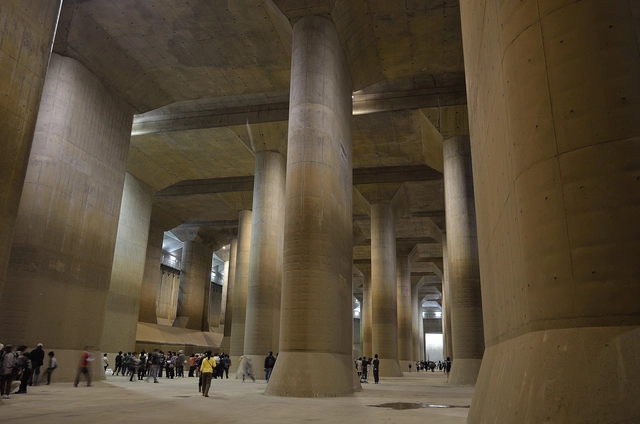
Rising sea levels, and the potential of extreme conditions globally, are threatening coastal cities around the world. While the Netherlands are often considered to be leading the engineering battle against the tides, Japan—with a renewed sense of urgency—are investing heavily in high-end systems and infrastructure to protect their largest metropoli.
https://www.archdaily.com/881308/doubts-loom-over-japans-vast-subterranean-water-control-systemsAD Editorial Team
Two large-scale US cultural projects have, this week, announced major updates relating to the renovation of existing buildings – and both involve, to a greater and lesser extent, American business magnate, media mogul, and philanthropist David Geffen.
Videos
Ali Alamedy's miniature worlds. Image via The New York Times
Although trained as a Control and Computer Engineer,Ali Alamedy has since turned his hand to manufacturing scaled, miniature dioramas. After being forced to leave his home in Iraq, he and his family are now based in Turkey – and it is here that he has honed a skill in constructing these tiny, intricate worlds from a broad range of ordinary materials. All scaled at 1:12, these complex and often hyper-realistic models are inspired by the environments around him, complemented by his experiences and, of course, his imagination. In this study of Alamedy's work, ArchDaily asks: how do you do it?
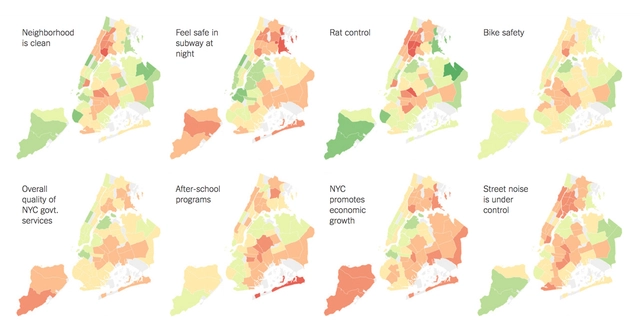
How satisfied are you with your city’s garbage service? Its parks? The way it handles pest control? What about homelessness? In the USA’s largest metropolis, which covers a total of 468.484 square miles (1,213.37 km2) and is home to over 8.5 million people, New Yorkers’ perception of their city and the services it provides reveals the “uneven distribution of New York’s opportunities,” according to a survey conducted by The New York Times.
The project also shows relative accord and satisfaction with fire and emergency medical services and agreement that use of tax dollars, public housing and traffic can be improved.
With 360 camera technology, the ability to transport people into a space through film has become all the more immersive. Viewers are able to turn the viewport in every direction to see the whole scene, or even to put on a headset for a more natural way of viewing a scene. Of course, this has important implications for viewing architecture, which many believe has become too image based, and therefore two-dimensional. 360 videos leave no corners conveniently hidden, as a traditional video or image would, perhaps providing a fuller picture of a place - could this perhaps open up a more human-scale understanding of space?
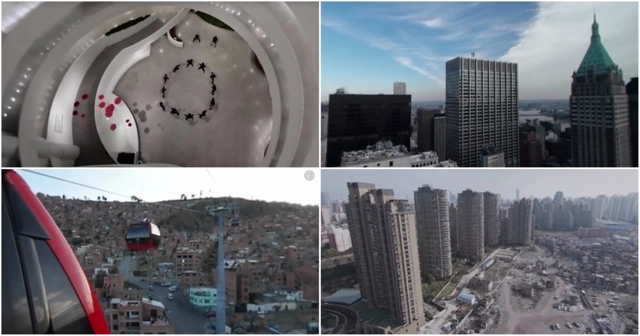
The New York Times have treated their Facebook followers to some great architectural insights through their Daily 360, getting more than their money’s worth out of their 360 camera equipment. Some of these must-see videos include a dance rehearsal taking place in the Guggenheim Museum’s rotunda, as well as an aerial view of La Paz, Bolivia. Read on to take a peek into the richness of earth’s urban spaces:
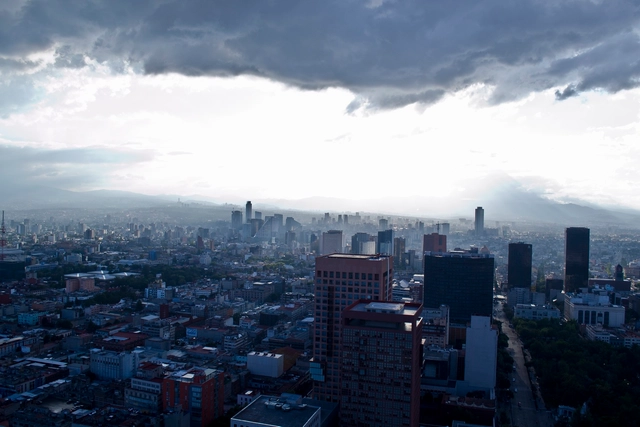
Contrary to some beliefs, climate change is not simply some unidentifiable threat perpetually on the horizon, but a phenomenon that has already had real impact on real world places. To illustrate the effects of our changing environment, the New York Times has launched a new multi-media series called “Changing Climate, Changing Cities,” written by architecture critic Michael Kimmelman, that aims to expose how climate change is “challenging the world’s urban centers.
The first installment takes a look Mexico City, where environmental issues that have already wreaked havoc for centuries, such as water shortage and ground subsidence, are beginning to see their effects multiplied by the city’s changing climate. The piece explains the root of these problems, and their effect of an already fragile infrastructure and social fabric.
This week's issue of The New York Times Magazine, the special New York issue with a theme of “New York Above 800 Feet,” takes a rather irreverent approach to the magazine’s design. Instead of being viewed in the traditional horizontal orientation, the periodical has been rotated 90 degrees and is meant to be viewed by turning the pages up. The long dimension, which is only 10.875 inches horizontally, becomes 17.875 inches vertically, and according to the magazine’s editor, Jake Silverstein, “‘[It] remains absurdly short for our subject, but it is in keeping with the striving spirit that has given New York City its distinctive skyline: This is as tall as it is possible for our magazine to be."