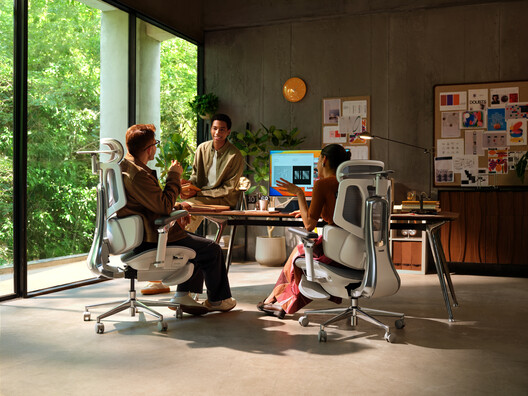
The office chair has evolved alongside changing workplaces over time. In each office era, the chair has reflected the way people work. Early office seating was built for clerical work: fixed wooden chairs arranged in rows across large administrative offices, where paperwork followed standardized routines. By the 1980s, computers began changing how people occupied a desk, and office furniture followed. Designers approached seating through ergonomics and biomechanics, refining adjustable height, lumbar support, synchronized recline, and the relationship between the body and the workstation. Later designers combined ergonomic research with new materials such as breathable suspension mesh instead of conventional foam upholstery.
The chair's evolution has never been driven by comfort alone. It has reflected broader transformations in workplace design, from corporate cubicles and open-plan offices to shared studios, co-working spaces, and home offices where one room often accommodates several activities throughout the day. Now, writing, drawing, video calls, reading, editing, and short breaks often happen without leaving the chair. This has also expanded what "ergonomic" means in office chairs. Instead of designing around one ideal sitting position, contemporary office seating reflects the reality that people rarely stay in a single posture for hours at a time.
The Office Chair as Part of the Intelligent Workplace
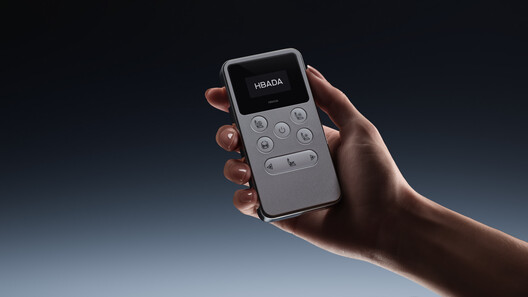
Many defining innovations in office seating have been immediately recognizable. Casters introduced mobility across the workspace. Gas lifts allowed chairs to adapt to different desk heights. Mesh backrests reduced heat buildup while creating lighter visual profiles that suited contemporary office interiors. Adjustable armrests and seat sliders made personalization a standard expectation. For the newest generation of office chairs, however, the biggest changes are happening inside the object. This raises a different design question: What does artificial intelligence look like when it disappears into furniture? One recent example is the HBADA X7 Smart Ergonomic Chair, which, according to HBADA, combines sensors, a control chip, and a motorized lumbar mechanism to reposition support as sitting posture changes.
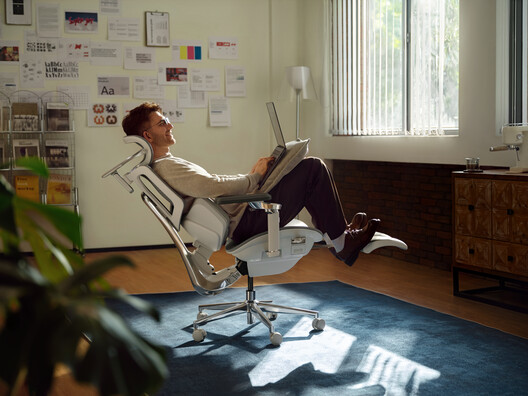
This follows a broader pattern across architecture and product design. Buildings conceal ventilation systems behind ceilings, integrate lighting into architectural details, and embed sensors that regulate temperature, daylight, or occupancy without becoming visible features. Technology has gradually become part of the building's infrastructure instead of something users constantly interact with. Furniture is beginning to follow the same path of concealment. Embedded sensors, processors, and motorized mechanisms can reduce the need for repeated manual adjustments, while controls remain available for individual preferences.
At the center of this system is a three-zone lumbar structure. Central and lateral support areas work together to support the lower back. The motorized mechanism adjusts the lumbar support forward and backward, while its height can be set manually. The approach is intended to maintain continuous contact with the lower back as the user changes position. Many conventional ergonomic chairs rely on manual adjustments, sometimes alongside passive mechanisms that respond to movement. Users decide where lumbar support sits, how much resistance the recline should have, or how deep the seat should be. Responsive seating keeps those adjustment points but adds systems that can react while someone is sitting and moving.
Designing for a Workday That Does Not Stay Still
One principle has remained consistent throughout the evolution of office seating: no chair eliminates the effects of prolonged sitting. Research over the past decade has shown that long, uninterrupted periods of sitting are associated with a range of health risks. Yet sitting remains an unavoidable part of many forms of office work, making ergonomics an important part of workplace design that supports comfort and alignment throughout the day. While architects and workplace designers incorporate sit-to-stand workstations, circulation, and flexible layouts to encourage movement, seating is also evolving to better accommodate the postural changes that happen while people remain at their desks. Responsive seating does not replace movement; it supports it.
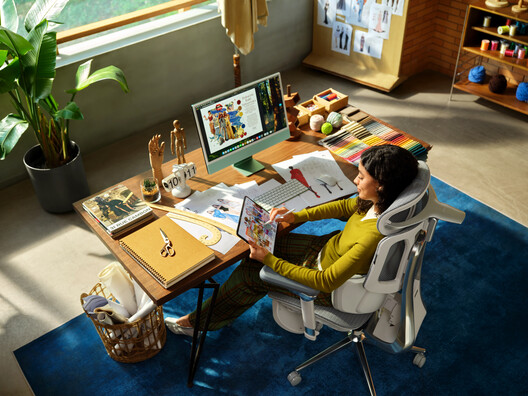
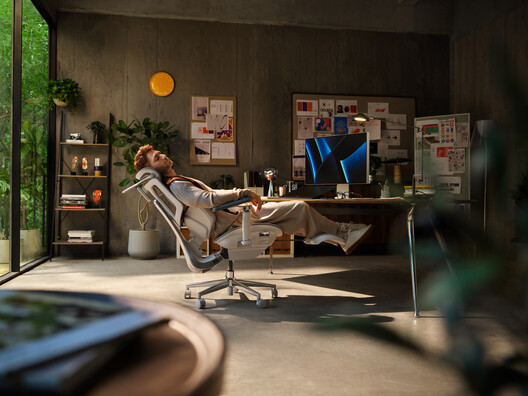
Systems such as the HBADA X7 Smart Ergonomic Chair are designed around the reality that people lean forward to type, turn toward colleagues, recline to read, or shift their weight repeatedly over the course of a day. The X7 combines automatic lumbar tracking with manual adjustments beyond the lower back. Its 4D bi-axial headrest can be repositioned to accommodate different head and neck angles, while its 720° multi-directional armrests support changes in how hands and arms are positioned during keyboard, tablet, or phone use. The seat depth adjusts from approximately 15.94"/40.5 to 17.91"/45.5 cm, while the seat height ranges from approximately 17.52"/44.5 to 20.87"/53 cm. A 140-degree recline further expands the range of positions available within the same chair.
Comfort Beyond Ergonomics
Material innovation has played a significant role throughout the history of office chairs. When mesh was first introduced in office chair design, it was not only an aesthetic choice but a breathable structural material that distributed pressure while allowing airflow around the body. That combination of material performance and visual lightness influenced an entire generation of office furniture.
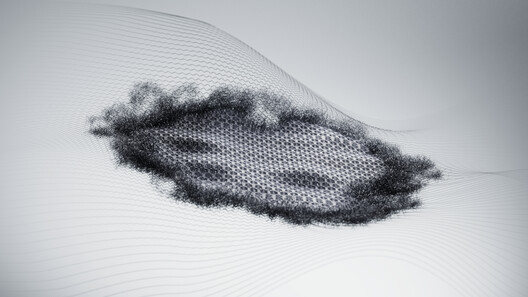
More recent seating systems such as the HBADA X7 Smart Ergonomic Chair explore additional forms of comfort through integrated ventilation or temperature management. The chair incorporates dual fans with three ventilation levels beneath the seating surface, alongside adaptive lumbar support, an 8D bionic massage system, and graphene heating.
The office chair has evolved through mechanics, ergonomics, materials, and now embedded technology. Earlier generations made innovation visible through springs, levers, wheels, or mesh construction. Contemporary seating hides much of that complexity within sensors, processors, and automated mechanisms. Human-centered, responsive seating complements workplaces already designed around flexibility, movement, and multiple modes of work, while reflecting a broader design direction in which technology becomes less visible and more integrated into the objects that shape their environments.
Learn more about the HBADA X7 Smart Ergonomic Chair and its responsive seating features here, and use the code archdaily at checkout for an exclusive discount.