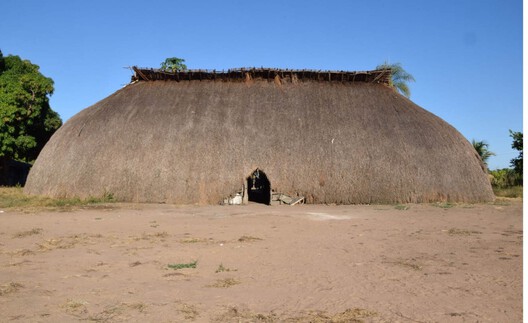
Anyone expecting the following words to offer a discourse on materiality, sustainable building techniques, ways of carving wood, or methods of weaving straw is mistaken. Instead, this article seeks to shift our gaze beyond the aspects that frequently define the debate on Indigenous peoples' culture when it comes to "architecture."
In a worldview where the very term "architecture" is foreign, approaching their structures—if indeed that word can adequately name them—from an exclusively material or technological standpoint remains an attempt to frame their ways of producing space within Western categories. This reduces a complex cosmology to a set of measurable attributes, as if it could be transformed into a checklist applicable to any architecture, thereby erasing the very thing that distinguishes it: the relationships between territory, body, and memory.
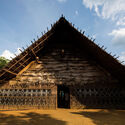
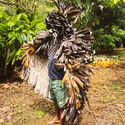
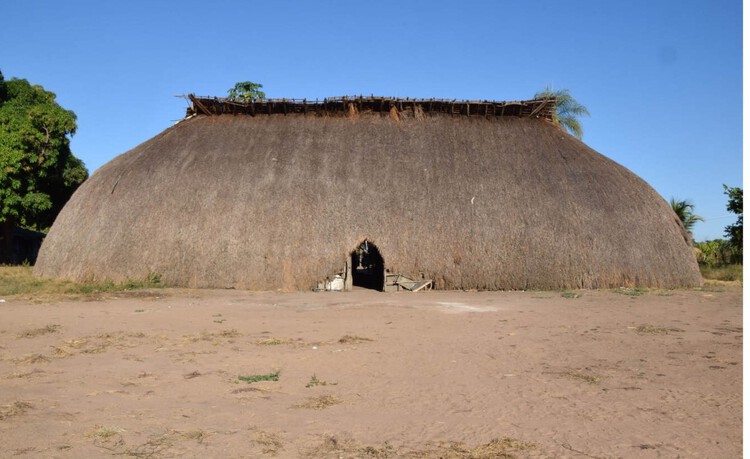
The central premise of this article, therefore, is grounded in the understanding that among many Indigenous peoples, the built space emerges, first and foremost, from a cosmological dimension. Materiality is not its organizing principle, but rather the expression of a way of inhabiting the universe in which space is inseparable from the relationships that give it meaning.
According to Davi Kopenawa, this cosmology is grounded in a web of reciprocity between humans, animals, plants, rivers, mountains, and spirits, where all share agency and belong to the same fabric of existence. In contrast, Western tradition tends to separate humanity from nature, reducing the latter to a resource available for exploitation. It is precisely from this divergence that distinct ways of occupying and giving meaning to space emerge.
"Architecture" in the Cosmovision of Indigenous Peoples
Examining the dwellings of Indigenous peoples through the classic lens of architecture means running up against a semantic and ontological barrier. In Western tradition, architecture presupposes a division between subject and object, culture and nature, alongside the figure of an architect-author who designs for a utilitarian purpose. For many Indigenous peoples, built space eludes this division. In several languages, the Western notion of "house" or "building" does not even exist in the same way; instead, it is an extension of social organization, the forest, and kinship relations.
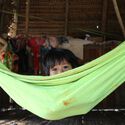
Take the perspective of the Yanomami, one of the largest relatively isolated Indigenous peoples in South America, where architecture cannot be reduced to a fixed structure or a simple shelter. Thiago Benucci defines it as "the place where hammocks are hung," a space situated in time and territory, relational in nature, continuously ephemeral and shifting, guided by a logic of minimal environmental impact.
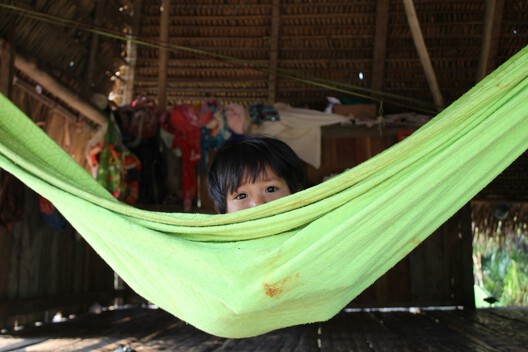
As the author demonstrates, inhabiting means being part of the urihi, the forest-land, understood not merely as a physical space, but as a web of pathways, memories, and relationships forged across generations. The inhabited place corresponds to the point where the hammock is momentarily "hung," connecting the present to the journeys of ancestors. Thus, Yanomami architecture must be understood less as the construction of permanent objects and more as the temporary materialization of relationships between people and territory. This argument was also put forward by Carsten and Hugh-Jones when discussing the peoples of the Guianas (1995), and cited by Benucci:
There are no inherited ancestral possessions and no lasting social unit that outlives the leaders who build the houses with which communities identify. The only permanent houses are the mountains, the abodes of invisible spirits; human settlements are but transient evidence of these permanent houses. – Carsten and Hugh-Jones
The Same Earth That Heals, Builds
Within this materialization, temporary as it may sometimes be, there lies a complex web of relationships with materials and techniques that go far beyond their "architectural" characteristics. At the beginning of the article "Construir uma outra aldeia" [Building Another Village], Daniela Alarcon recounts hearing from a Tupinambá woman—a member of an important coastal Brazilian Indigenous group—that if someone is bitten by a vine snake, their only chance of survival is to run to an anthill and eat three clods of earth. This Tupinambá prescription is part of a set of healing practices based on earth combined with other ingredients. "The earth that the ant kicks up, that is the medicine; they don't do that [turn the soil] for nothing."
This earth, therefore, goes far beyond its status as mere matter or resource. Present in medicinal knowledge, it reappears in floors and walls, making it impossible to categorize simply as raw material. What modern perspectives typically segregate into categories like materiality, culture, and belief manifests here as inseparable dimensions of a single existence. Building and healing are not distinct practices, but rather different ways of relating to the earth, recognizing in it a presence that sustains daily life across different spheres.
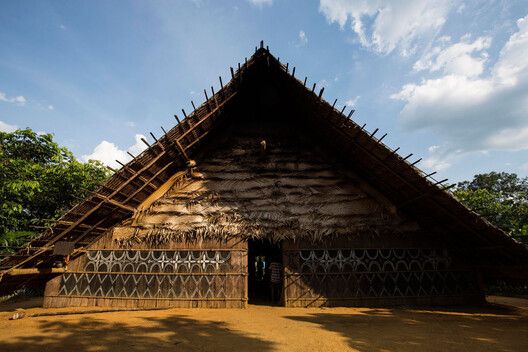
Territory as an Archive
On another scale, this integration of territory, memory, and ways of dwelling is also revealed in recent discoveries in the Amazon. In March 2025, the fall of a centennial tree in Fonte Boa (AM) brought to light funerary urns buried beneath the floodplain soil. From these, researchers identified traces of an ancient artificial island, raised with earth, ceramic fragments, and plant fibers to cope with the flood cycles of Lake Cochila. The structure reveals not only a sophisticated strategy for adapting to the forest but also a space where memory, ancestry, and dwelling intertwine. The urns, which contained human remains, fish, and turtles, point to a cosmology where food, territory, and funerary rituals are not separate domains, but expressions of the same way of existing.
The discovery reinforces that Indigenous building practices have always been associated with complex ways of coexisting with the environment, whether through ephemeral structures, like hammocks, or more permanent constructions. In both cases, these are modes of dwelling that contrast with contemporary sustainability models, which are often based on extractivist logic and decontextualized solutions.
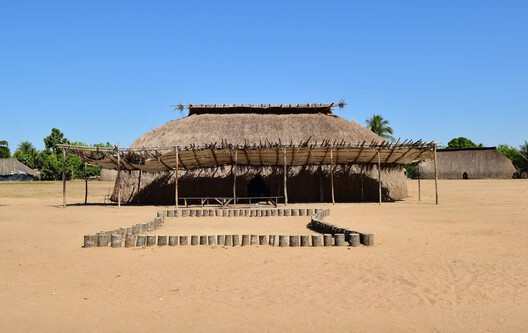
This is a critique that guides the work of the Organizmo Foundation, established by Colombian architect Ana María Gutiérrez. Upon returning to Colombia in 2008, she founded a center dedicated to ecological building and the preservation of ancestral wisdom from traditional communities. For Gutiérrez, the challenge is not to recover an idealized past, but to recognize ancestral wisdom as living knowledge. "As architects, we need to unlearn everything we have been taught," she states in an interview with The Guardian. "Our idea of progress is completely based on colonialist and extractivist practices. People talk about sustainability, but what exactly are we sustaining?"
Inhabiting the Permanence of Relationships
In recent years, we have seen a concerted effort—whether genuine or not—to expand the boundaries of architecture, stretching its limits and bringing it closer to other dimensions of life. Spurred perhaps by the fear of planetary changes and the survival of the human species, there is a growing realization that modern paradigms no longer provide sufficient answers. Even so, shifting architecture away from this established position is no simple task. It requires letting go of labels, categories, and catalogs. It demands boldness not only in techniques and materials, but above all in how we understand the meaning of building—not as the production of an object disconnected from the world, but as a part and consequence of the relationships that shape it.
In this movement, looking at the conception of "architecture" held by Indigenous peoples means understanding a profound respect for the ground we walk on, a desire for symbiosis without any claim to dominion over the territory, as Krenak asserts when he says that "instead of operating on the landscape, we must merge with it." This is an architecture that, in the words of Benucci, treads lightly on the earth, leaving the minimal footprint. It is a lightness that should not be mistaken for technical weakness, but rather understood through its own values and concepts.
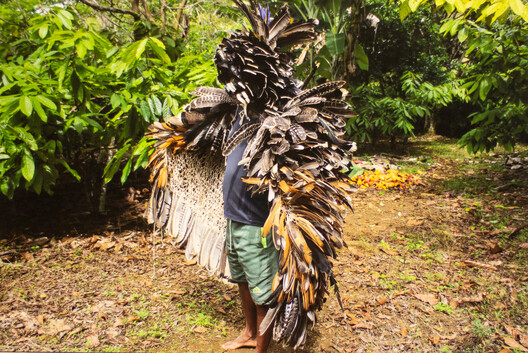
From this perspective, architecture ceases to be a practice geared toward the accumulation of matter and the imposition of permanent forms onto the landscape. Inhabiting is, instead, participating in the cycles of life, continually renewing the bonds between people, territory, and community. Against the logic of excess and possession, the "way of hanging hammocks" described by Benucci points to a different idea of permanence—not of things, but of relationships. Perhaps this is precisely where one of the greatest contributions of Indigenous cosmovision to contemporary architecture lies: reminding us that to build is not to occupy the Earth, but to learn how to live with it.
This article is part of the ArchDaily Topics: Interspecies Architecture: The Life of Materials, Ecological Alliances, and the Action of Nature. Every month we explore a topic in-depth through articles, interviews, news, and architecture projects. We invite you to learn more about our ArchDaily Topics. And, as always, at ArchDaily we welcome the contributions of our readers; if you want to submit an article or project, please contact us.
This article was written by Camilla Ghisleni. The translation is powered by AI.


