In the decades following independence, some of the most ambitious architectural experiments in the world did not emerge through museums, monuments, or government palaces. They emerged through universities. Across South Asia and Africa, newly formed nations turned campuses into testing grounds for entirely new ways of imagining collective life. These campuses functioned as more than educational institutions. They became territories where states tested how modernity might be organized, for citizens to gather, institutions to function, climate to shape architecture, and imported ideas to transform local realities.


Unlike isolated civic buildings, campuses offered something rare: scale. They operated like miniature cities, containing housing, infrastructure, landscapes, circulation systems, and public space within a controlled framework. For architects working in newly independent nations, this made universities ideal sites for experimentation. Modernism could be tested as an environmental, political, and social system rather than reduced to style.
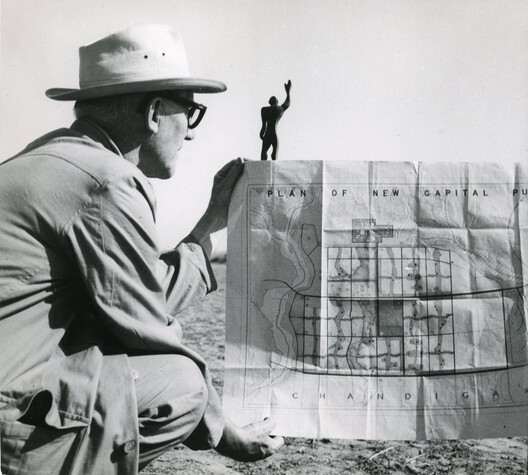
This ambition was visible in India almost immediately after independence. When Jawaharlal Nehru described Chandigarh as symbolic of a new nation freed from colonial tradition, he was not only referring to its monumental Capitol Complex. The city's educational and institutional sectors formed part of the same vision: a planned environment where governance, learning, and civic identity could be reorganized through architecture. Universities increasingly operated as extensions of statecraft. They would educate the bureaucrats, planners, and technocrats responsible for building the nation, while giving physical form to the bureaucratic and developmental ambitions these institutions promoted.
Related Article
Victoria and Albert Museum Investigates Tropical Modernism Movements in West Africa, Modern India, and Ghana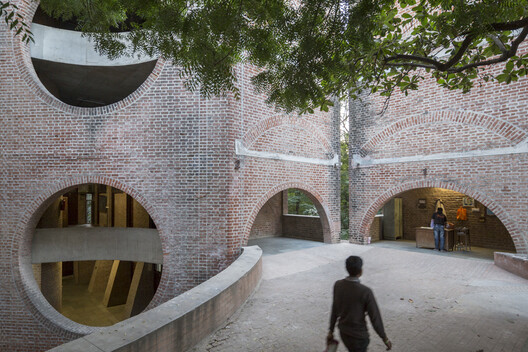
Symbolism only explains part of these campuses. It was the way they transformed modernism once it encountered climate. Many architects arriving from Europe brought with them the assumptions of the International Style: glass facades, universal planning systems, and machine-age aesthetics intended to function anywhere. But the realities of tropical heat, monsoon rain, dust, and unreliable infrastructure quickly exposed the limits of those ideas. Campuses became sites where modernism encountered climatic limits and began to change.
Modern architecture was gradually transformed through climatic pressures rather than rejected outright. Across postcolonial campuses, deep overhangs replaced exposed curtain walls, shaded corridors replaced sealed interiors, and courtyards became environmental devices rather than ornamental gestures. Architecture itself performed the work of cooling. Buildings relied on orientation, thermal mass, ventilation, and landscape rather than mechanical conditioning alone. Later framed as tropical modernism, these strategies operated first as responses to climate.
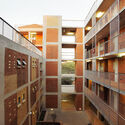
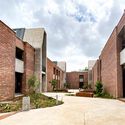
Few projects demonstrate this more clearly than the Indian Institute of Management Ahmedabad designed by Louis Kahn in collaboration with Balkrishna Doshi. The campus reads as monumental at first encounter — massive brick walls punctuated by geometric voids. But its spatial intelligence lies in how those forms work environmentally. Deep recessed openings minimize heat gain. Brick provides thermal stability in extreme temperatures. Courtyards and shaded circulation create cooler transitional spaces between classrooms, dormitories, and public gathering areas. The campus grounds institutional modernity in climate, material depth, and thermal performance rather than lightweight enclosure.
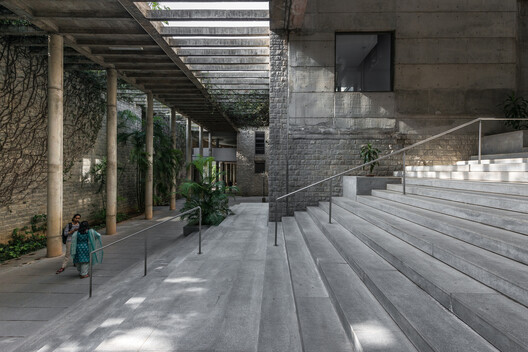
Environmental adaptation also reorganized how space was socially occupied. On many postcolonial campuses, circulation was no longer treated as merely functional. Corridors widened into gathering zones, terraces became extensions of classrooms, and shaded walkways encouraged informal interaction between students and faculty. Movement and occupation increasingly overlapped.
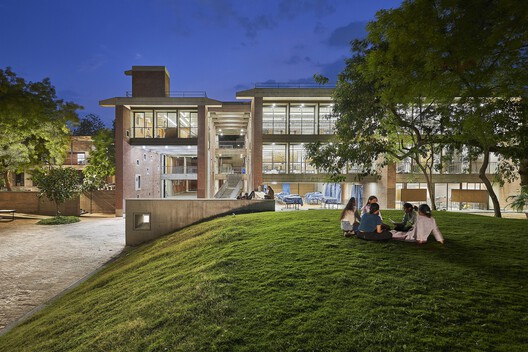
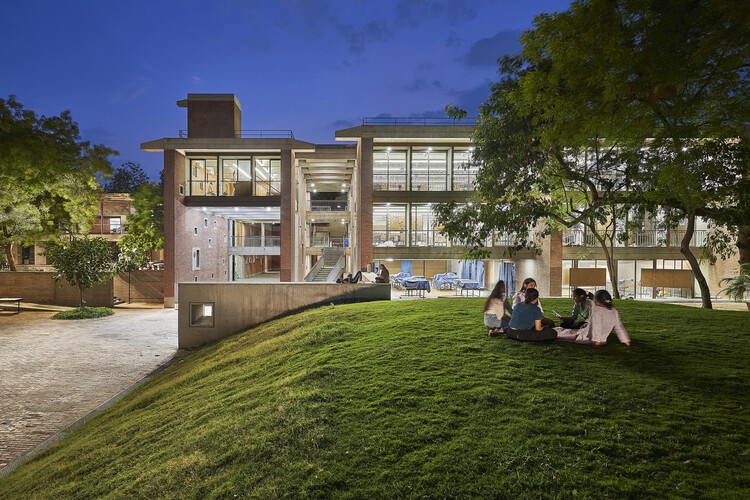
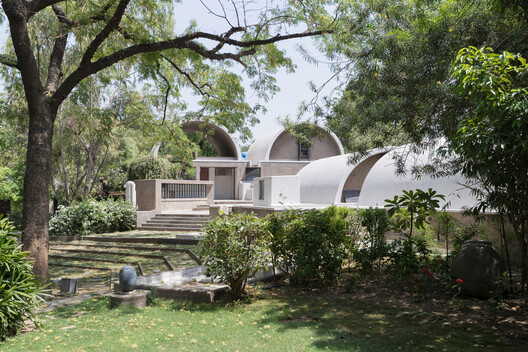
At the CEPT University, Balkrishna Doshi pushed this even further. The campus dissolves rigid boundaries between inside and outside through open studios, exposed brick platforms, shaded terraces, and porous circulation systems. Rather than isolating learning inside conditioned rooms, the architecture encourages occupation across gradients of light, heat, and enclosure. Students move continuously between landscape and building, between formal instruction and informal exchange. Learning unfolds across shifting gradients of shade, heat, enclosure, and exposure.
Environmental experimentation intersects with cultural negotiation here. Modernism arriving from Europe was transformed not only by heat and geography, but by different ways of inhabiting space. Courtyards, thresholds, verandahs, and open collective areas carried social meanings deeply rooted in local patterns of gathering and public life. Architects such as Doshi reworked modernist forms through Indian spatial traditions and everyday occupation.
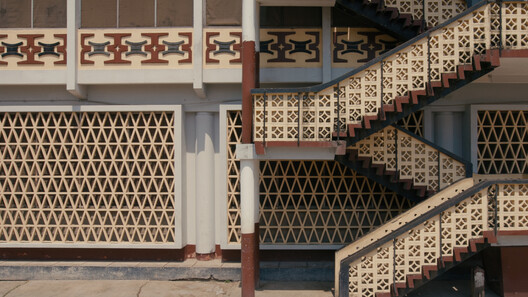
The same negotiation unfolded across parts of West Africa. Universities such as Obafemi Awolowo University adopted many principles associated with tropical modernism, including passive cooling systems, shaded circulation, and climatic orientation. But these campuses also reflected the political ambitions of newly independent African states, where architecture became tied to visions of technological progress and national self-determination. Educational institutions were expected to produce graduates capable of participating in postcolonial futures while helping define modern citizenship.
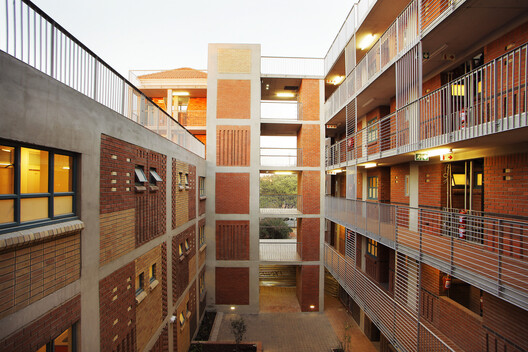
These campuses feel newly relevant today because their most innovative ideas were often treated as regional deviations from modernist orthodoxy. Deep shading devices, naturally ventilated corridors, thick masonry walls, and landscape-integrated planning were often treated as departures from the purity of high modernism. In an era increasingly defined by energy consumption and climate crisis, those same strategies now sit closer to contemporary environmental priorities.
Many of these campuses continue to function largely through passive environmental systems developed decades before sustainability became institutionalized language. Their architecture understood that climate was not an obstacle to design, but one of its primary generators. Postcolonial campuses anticipated current concerns around low-energy construction, adaptive comfort, and environmental responsiveness.

At the same time, these sites remain politically unfinished. Campuses such as Chandigarh's institutional complexes now face difficult questions around preservation, expansion, and infrastructural pressure. Air-conditioning retrofits often undermine the very climatic systems that made these buildings significant. New construction disrupts carefully calibrated spatial relationships. Conservation debates expose unresolved tensions about how postcolonial modernism should be valued: as heritage, infrastructure, or living institution.
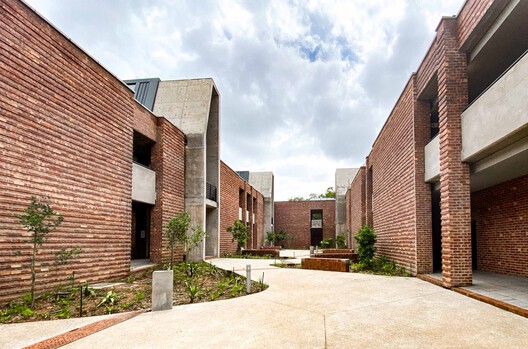
These campuses continue to feel unusually alive. They were conceived as frameworks for occupation, negotiation, and change. Students continue to inhabit their shaded corridors, gather in their courtyards, and adapt their spaces in ways the architects anticipated. The buildings age, evolve, and absorb new realities without entirely losing the ambitions embedded within them. These universities did not simply import modernism into new nations. Climate, material, pedagogy, and public life reshaped modernism into forms that remained contingent, adaptive, and locally negotiated. The lesson these campuses continue to offer lies in how architecture was treated as a collective experiment.
This article is part of the ArchDaily Topic: 20th Century Design in Flux: A Global Reinterpretation of Architectural History. Every month we explore a topic in-depth through articles, interviews, news, and architecture projects. We invite you to learn more about our ArchDaily Topics. And, as always, at ArchDaily we welcome the contributions of our readers; if you want to submit an article or project,contact us.