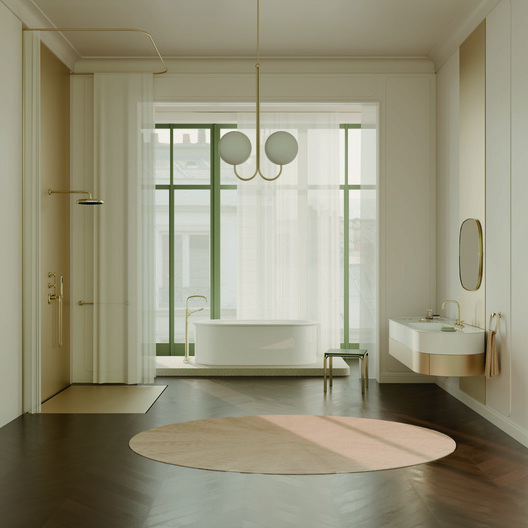
When is a form still circular or rectangular? In twentieth-century modernism, this question was largely absent. Architecture was built on clarity, reduction, and formal purity. Influenced by architects such as Le Corbusier and Ludwig Mies van der Rohe, modernist design established a visual order based on rational geometry, industrial materials, and the rejection of ornament. Circle and square, function and expression, were kept strictly apart—a logic that dictated the rigid, modular layouts of traditional bathrooms for decades.
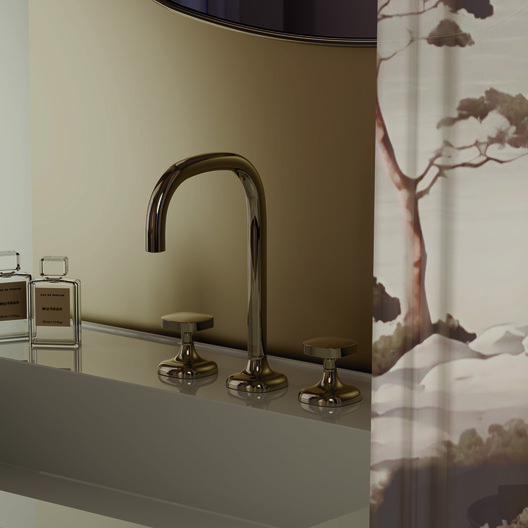
Today, many contemporary interiors still retain this clarity and minimalism while introducing softer transitions between forms and geometries. Over time, those strict separations began to soften. Geometries that once belonged to different systems of order now appear within a single continuous object. In this context, Dornbracht, together with Sieger Design, developed the Coya series: a bathroom fitting that moves between circular and rectilinear geometries. The form resists classification as either round or angular, remaining restrained and rooted in a minimal formal reduction, often described as a "squircle." As Caroline Schmitt, General Management at Dornbracht, notes:
With its hybrid form, Coya unites very different worlds. It is therefore ideal for individually designed rooms that do not follow a single, consistent style, but many at the same time.
Designing Between Opposites
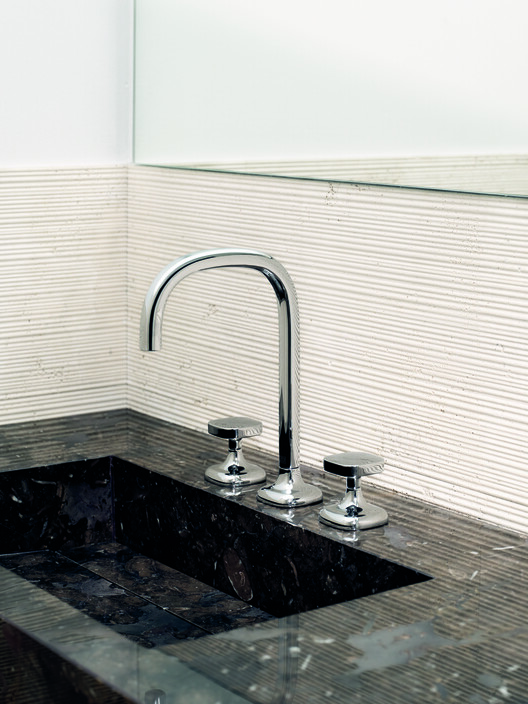
As the first series introduced under Dornbracht's brand claim "Inspiring your vision," Coya marks a shift in how fittings are positioned within interior space to mediate between geometries. Across the collection, from spout to rosettes to handles, the same formal logic applies. Soft transitions replace sharp edges, and each component is shaped as a continuous element rather than a separate part. Designer Michael Sieger describes this approach as an exploration of contradiction:
Coya is neither round nor angular and therefore defies clear categorization. At first glance, it seems surprising, almost counterintuitive. Only to appear incredibly coherent at the same time.
Shifting Interpretations of Contradiction
The idea of contradiction has appeared in different forms across architectural history, each carrying a distinct meaning within its own context. By the 1960s, the dominance of modernist clarity had already been questioned. Architect and theorist Robert Venturi, in his book Complexity and Contradiction in Architecture (1966), argued against reduction as a universal principle. In opposition to modernist orthodoxy, he proposed ambiguity, layering, and formal inconsistency as valid architectural strategies. His famous statement "Less is a bore" directly countered Ludwig Mies van der Rohe's "Less is more". A form like Coya demonstrates that the principle of "Less is more" does not have to mean rigid, sharp angles. Instead, it encompasses subtle, transitional geometries without introducing unnecessary ornament.
Postmodernism followed this trajectory, introducing historical references, ornament, and composite geometries. However, the logic of combining systems predates this period. Art Deco, emerging in the 1920s, combined geometric abstraction with craftsmanship and streamlined forms, merging symmetry, curvature, and modern industrial aesthetics within a single visual language. Earlier, 19th-century eclectic architecture assembled references from different historical periods into unified compositions, producing buildings defined by stylistic plurality rather than formal purity.
A Mediator Between Geometries
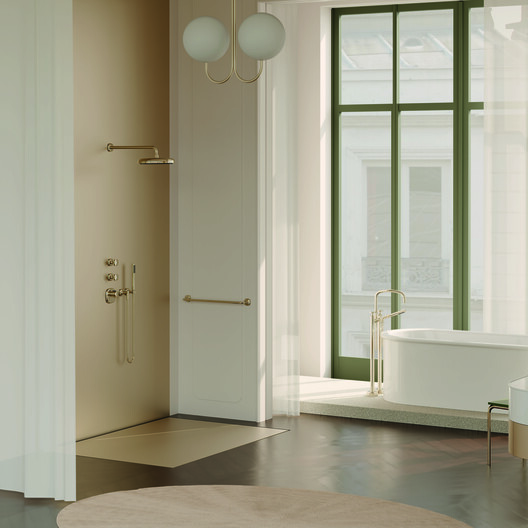
In contemporary design, on the other hand, formal clarity and hybrid approaches often coexist rather than being in opposition to one another. Residential and hospitality interiors frequently combine reduction with expression, minimal geometries with layered materiality, and strict spatial orders with more fluid interventions. Defined by technical precision and frequent use, bathrooms in particular become spaces where small formal decisions have a strong spatial impact.
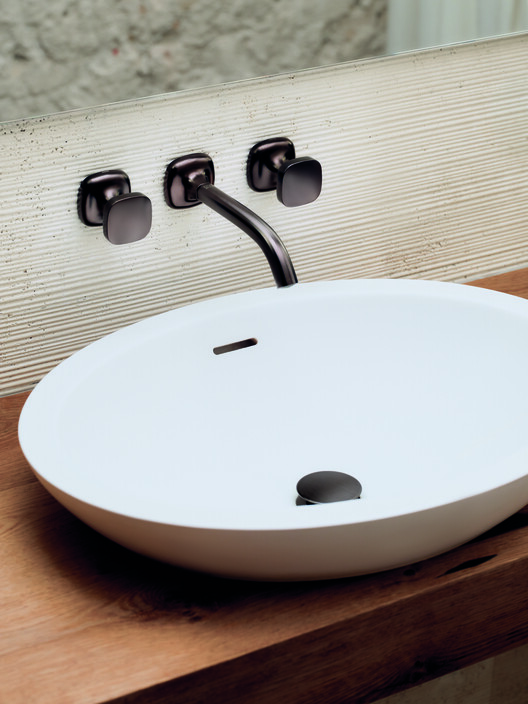
Within this context, fittings like Coya are defined not only by form but also by surface, finish, and their relationship to surrounding materials, for example in the contrast between a chrome fitting and a brown stone washbasin. Available in a range of finishes including Chrome, Champagne (22kt Gold), and Brushed Bronze, the series translates its formal transitions into distinct surface expressions, in which light, texture, and tone subtly shift the perception of geometry.
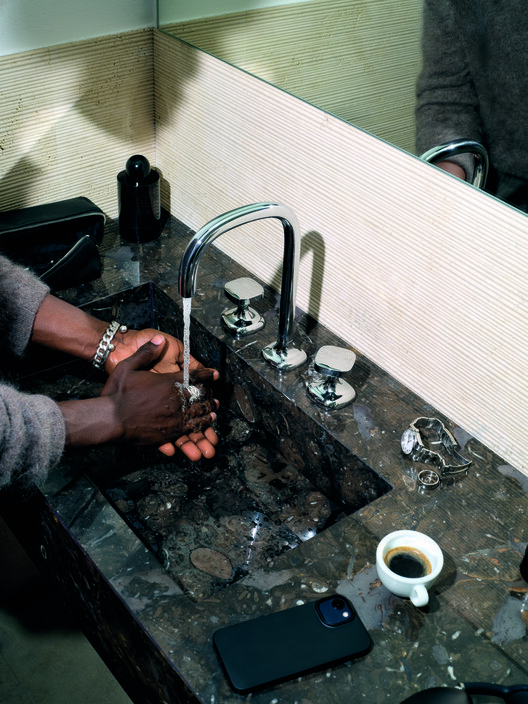
The presence of hybrid geometries is visible at the scale of interior and product design. The question is no longer whether forms belong to a single geometric strategy, but how they are resolved differently in everyday spatial use. This is reflected in fittings such as Coya, where circle and square are connected through gradual transitions, allowing proportion, detail, and material to define a continuous reading of form within the bathroom.