Across cultural platforms, heritage sites, and institutional developments, this week's news reflects how the built environment is reshaped through processes of transformation, reinterpretation, and public engagement. From archaeological reactivations and adaptive reuse strategies to museum expansions and large-scale international gatherings, architecture operates across multiple temporalities, balancing preservation with contemporary use and spatial continuity with evolving cultural programs. Within this context, ArchDaily's selection of installations and exhibitions from Milan Design Week 2026 highlights how design weeks increasingly function as curatorial frameworks for experimentation, while global events and institutional projects continue to expand the formats through which architecture is produced, shared, and debated.
Global Platforms, Events, and the Circulation of Ideas
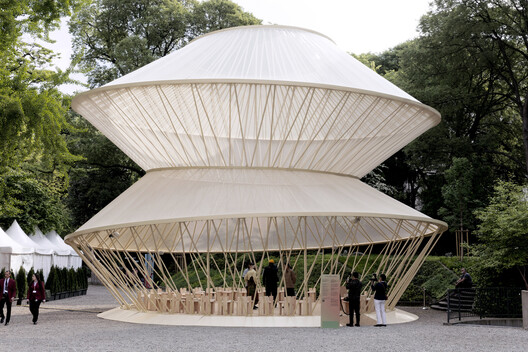
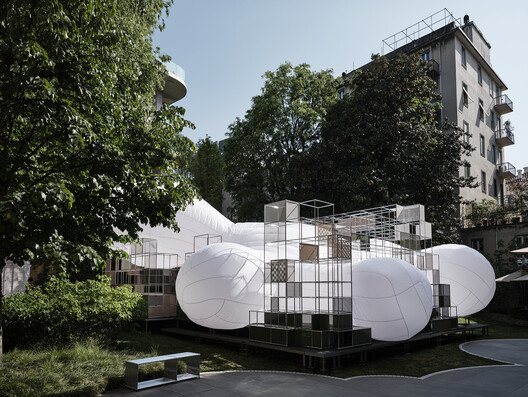
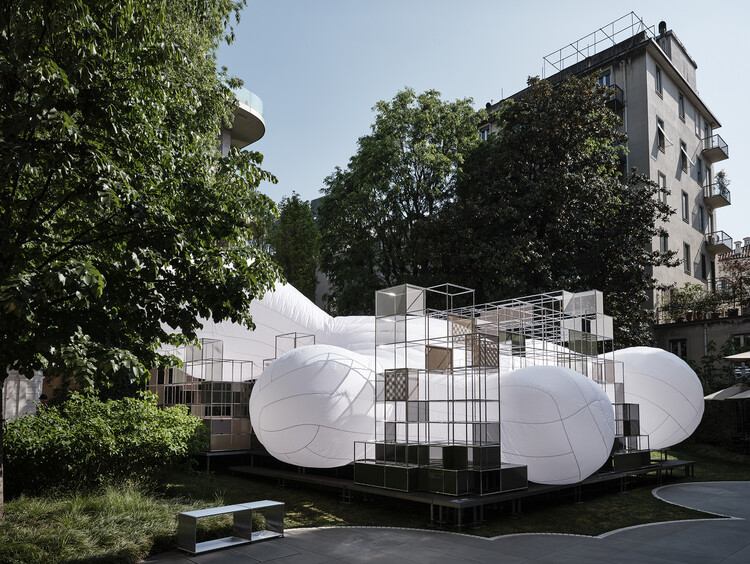
Following six days of exhibitions, installations, and industry exchange, Milan Design Week 2026 and the 64th edition of Salone del Mobile.Milano concluded with over 316,000 visitors from 167 countries, reaffirming Milan's central role within the global design calendar. Among the week's coverage, ArchDaily's selection of installations and exhibitions from across the city highlighted a series of projects presented during Fuorisalone, where this year's programming, framed by the theme "Be the Project," foregrounded process-driven experimentation, material research, and interdisciplinary collaboration. Across these works, installations increasingly operated as spatial and material tests rather than finalized displays, reflecting a broader shift in how design weeks function as platforms for research and exchange. In parallel, the UIA World Congress of Architects 2026 Barcelona has announced its full program, expanding the format of the event into a distributed, city-wide framework. Structured around the theme Becoming. Architectures for a Planet in Transition, the Congress combines lectures, exhibitions, workshops, and itineraries, emphasizing research-based practices and cross-disciplinary exchange while situating Barcelona itself as an active site of engagement.
Heritage Access and Adaptive Reuse Across Contexts
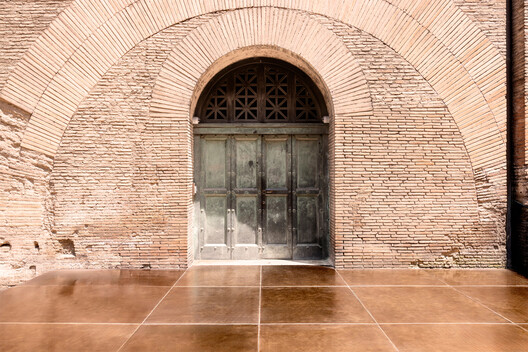
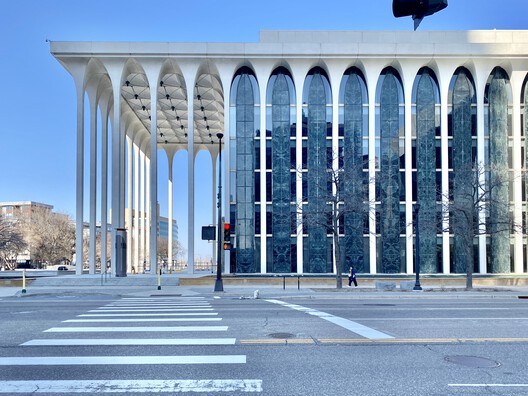
This week's developments also highlight how architecture continues to mediate between preservation and transformation through strategies of access and reuse. In Rome, STARTT's Pantheon – Micro Architectures for Archaeology project introduces a new visitor route through previously inaccessible areas behind the Rotunda, revealing layers of archaeological fabric while maintaining a clear distinction between contemporary interventions and ancient material. Rather than restoring the monument itself, the project reframes its broader urban and historical context. A parallel approach emerges in Minneapolis, where Minoru Yamasaki's former Northwestern National Life Insurance Company headquarters is set to be converted into a hotel. The proposal retains the building's defining formal elements while introducing hospitality and public-facing functions, reflecting broader shifts in the reuse of mid-century office buildings. Extending this discourse of institutional and spatial expansion, the Bass Museum of Art in Miami Beach has commissioned Johnston Marklee to develop a new campus addition building on Arata Isozaki's earlier framework. The proposal introduces a new exhibition pavilion alongside outdoor civic spaces, reinforcing the museum's role as an open cultural interface embedded within both landscape and urban context.
On the Radar
UNS Completes Wasl Tower in Dubai with Climate-Responsive Ceramic Facade
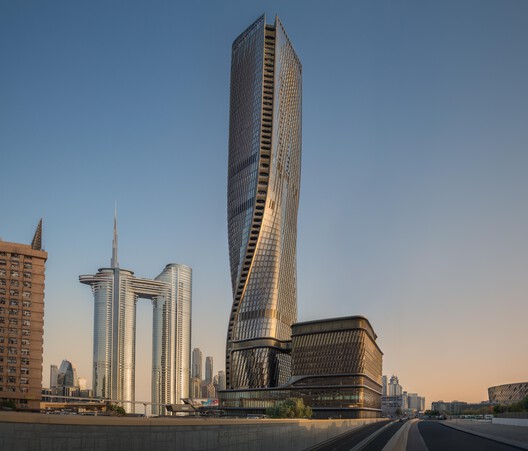
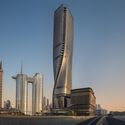
Completed in downtown Dubai, Wasl Tower by UNS in collaboration with Werner Sobek introduces a 302-metre-high mixed-use development along Sheikh Zayed Road, adjacent to the Burj Khalifa. The project combines hotel, residential, office, and public functions within a vertically organized structure that integrates programmatic diversity with a continuous facade system. The tower is defined by a terracotta ceramic envelope composed of thousands of fins that act as a passive shading device, reducing solar gain and supporting thermal regulation while responding to the building's orientation through parametric design strategies. Positioned as both an infrastructural and climatic system, the facade draws on regional material traditions while addressing contemporary environmental performance standards.
OPEN Breaks Ground on Meitu Cube Visual Arts Center in Xiamen, China
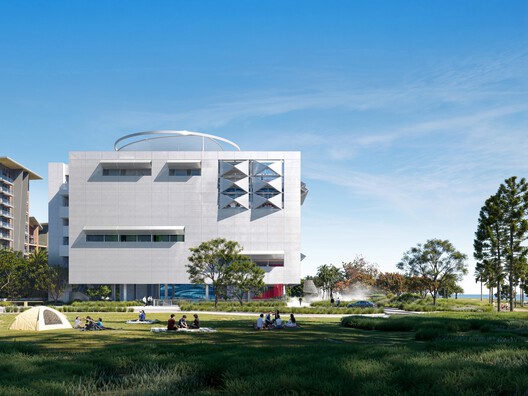
OPEN Architecture has begun construction on the Meitu Cube Visual Arts Center in Xiamen, China, a coastal cultural facility scheduled for completion in 2028. Located along the city's eastern shoreline, the project is conceived as a cubic volume that incorporates a high degree of spatial and programmatic flexibility, responding to shifting cultural and technological conditions. The building organizes a series of interlocking gallery types, including black-box and white-box spaces, alongside circulation routes, terraces, and public areas that can be reconfigured for exhibitions, performances, screenings, and events. Integrated landscape elements, including sunken plazas, rooftop terraces, and stacked greenery, extend the architectural system into the site, establishing transitions between interior space, public realm, and coastal environment.
Alvisi Kirimoto Completes Piazza Giuseppe Meroldi in Rome as Part of the "15 Roma" Urban Regeneration Program
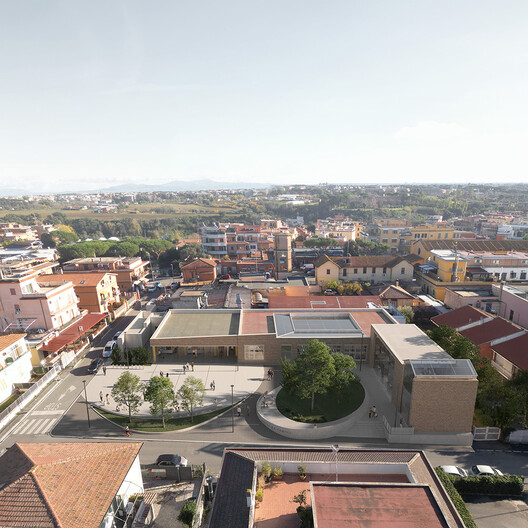
Alvisi Kirimoto has completed the redesign of Piazza Giuseppe Meroldi in Montespaccato, within Rome's XIII Municipality, as part of the 15 Roma urban regeneration program developed around the principles of the "15-minute city." Once a parking area and weekly market site, the square has been transformed into a public space structured through two complementary conditions: a green, landscaped zone with newly planted trees and shaded resting areas, and a mineral paved surface designed for flexible use and community activities. A continuous paving strategy ties the composition together, while the adjacent municipal building, now home to the Biblioteca Cornelia, extends the intervention's civic role with co-working, study, and multifunctional community spaces, reinforcing the square as a local point of social and urban exchange.