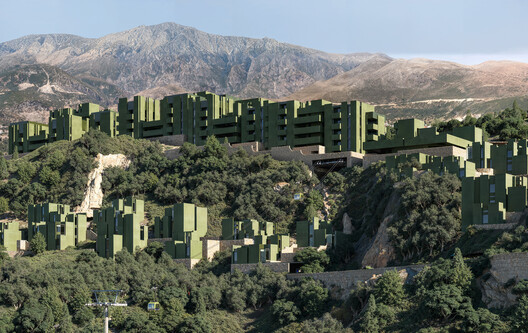
Bofill Taller de Arquitectura has revealed the final images of a new resort in Dhërmi, Albania, currently under construction. The project was first announced in 2024, in the context of the numerous developments proposed across the country over the past decade. This time, the project is neither a skyscraper nor an institutional building in Tirana, but a resort set along the mountainous coastline in the south of the country. The design responds to the existing landscape conditions, a coastal, mountainous area surrounded by forests that cover a significant portion of Albania's land surface. The project aims to preserve the character of the forest while engaging with the rugged terrain, jagged rocks, steep mountainsides, and dense pine and cypress forests.
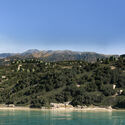
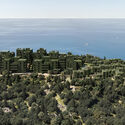
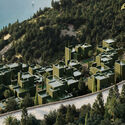
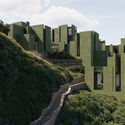
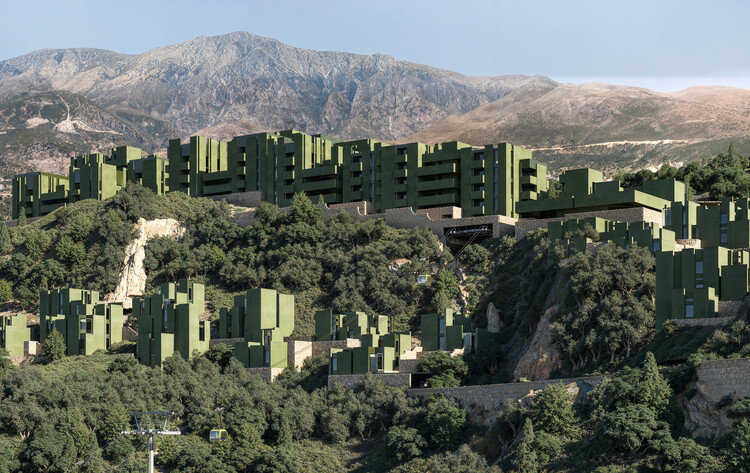
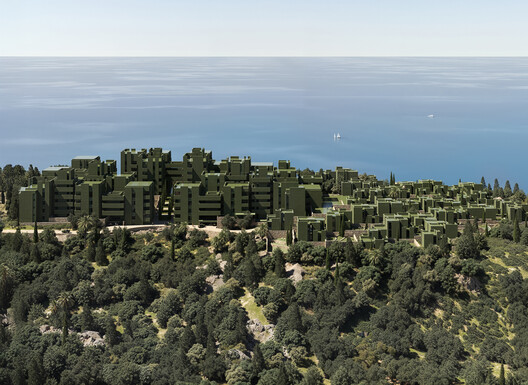
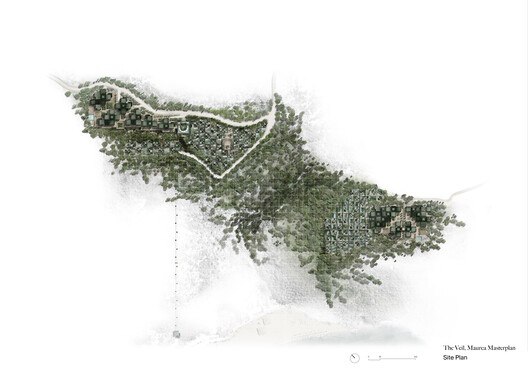
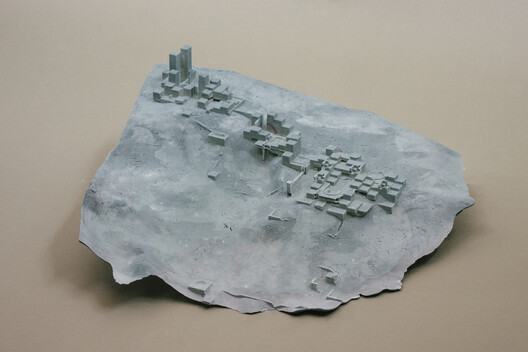
Bofill Taller de Arquitectura's The Veil resort in Dhërmi occupies two plots, one larger than the other, across which 366 apartments and 77 villas are distributed in sixteen typologies of varying size and organization. The floor plan is composed of a series of squares, while the building section varies in height to provide different spatial experiences suited to hotel pavilions, apartments, and villas. The various typologies are positioned in response to the site's topography, settling onto platforms rather than relying on excavation. Within this framework, the layout avoids significant trees and other elements of existing vegetation. The ensemble is envisioned as a light veil laid over the landscape.
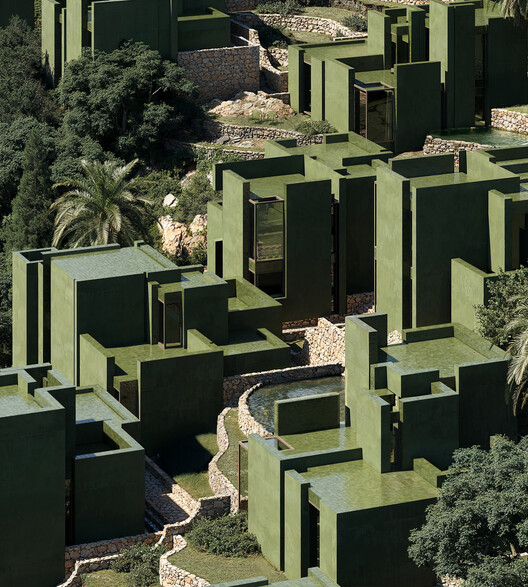
A base composed of locally sourced stone follows the rise and fall of the terrain, with the resort's volumes connected by exterior stairs, bridges, and walkways. The tones of this paving stone were determined using samples taken from the surrounding landscape, resulting in a palette of four colors. While the volumes vary in size and configuration, they are unified through a consistent color scheme and façade treatment of concrete and glazed ceramic tiles. This strategy allows the architecture to blend into the landscape, potentially reflecting its light and shadows.
The final composition is defined by a relationship between horizontal platforms and vertical growth; the buildings are situated among the trees and oriented toward views of the Adriatic Sea. Guests are accommodated in spaces with large windows, balconies, terraces, and pools, creating an open and permeable atmosphere. Among the volumes, a principal communal building contains a social club, restaurant, gym, and a series of pools. At its center, a courtyard departs from the otherwise rectilinear language of the project, curving around a group of ancient trees.
Other recent projects unveiled around the world include Kengo Kuma & Associates' first project in Ecuador, a 32-story mixed-use tower set to rise in Quito's central business district; Wilmotte & Associés' renovation of the Korean 63 Tower skyscraper to host a new branch of the French Centre Pompidou in collaboration with the local Hanwha Foundation of Culture; and Tsuyoshi Tane's Sea of Time – TOHOKU, a permanent museum in Tomioka, Japan, designed to host the artwork of Tatsuo Miyajima. The University of Toronto has also revealed the design for a new facility for health research and education, designed by MVRDV and Diamond Schmitt Architects in collaboration with Two Row Architect.


