Although societies have transformed through the ages, wealth never truly seems to go out of style. That said, the manner in which it is expressed continually adapts to each successive cultural epoch. As a consequence of evolving social mores and emerging technologies, the ideal of “luxury” and “splendour” sees priorities shift from opulence to subtlety, from tradition to innovation, and from visual ornamentation to physical comfort.
AD Classics are ArchDaily's continually updated collection of longer-form building studies of the world's most significant architectural projects. In these ten examples of "high-end" residences, which represent centuries of history across three separate continents, the ever-changing nature of status, power and fine living is revealed.
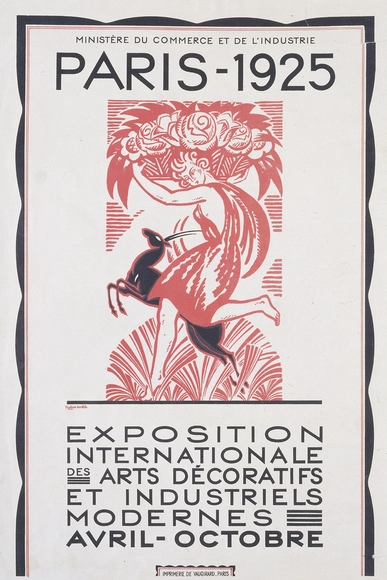
The Exposition’s poster, designed by Robert Bonfils. ImageCourtesy of the Victoria and Albert Museum
The end of the First World War did not mark the end of struggle in Europe. France, as the primary location of the conflict’s Western Front, suffered heavy losses in both manpower and industrial productivity; the resulting economic instability would plague the country well into the 1920s.[1] It was in the midst of these uncertain times that the French would signal their intention to look not to their recent troubled past, but to a brighter and more optimistic future. This signal came in the form of the Exposition Internationale des Arts Décoratifs et Industriels Modernes (International Exposition of Decorative Arts and Modern Industries) of 1925 – a landmark exhibition which both gave rise to a new international style and, ultimately, provided its name: Art Deco.
With UNESCO's recent announcement that 17 buildings by Le Corbusier are to be added to the World Heritage List, Monocle 24's Section D speaks to a number of organisations—including the Twentieth Century Society, devotees of Frank Lloyd Wright in Arizona, London's Victoria Albert Museum, and the Cooper Hewitt Smithsonian in New York City—in order to understand why architectural preservation is important, and who decides what’s worth saving.
One of the most significant buildings of the late modernist style, Le Corbusier’s Convent de la Tourette exemplifies the architect’s style and sensibilities in the latter end of his career. Built between 1956 and 1960 on a hillside near Lyon, France, the priory dominates the landscape, with its strict, geometric form.
In terms of memorialization, being selected to represent your country as the face of a banknote is one of the highest honors you can achieve. Even if electronic transfer seems to be the way of the future, cash remains the reliable standard for exchange of goods and services, so being pasted to the front of a bill guarantees people will see your face on a near-daily basis, ensuring your legacy carries on.
In some countries, the names of the faces even become slang terms for the bills themselves. While “counting Le Corbusiers” doesn’t quite roll off the tongue, a select few architects have still been lucky enough to have been featured on such banknotes in recent history. Read on to find out who the 15 architects immortalized in currency are and what they’re worth.
Claude Parent, a celebrated French architect and Commandeur de la Légion d'honneur, died on the evening of the 27th February 2016, the day after his 93rd birthday. Born in 1923 in Neuilly-sur-Seine, Parent was a member of the Académie des Beaux-Arts in Paris and, throughout his career, developed a limited but extremely influential body of built work ranging from nuclear power stations to shockingly unconventional shopping centers, such as his project in Sens. Described as both a utopian and a 'supermodernist' in his own lifetime, the methodology he shaped has played a significant role for his peers of all generations and for contemporary artists and thinkers including Jean Nouvel, who began his professional life as a collaborator.
“The photograph itself is in no way animated..., but it animates me: this is what creates every adventure.” Roland Barthes, Camera Lucida
A new exhibition is coming out of the Le Corbusier portfolio of architectural photographer Cemal Emden who has been working on the master architect’s oeuvre for the last five years. The exhibition, organized by Istanbul Association of Architects in Private Practice (IstanbulSMD) will be inaugurated in Isik Art Gallery (Istanbul) on 9th of March 2016 and it will put in display a number of the major works of Le Corbusier, spanning over a period of half a century. Apart from Emden’s photographs, texts by Turkish and international scholars who studied Le Corbusier’s work will also be featured in the exhibition.
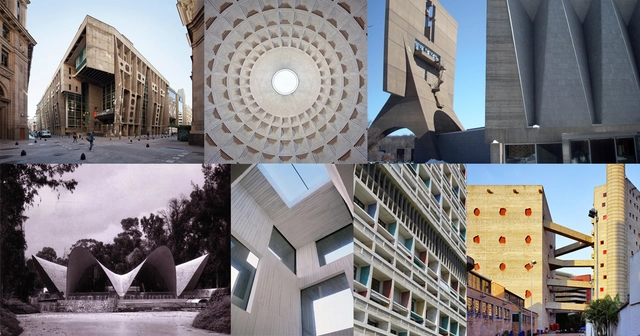
“Concrete has the ability to be primitive and technological, massive and levitating, to combine the properties of steel with those of mud,” says Rowan Moore in his list of The 10 best concrete buildings created for The Guardian. Through examples spanning three continents, Moore unites old standbys with unexpected wonders, all of which show the varied possibilities inherent in mixing water, aggregate, and cement. In a list that incorporates examples from Classical times to the present, Moore establishes concrete’s unique ability to adapt to different times, styles, applications, and treatments.
Examples by Le Corbusier, Álvaro Siza, Lina Bo Bardi, and Marcel Breuer demonstrate that concrete is anything but workaday or utilitarian. Moore’s list affirms that a material simultaneously strong and light, durable, sustainable, and fire-resistant, can scarcely be considered anything short of miraculous. Of course, ten buildings can only provide an abridged version of concrete’s possibilities, and Moore cheekily apologizes for some of the obvious omissions. Check out the full list here.
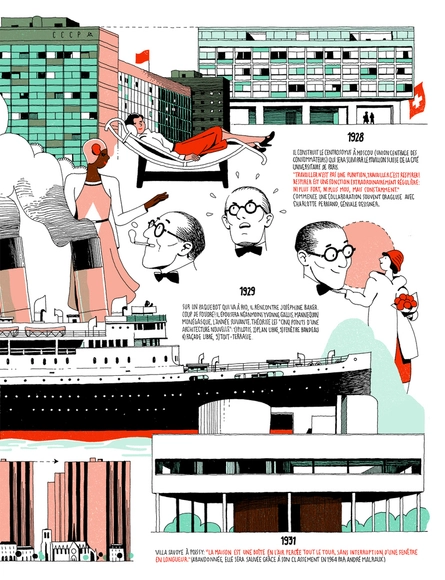
French artist and illustrator Vincent Mahéhas shared his most recent work with us -- a series of illustrations made for a special edition of Telerama magazine that depicts the life of the renowned Swiss-French architect, Le Corbusier. In just eight pages, the artist highlights the most relevant facts of this unforgettable architect's life. Expressed in green and pink tones, we can see key moments that have without a doubt shifted the course of contemporary architecture, with the extreme care and clarity that Mahé's work presents us.
With this year marking the 50th anniversary of Le Corbusier’s death, the team of organizations is seeking “contemporary interpretations concerning multidisciplinary approaches over Modernism and specifically over Le Corbusier’s work, while [exploring] possible themes and directions of the memorial representation” in present day. Designs should emphasize commentary, rather than a tribute to Le Corbusier.
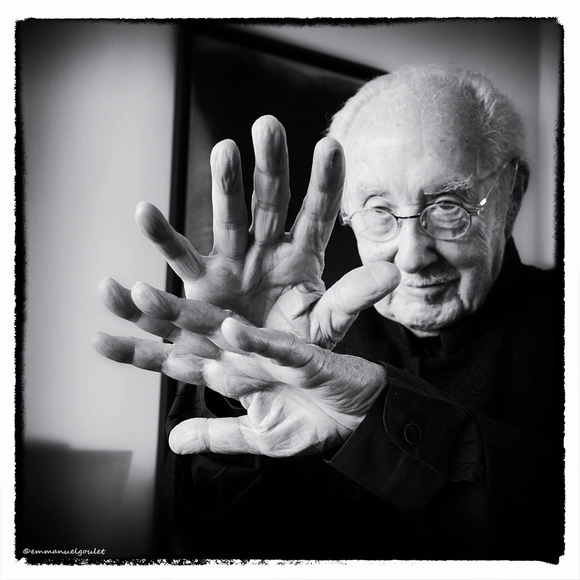
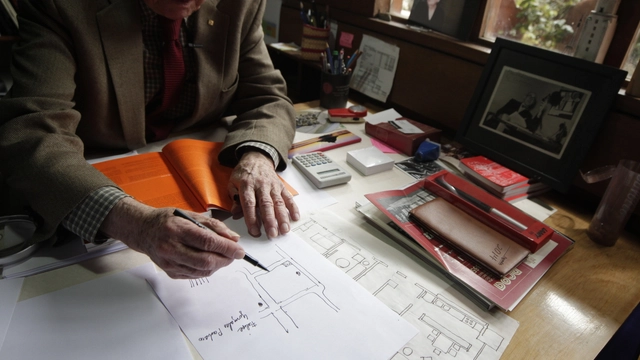
Hiding out from the gentle Bogotá rain, a cat with turquoise eyes and a black and white coat prowls along the ledge of an office hidden in the midst of lush vegetation. A large window with a wooden frame filters the light and illuminates the interior: a desk, hundreds of books, manila folders, and backlit pictures. Sitting comfortably in his chair, 91-year-old Colombian architect Germán Samper takes a pencil, presses it to the surface of a sheet of paper, and begins to explain everything he is saying by drawing for us in the most clear and simple manner possible.
Whether he's giving instructions on taking a taxi in Bogotá or explaining the recent modifications to the historic Colsubisdio citadel, Samper -- a master of Colombian architecture -- can express ideas on paper with an ease that makes us think that drawing might be very simple, but it's really just a great trick.
Perseverance is key and Samper knows this from experience. "I don't understand why architects don't draw more if it is truly a pleasure," he ponders.
After the break, a conversation with Germán Samper and a series of unedited sketches by the Colombian architect.
This week marks 50 years since the passing of Le Corbusier. To honour his 78-year career, we’ve curated a selection of videos and documentaries about the renowned architect. Spanning multiple languages, these films explore topics ranging from the historical context of his era to the preservation of the Villa Savoye and his work in Argentina.
What moves us humans, physically and emotionally? This is the theme explored by the protagonist of modern architecture Le Corbusier (1887-1965) as well as by the great Danish artist Asger Jorn (1914-1973) in their architecture, art and writings. With the exhibition What moves us? Le Corbusier & Asger Jorn, Museum Jorn brings the two artists and thinkers who both wanted to change the world together again.
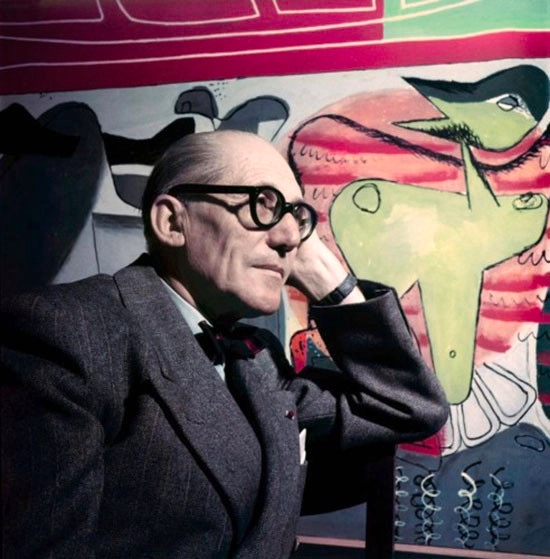
You know him for his round glasses, affinity for concrete and undying love for modernism, but do you really know Le Corbusier? Le Corbusier led his life not just as the 20th century's most influential architect, but also as an artist, socialite and theoretician. Taught by architects August Perret and Peter Behrens, criticized by the likes of Jane Jacobs and celebrated worldwide, Le Corbusier's legacy is undeniable. Dabbling often with controversy, Le Corbusier preferred the mantra “Architecture or Revolution,” designing structures that have been dubbed "anti-humanist." While some propose that his buildings collectively become a UNESCO World Heritage site, many call for their demolition.
In 2015, 50 years after his death, the debate on the calibre of his controversial projects rages on. To mark a half-century since the death of architecture's concrete man, we've rounded up 50 little-known facts from his illustrious 78-year life. Dive into the details of Le Corbusier's wild affairs, adventures and architecture after the break.
https://www.archdaily.com/772274/50-things-you-didnt-know-about-le-corbusierAD Editorial Team
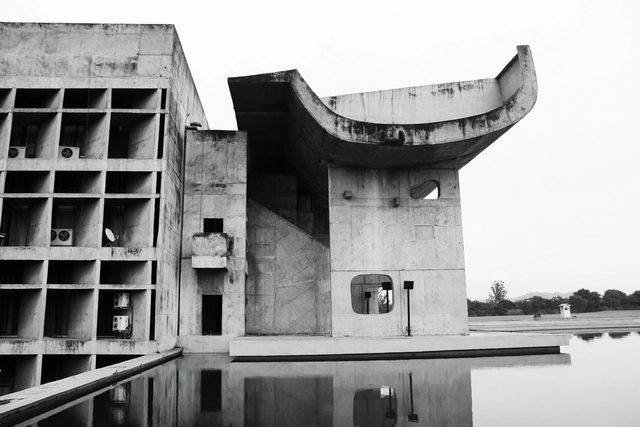
Le Corbusier and Pierre Jeanneret built sublime works amidst the unique landscape of Chandigarh, at the foothills of the Himalayas. They gave the city a new order, creating new axises, new perspectives and new landmarks. Built in the 1950s and early 1960s, the buildings form one of the most significant architectural complexes of the 20th century, offering a unique experience for visitors.
Architect and photographer Fernanda Antonio has shared photos with us from her journey throughout the city, capturing eight buildings and monuments, with special attention given to Le Corbusier’s Capital Complex. View all of the images after the break.
Exhibition, “Anthony Ames: Object-Type Landscapes” is presented and curated by New York-based non-profit Curatorial Project in collaboration with Anthony Ames Architect of Atlanta, Georgia. The exhibition focuses on Ames’s unique work, which is deeply inspired by modern vocabulary of Le Corbusier. Ames’s work is a continuation and adaptation of Le Corbusier’s visual and spatial discoveries, and design strategies. In addition to primarily built residential works the architect experiments with reductive poetic paintings, three-dimensional sculptural compositions, rugs, as well as furniture and porcelain pieces, exploring infinite possibilities in the aesthetics of modern domestic architecture. While it is often the objective of ambitious contemporary architects to define their signature style in architecture, the work of Ames focuses on such important issues as continuity, traditions, and creating a sense of balance and comfort by operating within the familiar. The exhibition gathers his paintings, sculptural compositions, and porcelain pieces within the entire setting of Le Corbusier-designed Casa Curutchet (La Plata, Buenos Aires, 1948-53) that itself can be described as an exploded purist painting. The exhibition will coincide with the XV Buenos Aires Architecture Bienal; it is part of the official program of the Bienal.
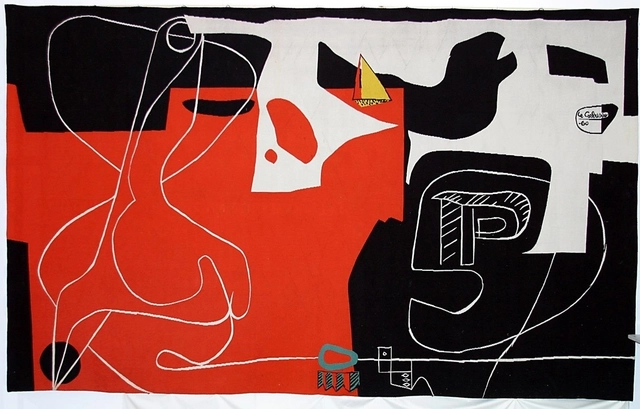
On June 9, 2015, philanthropists finally acquired a tapestry by Le Corbusier originally intended to be hung in the Sydney Opera House. After Jørn Utzon won the commission for the building in 1958, he wrote to Le Corbusier, whom he admired, requesting a piece of “decoration, carpet and painting” for the Sydney Opera House, including drawings of his design. The two met in Paris in 1959 and the work was completed and delivered in 1960, where it was hung in Utzon’s own house. After Utzon left Australia in 1966, the tapestry was never installed in the Opera House, remaining in the Utzon house until now. Read the whole story on Architecture AU here.


.jpg?1472236051&format=webp&width=640&height=580)


.jpg?1472236051)