ArchDaily is continuing our partnership with The Architectural Review, bringing you short introductions to the themes of the magazine’s monthly editions. In this post, we take a look at AR’s September 2014 issue, which includes an examination of the sometimes difficult relationship between architecture and disability. Here, AR Editor Catherine Slessor argues that we should adapt our understanding of Le Corbusier's Modulor Man to be more inclusive, asking "What happens when disability is not seen as a problem for architecture to solve, but as a potential generative impetus?"
From Vitruvius to Le Corbusier, the mathematical proportions of the human form have historically been used to shape and define architecture. Man is, essentially, the ultimate measure of all things. The famous Modulor Man was originally based on the height of the average Frenchman (1.75 metres, or 5 feet 9 inches) but was later increased to a more strapping 1.83 metres (6 feet) because of Corb’s penchant for English detective novels in which (literally) upstanding characters such as policemen, were always 6 feet tall.
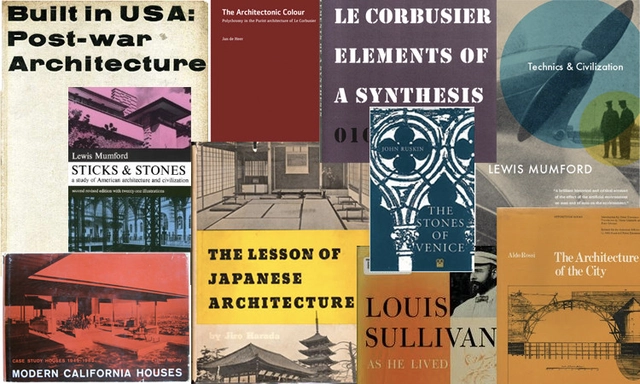
If you don't have access to an architecture library (and even if you do), sifting through shelves can take hours. Buying books can be even more painful — for your wallet, at least. Instead, why not browse this list of 25 books that are all free and easily accessible online? Some are well-known classics of architecture literature, but we hope you find a few surprises as well.
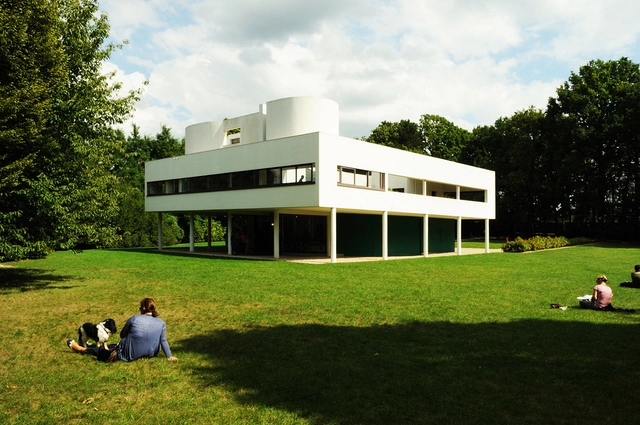
Five of history's most iconic modern houses are re-created as illustrations in this two-minute video created by Matteo Muci. Set to the tune of cleverly timed, light-hearted music, the animation constructs the houses piece-by-piece on playful pastel backgrounds. The five homes featured in the short but sweet video are Le Courbusier's Villa Savoye, Gerrit Rietveld's Rietveld Schröder House, Ludwig Mies van der Rohe's Farnsworth House, Philip Johnson's Glass House and Frank Lloyd Wright's Fallingwater.
Check out this rare footage that captures Le Corbusier as a “young man of 71-years-old” surrounded by paintings and discussing his work, poetry and the "ideal city" within his 1933, self-designed Paris flat.
Where do you receive inspiration? Nalina Moses asked the question to nine contemporary residential architects, asking each to choose one residence that had left an impression on them. The following answers were first published on the AIA’s website in the article “Homing Instinct."
When nine accomplished residential architects were asked to pick a house—any house—that has left the greatest impression on them as designers, most of their choices ran succinctly along the canon of American or European Modern architecture. Two—Alvar Aalto’s Villa Mairea and Pierre Chareau’s La Maison de Verre—were even tapped twice.
If the houses these designers chose weren’t surprising, the reasons they chose them were. Rather than groundbreaking style or technologies, what they cited were the moments of comfort, excitement, and refinement they offered: the restful proportions of a bedroom, the feel of a crafted wood handrail, an ocean view unfolding beyond an outdoor stair.
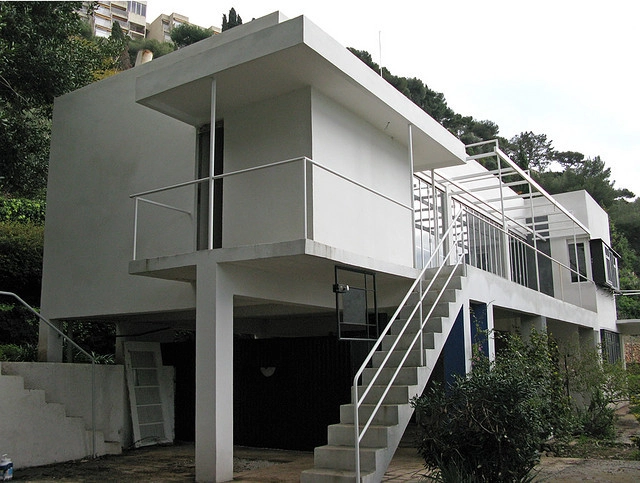
In a public interview, director Mary McGuckian speaks with Shane O'Toole of DoCoMoMo Ireland about her soon-to-be-released film, "The Price of Desire," a biopic about the influential Irish modernist Eileen Gray - narrated from the perspective of Le Corbusier, no less. McGuckian explains how the film and the extensive research behind it went far beyond the usual remit of a biopic. Indeed, not only did it spawn an accompanying documentary ("Gray Matters", directed by Marco Orsini) and book, it even played a pivotal role in the restoration of E1027, Gray's seminal house design, to a point where it was possible to film on location.
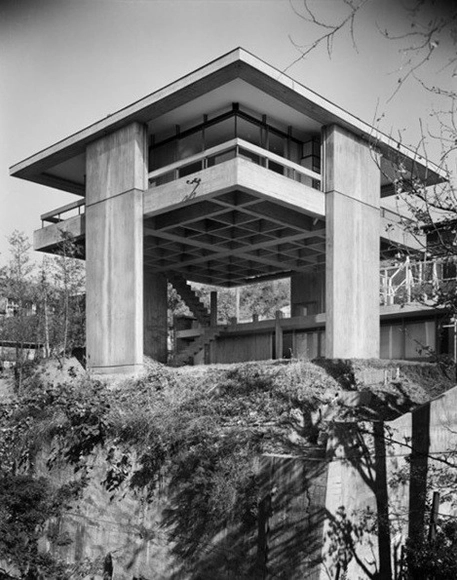
In this article, first published in the Australian Design Review as "The Meeting of East and West: Kikutake and Le Corbusier", Michael Holt outlines the cross-fertilization of ideas that helped spawn the Japanese Metabolist movement, focusing on how Le Corbusier's ideals were key in the design of one of the movement's most enigmatic projects, Kiyonori Kikutake's Sky House.
Japanese architect Kiyonori Kikutake’s Sky House (1958) remains an exemplary project that defines the Metabolist agenda but, more significantly, underscores the notion that a single-family dwelling can be ideologically recursive and strategic. Kikutake, however, was not without a somewhat unlikely precedent in the renowned Le Corbusier.
Both architects established an order and method of working via their smallest designs – Kikutake in Sky House and Le Corbusier at Villa Savoye (1929) – and developed their notions through written accounts (Kikutake’s Metabolist Manifesto, 1960 and Le Corbusier’s Purist Manifesto, predating the built work, in 1918). Finally, each scales up their ideas to the level of the urban through Kikutake’s Tower-Shaped Community Project (1959) and Le Corbusier’s Urbanisme at Chandigarh, India (1953). To locate the origin of the influence, it is necessary to first examine Le Corbusier’s position as the figurehead of Congrès International d’Architecture Moderne (CIAM).
Read on for more about this unlikely chain of influence
This article by Avinash Rajagopal, originally published in Metropolis Magazine as 'The Little Prince' and Le Corbusier investigates the link between Le Corbusier and Antoine de Saint-Exupéry, writer of The Little Prince.
On October 22, 1929, a French architect got on the inaugural flight of the Aeroposta Argentina, a pioneering airline service that flew from Buenos Aires to Asuncion del Paraguay, flown by a French co-pilot. The act of flying would deeply influence the creative output of both passenger and pilot.
The former, of course, was Le Corbusier. The latter was Antoine de Saint-Exupéry, later to be famous as the creator of The Little Prince (1943), the well-beloved tale of a planet-hopping, fox-befriending, flower-loving space child.
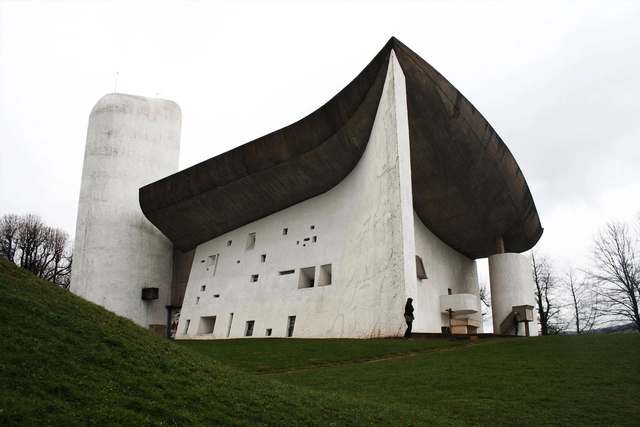
On Friday, a nun gave warning that the Chapel of Ronchamp, considered by many to be one of the key architectural works of the last century, had been vandalized. When police arrived on the scene, they found signs of forced entry: a stained-glass window, one of many executed by Le Corbusier, was broken and a concrete trunk was missing. As Le Monde reports, the intruders had also attempted to gain entry via a door. The overall damage was, according to some, "priceless" because the stained-glass had borne an original illustration by Le Corbusier. An initial assessment from the department of historical monuments found the window to be irreparable.
Where does architecture and the automobile industry meet? Many architects, including Le Corbusier, have tried to understand how building construction can be more like car manufacturing, with mass-produced parts that can be easily assembled on site. Ford recently explored the idea at their Design with a Purpose: Built Tough panel discussion held at New York's Center for Architecture. Click here to read The New York Times' coverage of the discussion, and check out ArchDaily editor-in-chief's thoughts on cars and architecture here.
Since the dawn of the modern era, there has been a strong relationship between architecture and the car, especially in the works of Le Corbusier.
Le Corbusier was fascinated by his car (the Voisin C7 Lumineuse); the aesthetics of this functional, mass produced machine deeply influenced his designs. Its focus on function translated into his concept that houses should be "machines for living" and inspired a series of experiments of mass produced, pre-fab houses (such as the Maison Citrohan). Most of these concepts were later materialized in the iconic Villa Savoye, whose floorplan was even designed to accommodate the car's turning radius.
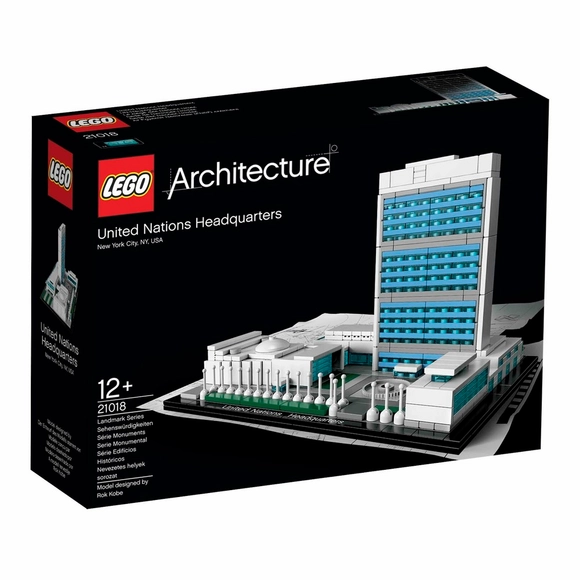
LEGO® has officially announced the next addition to their architecture-inspired products: The United Nations Headquarters. Standing alongside New York City’s East River, the United Nations Headquarters is a beacon of modernism and international collaboration, designed by a team of multinational architects including Le Corbusier and Oscar Niemeyer. Scaling 5 inches high x 8 inches wide x 6 inches deep, this representation of the UN Headquarters costs $49.99.
Check out more about the building and its history here.
In this article, which originally appeared on Architectural Review, Iman Ansari interviews Peter Eisenman about his personal views on architecture throughout the course of his career.
Iman Ansari: More than any other contemporary architect, you have sought a space for architecture outside the traditional and conventional realm. You have continually argued that modern architecture was never fully modern and it failed to produce a cognitive reflection about the nature of architecture in a fundamental way. From your early houses, we see a search for a system of architectural meaning and an attempt to establish a linguistic model for architecture: The idea that buildings are not simply physical objects, but artifacts with meaning, or signs dispersed across some larger social text. But these houses were also part of a larger project that was about the nature of drawing and representation in architecture. You described them as “cardboard architecture” which neglects the architectural material, scale, function, site, and all semantics associations in favor of architecture as “syntax”: conception of form as an index, a signal or a notation. So to me, it seems like between the object and the idea of the object, your approach favors the latter. The physical house is merely a medium through which the conception of the virtual or conceptual house becomes possible. In that sense, the real building exists only in your drawings.
Peter Eisenman: The “real architecture” only exists in the drawings. The “real building” exists outside the drawings. The difference here is that “architecture” and “building” are not the same.
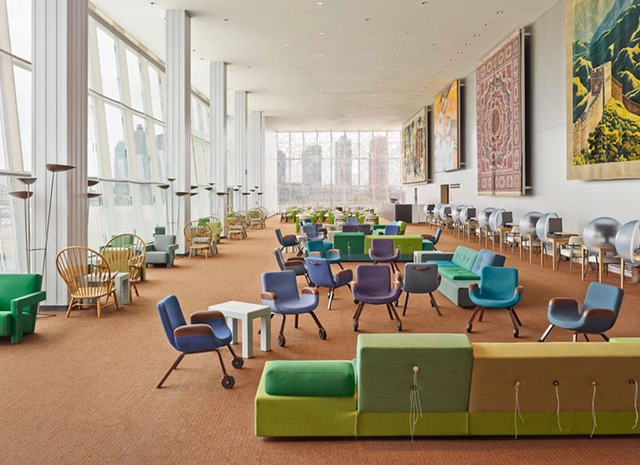
Dutch designers, Rem Koolhaas and Hella Jongerius, have revamped the delegates' lounge in the United Nations building just in time for the 68th General Assembly this week. The "workshop of peace" lounge space, originally designed in 1952 by Wallace K. Harrison in collaboration with renowned modernists Le Corbusier and Oscar Neimeyer, now sports a range of pastel-colored sofas and lounge chairs, opting for minimal intervention in attempts to maximize the social space. Read more about the UN North Delegates lobby on Gizmodo.
https://www.archdaily.com/430669/koolhaas-revamps-un-building-s-modernist-era-loungeJose Luis Gabriel Cruz
The Wall Street Journal recently detailed the complex history of E-1027, the house which Eileen Gray designed with her lover Jean Badovici in Southern France: from the murals which Le Corbusier painted on the walls (without Gray's permission) to the murder that happened there in 1996 to the restoration that has been going on for over a decade (a supposed "massacre" of the original). You can read the full article here.




.jpg?1391552166)



.jpg?1379388488 "An axonometric drawing of Eisenman’s House II, (1975). Image Courtesy of an-onymous.com")

.jpg?1379388545 "Model of Cannaregio project with House 11a at different scales (1978). Image Courtesy of an-onymous.com")
_with_a_caption_from_Eisenman.jpg?1379388568 "The cover of Michael Haneke's \"Funny Games\" (2007) with a caption from Eisenman. Image Courtesy of an-onymous.com")