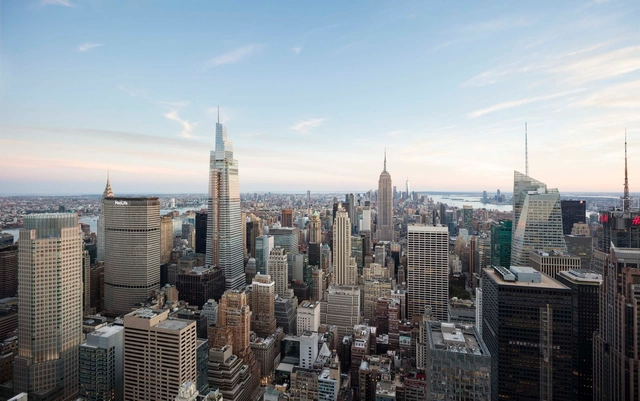
As the largest city in the United States, New York City is one of the most diverse and vibrant cities in the world, recognized by many as the center for global media, culture, fashion art, and finance. The city was founded in 1624 by settlers from the Dutch Republic and has since grown into “the city that never sleeps”.
While almost every style of architecture exists in New York City, the metropolis is most well known for its skyscrapers, both in historical styles such as Neoclassical and Art Deco and in their varied contemporary expressions. The first building to bring the world's tallest title to New York was the New York World Building, in 1890. Later, New York City was home to the world's tallest building for 75 continuous years, starting with the Park Row Building in 1899.
The Camden Highline, a London project that plans to turn a disused stretch of railway viaduct into a new elevated park and walking route, was submitted for planning. The 1.2km route, 8 meters above ground, will connect Camden Gardens in the west to York Way in the east. The design was awarded to a team led by James Corner Field Operations, the practice behind the New York High Line, who will work with Kentish town-based vPPR Architects, London artist Hew Locke, community consultation organization Street Space and Dutch garden designer Piet Oudolf, among others.
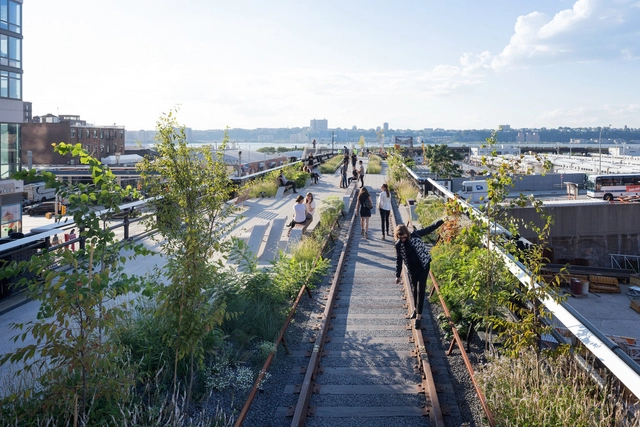
Eight long and prosperous years have passed since the first part of the New York High Line opened in 2009. As a prominent piece New York's architectural and urban identity, it is no wonder that it has been awarded the Harvard GSDVeronica Rudge Green Prize in Urban Design, recognising the ongoing efforts of the Friends of the High Line for their adaptivity to the changing context of the park and their support from the beginning for design excellence.
The jury was particularly inspired by the multidisciplinary project between James Corner Field Operations, Diller Scofidio + Renfro, and Piet Oudolf, spanning the public and private domains as a model of collaborative design. It was also commented on the social and political relevance of the High Line in saving a piece of American history from ruin and interacting through community outreach programs and a wider dissemination program for cities across the US.
Walk into the cafeteria at the Googleplex and you are nudged into the “right” choice. Sweets? Color-coded red and placed on the bottom shelf to make them just a bit harder to reach. “Instead of that chocolate bar, sir, wouldn’t you much rather consume this oh-so-conveniently-located apple? It’s good for you! Look, we labelled it green!”
Like the Google cafeteria guides you to take responsibility of your health, Google wants to transform the construction industry to take responsibility of the “health” of its buildings. They have been leveraging for transparency in the content of building materials, so that, like consumers who read what’s in a Snickers bar before eating it, they’ll know the “ingredients” of materials to choose the greenest, what they call “healthiest,” options.[2]
These examples illustrate the trend of “medicalization” in our increasingly health-obsessed society: when ordinary problems (such as construction, productivity, etc.) are defined and understood in medical terms. In their book Imperfect Health, Borasi and Zardini argue that through this process, architecture and design has been mistakenly burdened with the normalizing, moralistic function of “curing” the human body. [3]
While I find the idea that design should “force” healthiness somewhat paternalistic and ultimately limited, I don’t think this “medicalized” language is all bad – especially if we can use it in new and revitalizing ways. Allow me to prescribe two examples: the most popular and the (potentially) most ambitious urban renewal projects in New York City today, the High Line and the Delancey Underground (or the Low Line).
More on “curative” spaces after the break. (Trust me, it’s good for you.)
Mayor Michael R. Bloomberg is set to announce Cornell University and its partner, the Technion – Israel Institute of Technology, winner of the intense, yearlong competition to build a New York City Tech Campus on Roosevelt Island. The announcement follows Stanford University’s unexpected withdraw from the competition after tense negotiations with the Bloomberg administration. Meanwhile, last Friday Cornell received a $350 million donation in support of their proposal, being the largest gift the University has ever received.
The St. Petersburg Pier, a long-adored and long-outdated West Florida cultural attraction, has unveiled the semi-finalists in its international redesign competition. Of the twenty-three qualified inquiries received, nine were chosen to move forward in the contest. The competition attracted big names in the architecture world; BIG, West 8Urban Design, James Corner Field Operations, and HOK Architects were among the participants.


.jpg?1653033928&format=webp&width=640&height=580)

.jpg?1653033936 "Camden Highline aerial view visualisation. Image © Hayes Davidson")
.jpg?1653033928 "Camden Highline ground level view visualisation. Image © Hayes Davidson")
.jpg?1653033934 "Camden Highline axon drawing. Image © Camden Highline")
.jpg?1653033928)