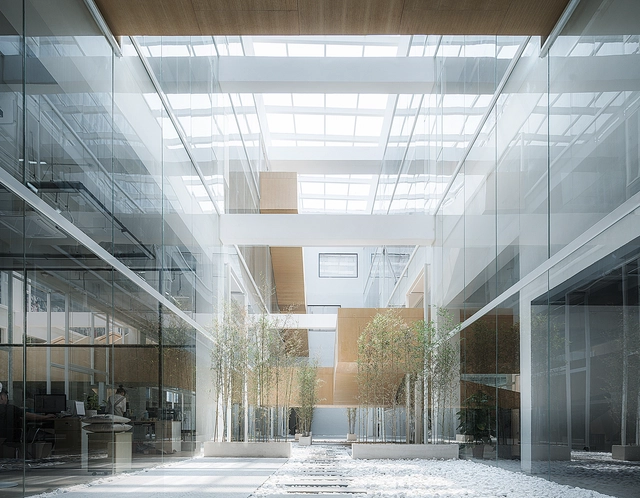
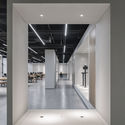
Skidmore, Owings & Merrill’s first venture in Milan is an adaptive reuse of an early 60’s building, originally designed by architects Gio Ponti, Piero Portaluppi and Antonio Fornaroli. The firm imagined a scheme that renovates the former Allianz Milanese headquarters while transforming the Corso Italia Complex into a modern office space.
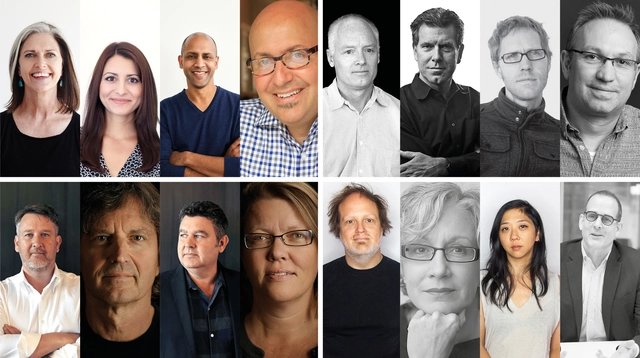
Top row, left to right: team led by Deborah Berke Partners; team led by Kevin Daly Architects. Bottom row, left to right: team led by Olson Kundig; team led by Schaum/Shieh Architects.. Image Courtesy of the respective teams
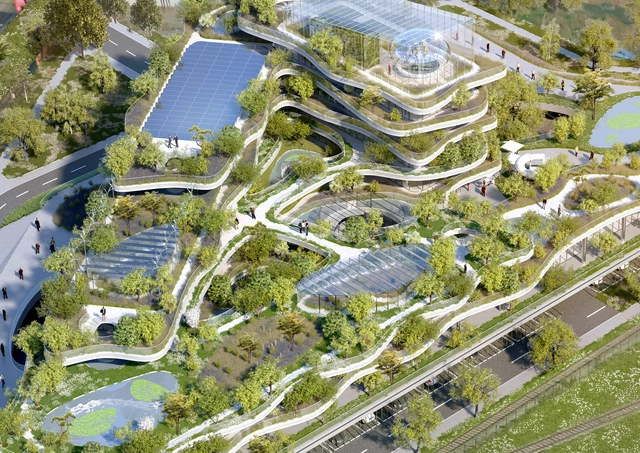
In a design proposal for Soprema’s new company headquarters in Strasbourg, France, Vincent Callebaut Architectures envisions an 8,225 square-meter ecological utopia. The building, called Semaphore, is described in the program as a “green flex office for nomad co-workers” and is dedicated to urban agriculture and employee well-being.
An eco-futuristic building, Semaphore is inspired by biomimicry and intended as a poetic landmark, as well as aiming to serve as a showcase for Soprema’s entire range of insulation, waterproofing, and greening products. The design is an ecological prototype of the green city of the future, working to achieve a symbiosis between humans and nature.
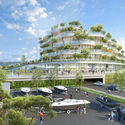
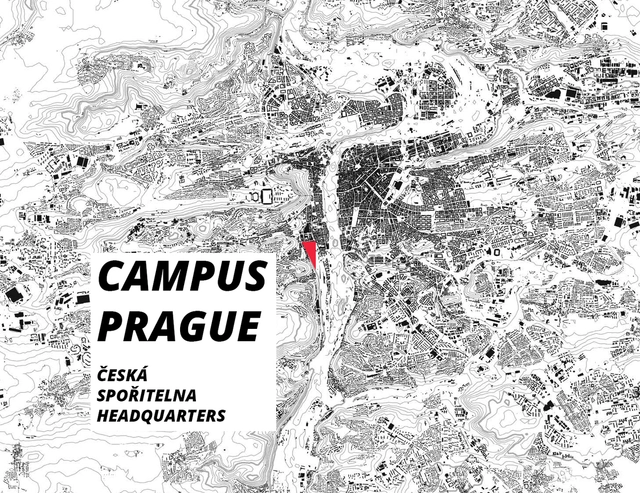
The biggest Czech bank is building its new headquarters – changing a brownfield neighbouring Prague’s historical core – supporting creation of a fresh, liveable city district – forming contemporary environment for its employees, visitors and inhabitants of Prague.
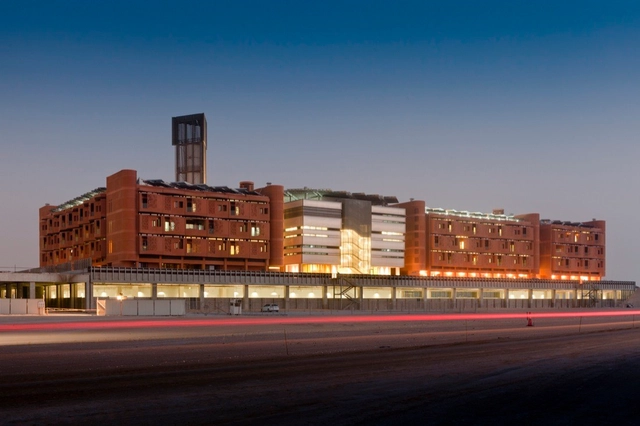
Masdar Institure. Image Courtesy of Foster + Partners
The Norman Foster Foundation has announced plans for its new Madrid-based headquarters to be opened in June this year, whose inauguration will be marked by the first session of the global forum Future is Now, addressing future social, economic and design concerns architecture will face. With the intersection of art, technology, and design, the Foundation facilitates multifaceted thinking and discourse among architects and designers. The opening of its new headquarters is a vital step in “establishing a world-class archive and inaugurating an international program of research, education, and interdisciplinary projects.”
According to the Foundation, “the decision to establish the Foundation as an independent entity, separate from the architectural practice of Foster + Partners, grew out of the perceived need for a permanent physical space that could house the Archive and study center, receive students and graduates, and present programs and projects."
https://www.archdaily.com/868821/norman-foster-foundations-madrid-headquarters-to-inaugurate-with-global-forum-in-juneOsman Bari
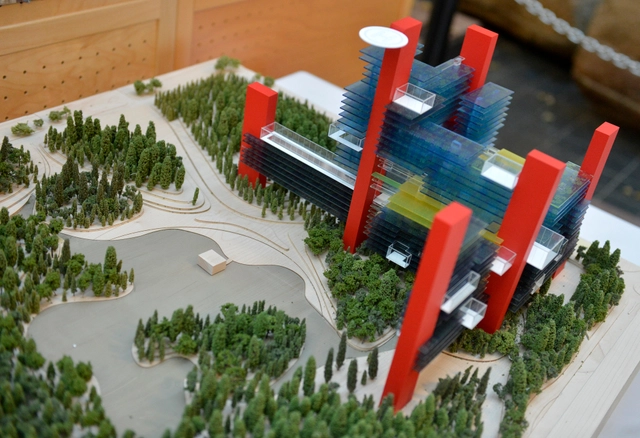
Norwegian energy corporation Statoil has revealed proposals for a new corporate headquarters from the five architecture firms that were shortlisted last October: OMA, Foster + Partners with Space Group, Snøhetta, Wingårdhs, and Helen & Hard with SAAHA. The competition--announced in September of 2013--called for a project that would "take into consideration a number of new measures in the region regarding public transport, parking, roads and other types of infrastructure." The winner will be announced in April/May.
Statoil hasn't disclosed which project belongs to which firm, but the ArchDaily editors have had some fun trying to put a name to each model. What do you think? Let us know your guesses in the comments!
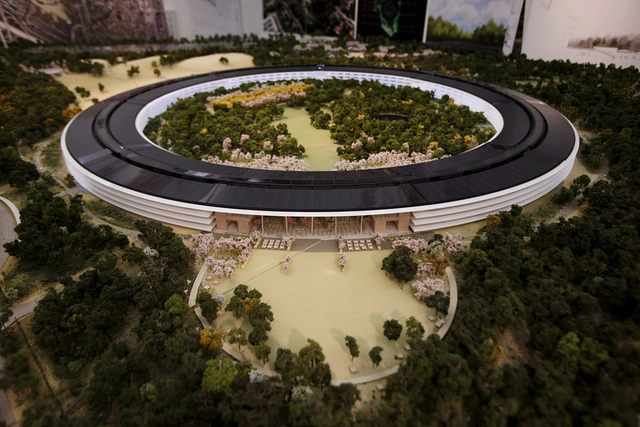
UPDATE: Although having already cleared a preliminary vote, the Apple HQ was given unanimous approval from the Cupertino council yesterday. One "largely perfunctory" vote remains for November 15th. Detailed images, after the break.
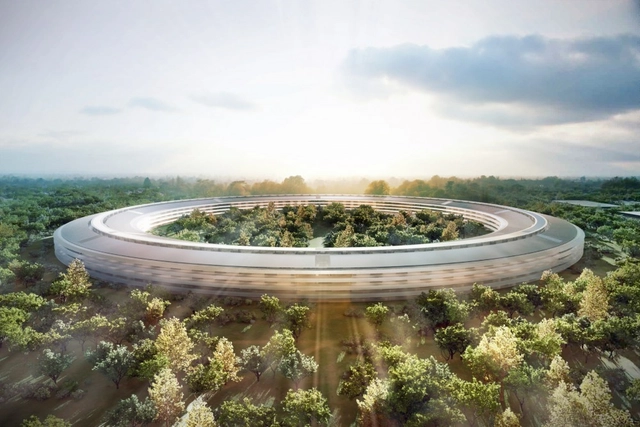
Richard Nieva (CNET) reports that plans for Apple's new corporate headquarters have been approved by Cupertino's planning commission (the final, deciding vote will be in November 2014). The "spaceship", designed by Foster + Partners in collaboration with Kier & Wright, will cover 2.8 million square feet, host up to 14,000 employees, include "a 600-seat restaurant with four-story glass sliding doors", be surrounded by over 6000 trees, and - to top it off - come with a price tag close to $5 billion.
In a recent article for the Financial Times, Edwin Heathcote explores the 'Skyscraper Index', an informal term that suggests a correlation between the construction of a big company's ambitious headquarters and subsequent financial crisis: "Think of the Empire State Building opening into the Wall Street crash of 1929, the Twin Towers being completed as New York City was flirting with bankruptcy or the Petronas Towers in Kuala Lumpur taking the mantle of the world’s tallest building and presaging the Asian financial crisis." Heathcote goes on to describe the latest generation of headquarters being constructed for our current, tech-oriented goliaths - like Apple's monolithic "donut", by Foster + Partners, and Facebook's Gehry-designed Menlo Park campus - and wonders: "if skyscrapers can tell us something about the temperature of an overheating economy, what do these groundscraping new HQs say?" Read the full article here.
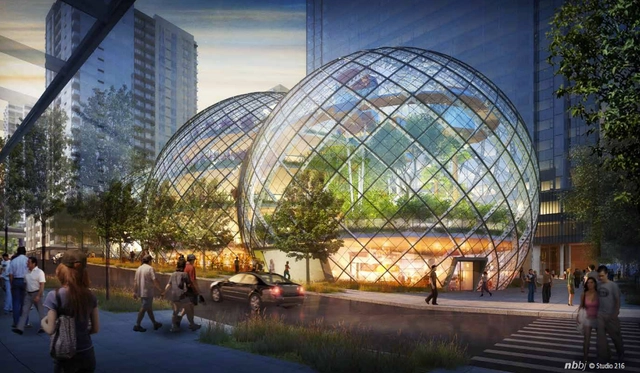
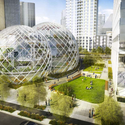
In an attempt to “create an alternative environment” in the center of Amazon’s recently approved, three-block headquarters planned for downtown Seattle, NBBJ has submitted a revision that would replace a six-story office building with a tri-sphere biodome that will host various forms of plant life and provide a more natural setting for employees to work and socialize. Perhaps this change is Amazon’s way of “keeping up with the Joneses”, as many leading corporations - Apple, Google, and Facebook - have been unveiling plans to construct one-of-the-kind office complexes centered around sustainability, innovation and collaboration.
The announcement instigated a flurry of analyses and criticisms over the meaning of the design for the world – the Zen-like significance of the circle, the role of architecture in this technologically-driven age, the legacy and hubris of Jobs – but produced very little discussion over its meaning for the company itself.
Meanwhile, months before news of the “spaceship” landed, another internet giant was searching the California landscape for its own space to call home. Still very much under-wraps, the new Googleplex will be the first time Google builds a workplace completely from scratch. [2]
These projects will be the Magnum Opuses, the ultimate physical representations, of the two most influential Tech companies in the world, and the two share striking similarities. So let’s clash the plans of these two titans and take another look at Apple 2 – but this time in the light of Google – and see what they can tell us about these companies’ futures.













.jpg?1505225945 "Staff Canteen")