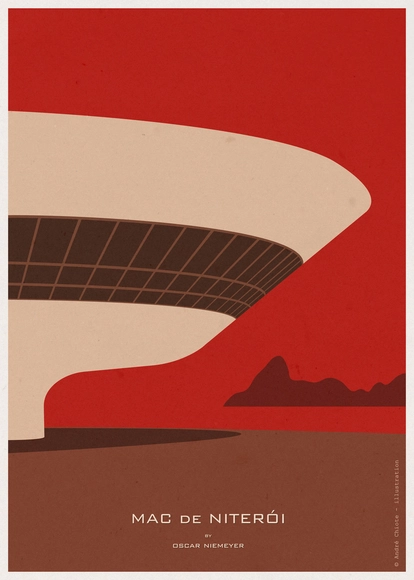
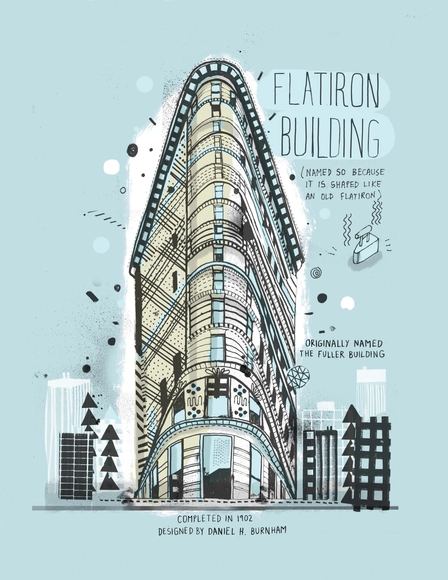
André Chiote, a Portuguese architect renowned for designing illustrations that represent some of architecture’s most iconic buildings, has agreed to give five lucky winners a copy of their favorite print. To participate, browse through Chiote’s collection on his online shop and tell us which illustration you like the best in the comment section below.
You have until Wednesday, January 29th to submit your comments. Winners will be contacted the following day. Good luck!
Related Companies founder Stephen Ross has commissioned London designer and architect Thomas Heatherwick to design what could be, according to the Wall Street Journal, “one of the most expensive works of public art in the world.” Planned to be the centerpiece of Related’s Hudson Yards project in Manhattan’s West Side, the estimated $75 million artwork and its surrounding 4-acre public space aims to become “new icon for the city.”
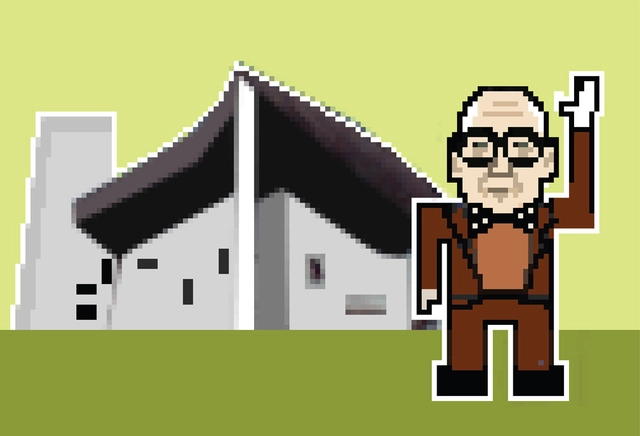
Complicating is easy, simplifying is difficult. To simplify you have to remove, and to remove you have to know what to take away. The idea of this project, called ARCHIPIX (Less is Pixel) by Federico Babina Architect, is to represent the complexity of the forms and personalities through the simplicity of the pixel. Masters of modern architecture, paired with a building that represents their essence, often become desktop icons. A digital "pointillism" where the mouse replaces the brush. The pixel reappears and emphasizes the importance of the single dot, seen as something essential that in combination with other points form a more complex picture. A metaphor of architecture where every little detail is a key component of the whole mosaic.
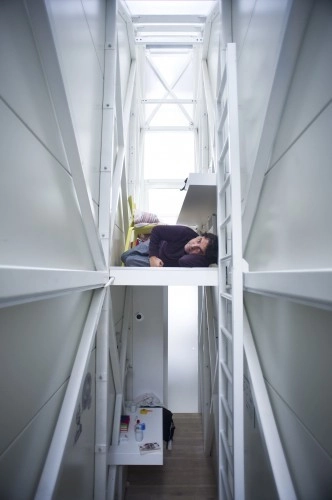
Would you ever want live in the Keret House - the world's skinniest dwelling - in Warsaw, Poland? Well, now's your chance. The Polish Modern Art Foundation has announced an open call for resident applications to artists (under age 35) practicing in the fields of architecture, visual arts, literature, music or film. If selected, artists will have the opportunity to live in the Keret House for up to 21 days to realize a project of their own design. The residency aims to foster individual artistic expression, promote creative exchange, and expose artists to the cultural environment of Poland while offering them the chance to experience what many believe to be an "impossible architecture." See if you are eligible to apply here.
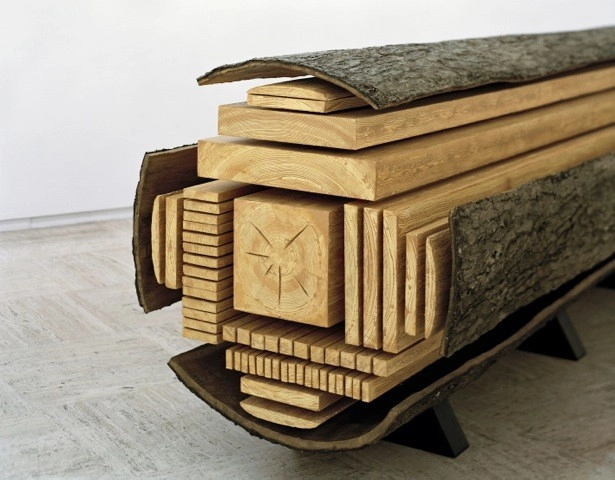
Created by Swiss sculpter Vincent Kohler, this stunning installation beautifully deconstructs the log. Titled “Billon”, 110 x 100 x 300 cm piece is made of wood, polystyrène, and résine.
ALL THE BUILDINGS IN NEW YORK is a blog, a book, and, above all, illustrator James Gulliver Hancock's love letter to New York City.
As his website reveals, Hancock "panics that he may not be able to draw everything in the world… at least once." Since Kindergarten, he's been obsessed with drawing in meticulous detail (or, as he tells the Atlantic Cities, with a mix of "technicality and whimsy"), a characteristic this native Australian brought with him when he moved to Brooklyn, New York.
What began as a blog, All The Buildings In New York, to keep track of his many sketches of New York's architecture (particularly the brownstones), is now a book (All The Buildings in New York: That I've Drawn So Far - which includes about 500 drawings). Organized by neighborhoods, it features New York architectural icons from the past and present, including the Chrysler Building, the Flatiron, Apple's 5th Avenue store, as well as the everyday buildings that make up New York's unique cityscape.
See more images from All the Buildings in New York, after the break...
With just a Rotring Isograph pen on arches paper, artist Mark Lascelles Thornton completed this scrupulously detailed architectural drawing project titled "The Happiness Machine". Each sheet represents a city - such as Chicago, Shanghai, London and New York - and is stylized in red and gray ink.
In addition to the meticulous detail of the buildings, the work is even more amazing considering the scale: the final piece will spread across eight panels measuring 8 by 5 feet.
The internationally - and often controversial - acclaimed artist Christo has unveiled the “largest indoor sculpture ever made”. Prepared to debut in a public exhibition starting March 16, the inflated “Big Air Package” has been designed to occupy a 117-meter-tall former gas tank known as Gasometer Oberhausen in Germany. The 90-meter-high, 50-meter-wide sculpture is made from 20,350 square meters of semitransparent polyester fabric and 4,500 meters of rope, with a total weight of 5.3 tons and a volume of 177,000 cubic meters.
The seemingly endless, inflatable installation was conceived in 2010 and is Christo’s first major work after the passing of his wife and artistic partner Jeanne-Claude in 2009.
More on Christo’s “Big Air Package” after the break...
Created and conceived by Patrick Duffy, the creative director of the OUT NYC, and designed by award-winning Italian designer and architect Antonio Pio Saracino, the Arches of Hope installation will be launched at its opening reception on Thursday, January 17, from 6:30pm-8:30pm at the OUT NYC and be on display until January 24. In collaboration with Lifebeat: Music Fights HIV/AIDS and the MTV Staying Alive Foundation, the stunning and inspiring interactive art installation will be unveiled on the eve of President Obama’s second inauguration as part of a multi-faceted campaign aimed at raising awareness of the rise of HIV and AIDS in young people. More images and information after the break.
Designed by Paolo Venturella & MenoMenoPiu Architects, their ‘Solar Loop’ finalist entry for the Land Art Generator Initiative competition aims to expose more surface as possible to the southern solar rays. Sited in FreshKills Park in New York City, the shape comes directly from the solar diagrams, and deals easily with the sun following it with the best angle almost like a frozen artificial sunflower.bThe aesthetic of the sculpture is the result of this dialogue that becomes synthesis between the solar power and the park. More images and architects’ description after the break.
Earlier this week, we announced the completion of the world’s narrowest house in Warsaw, Poland. The Keret House was first conceived as a seemingly impossible vision of the Polish architect Jakub Szczesnyof Centrala, who first presented the idea as an artistic concept during the WolaArt festival in 2009. Now, three years later, the vision has become a reality and is drawing a significant amount of international attention to the city of Warsaw.
Built between two existing structures from two historical epochs, the narrow infill is more of an art installation that reacts to the past and present of Warsaw. Although the semi-transparent, windowless structure’s widest point measures only 122 centimeters, it’s naturally lit interior doesn’t seem nearly as claustrophobic as one would think.
The Keret House will serve indefinitely as a temporary home for traveling writers, starting with Israeli writer Etgar Keret.
Images and the architects’ description after the break…
The hand-drawn work of Chris Dent takes on the modern metropolis – depicting architecture in a way that is at once meticulously accurate & playfully imaginative.
The highly anticipated “Twilight Epiphany” Skyspace, designed by American artist James Turrell, will open to the public today with a sunset light show. The abstract pyramidal structure complements the natural light present at sunrise and sunset, creating a mesmerizing light show that connects the beauty of the natural world with the surrounding campus. This experience is enhanced by an LED light performance that projects onto the 72-by-72-foot thin white roof, which offers views to the sky through a 14-by-14-foot opening. Additionally, the Turrell Skyspace is acoustically engineered for musical performances and serves as a laboratory for music school students, as it stands adjacent to the Shepher School of Music on the Rice University campus in Houston, Texas.
David Leebron, Rice University President: “The campus has to play its role in inspiring our students.”
Continue after the break to watch a sneak preview of the Turrell Skyspace light show.
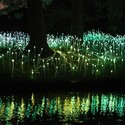
Visitors poured into Longwood Gardens this past Saturday to see 23-acres of breathtaking ‘Light: Installations’ by artist Bruce Munro. Although Munro describes the installations as simply “sketchbook jottings realized”, this “large-scale one-man-show” is anything but a simple feat. Eight large outdoor installations, two installations within the 4-acre Grand Conservatory and a collection of illuminated sculptures in the Music Room are keeping visitors mesmerized for hours.
Munro’s ‘Light: Installations’ are being shown for the first time outside of the UK. They will remain open until September 29th this year. Continue reading for more images and information.
“A Thousand Traps to Escape” is a temporary installation designed by 13 students from Laval University under Olivier Bourgeois in the Magdalen Islands in Quebec, Canada. The project builds on the collaboration of themes of architecture, art, landscape and installation in the creation of space based on simple materials, the landscape and “the basic rules of construction”. The “local material” chosen for this construction is the ubiquitous lobster trap made of wood and fishnet. Its formal simplicity allowed for an basic stacking technique that produced relatively complex visual results of transparencies and opacities.
Read on for more information on the development of this project.
Vacant land is a looming problem for many cities, especially when it remains undeveloped for years or is transformed into garbage dumps and parking lots. But when designers begin to notice these voids within the activity of a city they are able to unlock the inherent potential in the land. That is precisely what “Not a Vacant Lot”, as part of DesignPhiladephia, did this October. Philadelphia’s 40,000 vacant lots are both a challenge and an opportunity for young designers, artists and architects to tranform these under-utilized spaces into experiences within the fabric of the urban environment. The focal point of the design intervention was at the University of the Arts lot on 313 S. Broad Street, just a few blocks from Philadelphia’s center. It featured a reinterpreted map of Philadelphia by PennDesign students and Marianne Bernstein’sPlay House, an 8′x8′ aluminum cube which, in its simplicity, could unlock the potential of this particular lot. But this engagement of vacant land was just one such intervention in a series artist installations throughout Philadelphia. Another such intervention, GroundPaper, was designed by two collaborating artists, Mike Ski and KT Butterfield. The site of their choosing was along the banks of the Delaware River in Fishtown, a neighborhood of Philadelphia.
Read on to see what artists can accomplish with no budget, a vacant lot and an inspired idea.
Controversial artists Christo and Jeanne-Claude – known for making large-scale architectural interventions in urban and rural environments – have finally gotten approval from the Bureau of Land Management to construct their most recent project “Over the River”, which will stretch along 5.9 miles along the Arkansas River in Southern Colorado.
Read on for details of the project and more images!