
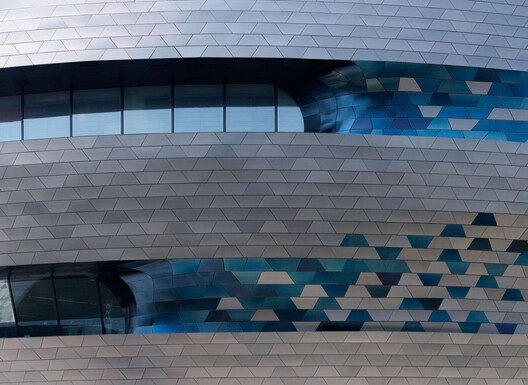
In September 2008, at a series of sessions organized alongside the 11th Venice Architecture Biennale under the name of the Dark Side Club, a text was presented that announced, for the first time since Modernism, a new style for architecture. Parametricism as Style, written by Patrik Schumacher, then a partner at Zaha Hadid Architects, called it "the great new style after modernism" and recast Postmodernism and Deconstructivism as "transitional episodes" that had prepared its arrival. What the manifesto proposed was a design logic in which every element of a project, from the urban plan down to the tectonic detail, the interior and the product, would be treated as a variable, so that form could differentiate continuously and adapt to the shifting demands placed upon it.
Eighteen years is a long time in digital culture, and the manifesto has had an unusually long afterlife. It was relaunched in 2016 as Parametricism 2.0: Rethinking Architecture's Agenda for the 21st Century, an entire issue of Architectural Design built on the premise that the style had been delayed by circumstance while remaining intact as a project, one presented by its publisher as "progressing beyond its experimental roots to make an impact on a broader scale" while maintaining that parametricism was "not universal, but it's sufficiently entrenched." Architecture has no shortage of manifestos, but very few of their authors are still around to be asked whether their prophecies have come true.

Reread today, the text holds up best as a document of a particular moment, when fifteen years of digital experiment had accumulated without a theory to organize them. The argument here is that the three things it bundled together (a technique, a set of formal rules and a diagnosis of society) have since come apart, each for its own reasons, and that what survives is the demand underneath them, the idea that a style is a research program, a set of rules about what to pursue and what to refuse, and that a discipline is weaker without one. By that measure, the manifesto has been both defeated and vindicated.
Scripting
In 1993, Greg Lynn guest-edited Folding in Architecture, an issue of Architectural Design that read Gilles Deleuze's The Fold (first published in French in 1988) as a brief for an architecture of continuous variation. Behind it lay Bernard Cache's objectile, a term Deleuze took from him to describe an object conceived as a function, a rule capable of generating a whole family of variants. Much of what the 2008 text would claim was already present in that idea, although in the 1990s it lived inside animation software developed for the film industry, within reach of a handful of studios and schools. That changed in September 2007, a year before Venice, when David Rutten released a free Rhino plug-in called Explicit History, soon renamed Grasshopper and eventually folded into Rhino 6 in 2018 as part of the package. Within a decade, associative modeling had stopped being an avant-garde competence and become an ordinary office tool.
In September 2010, the researcher Daniel Davis argued that a parametric model is a means of representation with no form of its own, and that drawing the Villa Savoye in Grasshopper would not make it parametric architecture, which is another way of saying that the technique could travel without the style. The manifesto was poorly placed to answer, since it had tied the style to its instruments from the start. Among its heuristics, besides the instructions to interarticulate and to morph, it told architects to "use splines, nurbs, generative components, script rather than model", a list that places software and modeling routines among the style's principles.
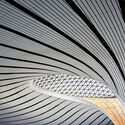
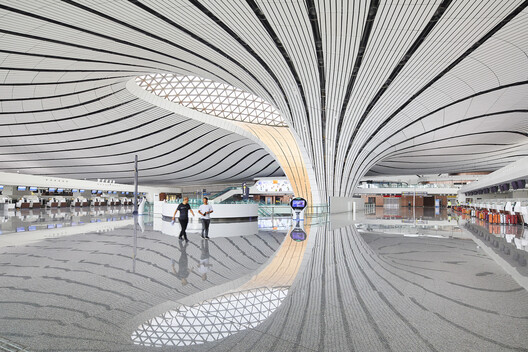
The manifesto also explained why this style, and why now. Styles, in its account, arise from the conditions that make them necessary, and the conditions were those of "the socio-economic era of post-fordism", a heterogeneous society whose complexity would demand an architecture of continuous differentiation, whether or not anyone liked it. Measured against that standard, the record since then divides badly. The technique became universal for reasons that have little to do with post-Fordist complexity and a great deal to do with a plug-in being free and a construction economy that wanted its arithmetic checked. The forms, meanwhile, took hold mostly in very large, one-off commissions (airports, stadiums, cultural institutions), the few programs whose budgets could absorb a method in which form was settled first and structure and envelope were resolved afterwards. Beijing Daxing International Airport, designed by Zaha Hadid Architects and opened in 2019, belongs to this type at its largest-scale buildings, and it is instructive precisely because it is so hard to repeat.
Mario Carpo offers a second reading in which the technology moves first and style trails behind it. In The Second Digital Turn, published in 2017, he treats the smooth, curving surfaces of the 1990s as the signature of a first digital age, shaped by tools that were still short of computing power, and describes what followed as a different regime, in which software has become a set of "tools for thinking" and the data-compression techniques on which earlier design depended are no longer needed. The spline was one of those techniques, a compact shorthand standing in for a list of coordinates too long to handle. If the smooth geometry owed its necessity to the hardware of a particular decade, it carried a date from the start, and digital design was already moving toward discrete parts and aggregation while the manifesto was being relaunched in 2016.
Rules and Refusals
Read now, the manifesto is stranger than its reputation; it contains almost no description of buildings and a great deal of legislation. The apparatus comes from Imre Lakatos, the philosopher of science who argued that theories are never tested one at a time and are defended instead as programs, with a hard core that adherents agree to protect and a belt of working assumptions that absorbs the damage when evidence goes against them. Lakatos attached to the model a criterion that keeps it honest, by which a program is progressing while it keeps turning up things nobody was looking for, and degenerating once its energy goes into explaining what it got wrong. Transposed to architecture, this produces a list of techniques to pursue and a list of refusals, and it is the second that has aged most strangely (avoid repetition, avoid straight lines, avoid right angles, avoid corners).
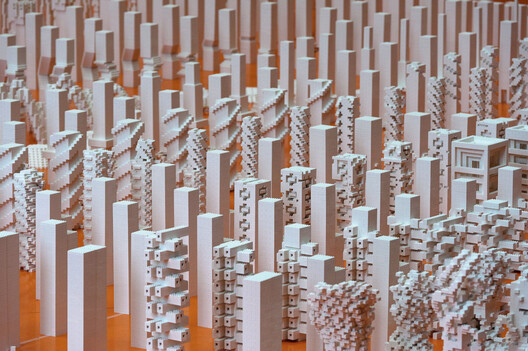
"There can be neither verification, nor final refutation merely based on its built results", the text declares of a style, which places the enterprise beyond the reach of any individual disappointment. It can look like a cheap trick, although it is roughly how any discipline shields a young idea from its own early prototypes. However, what Lakatos also provided was a way of determining when the protection had ceased to be effective; its expiry date. Eighteen years spent on the wrong side of his distinction is a long time when adoption is slower than predicted.
Of all the refusals, the ban on repetition was the most significant. Its justification has to be read from the diagnosis, which contrasted the "mass society" of modernism and its single standard of consumption with a far more heterogeneous present, and concluded, in effect, that a society which no longer consumed identical things should no longer be housed in them. That is a statement about the economy, and it depends on what the economy rewards. Embodied carbon is now measured, increasingly priced and, in countries such as France and Denmark, limited by regulation, and since a large share of it sits in structure and envelope, ordering the same element a thousand times, with less waste, faster fitting and some prospect of demounting and reuse, has come to count in a project's favor.
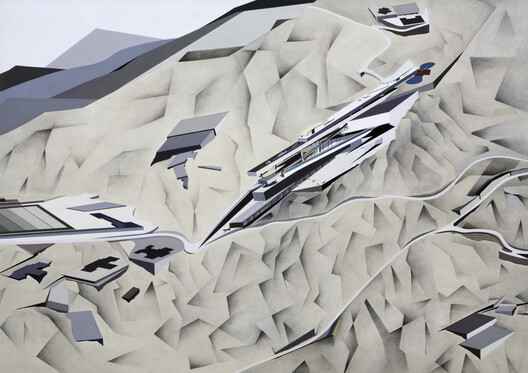
The style's own revision came in 2017 under the name Tectonism, later described as "a sub-style within parametricism", a modest label for what is, in practice, a change of direction. Form is now meant to emerge from structural behavior and from what a robotic arm or a concrete printer can actually do, so that geometry follows the flow of forces and the reach of the machine. The term had already been explored in 1995, when Kenneth Frampton, in Studies in Tectonic Culture, used it to describe architecture as a poetics of construction, something read in the way a building meets the ground, carries its roof and, above all, joins one part to another, and set it against the scenographic, the building conceived as an image. It is a curious inheritance for a style whose founding text had legislated against precisely that kind of legibility (avoid clear-cut zones, it instructed, and never add or subtract "without elaborate interarticulations"), which comes close to banning the joint altogether. The flow of forces appears instead as ribs and striations drawn across a single continuous figure, as in Striatus, the printed concrete footbridge that Zaha Hadid Architects built in Venice in 2021 with ETH Zurich's Block Research Group, where structure turns into pattern and the engineering diagram takes over the role the render once played.
Economy in the Form
The manifesto's case for its forms was social and economic (before it was formal). Parametricism offered itself as the spatial form of a networked, self-organizing society, an order that arises from interaction without anyone drawing it up, which describes a building and, in slightly different terms, a market. In Architecture and Utopia, Manfredo Tafuri had warned that architecture's formal radicalism is routinely absorbed by the development it believes itself to be criticizing, and Douglas Spencer, in The Architecture of Neoliberalism (2016), brought that warning up to date by reading smooth, continuously differentiated space as the favored environment of neoliberal management, emancipatory in its imagery and discreet about the labor and procurement conditions that produced it. Read as determinism, the argument is easily dismissed, given how many architects have used these tools with no interest in the economics attached to them. Still, the style's most complete buildings were only possible for clients who could afford them.
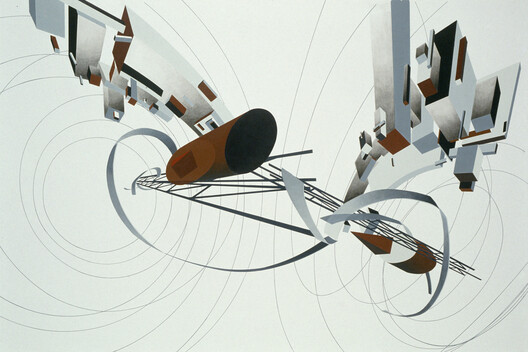
But if the social half of the case came away without anyone much noticing, the technical half has come apart more recently. Image generators trained on, among much else, two decades of published architecture now produce continuous differentiation on request, with no associative model, no parameters and no structural reasoning of any kind (a long way, it should be said, from "script rather than model"). For twenty years the parametric surface worked as a credential, telling a client or a jury that the office behind it had computational capacity and could carry the risk that came with it, and once the same surface can be produced in seconds it stops telling anyone very much. By the manifesto's own definition, a style that survives as appearance, with no research program underneath it, has become one more look among the many it had hoped to supersede.
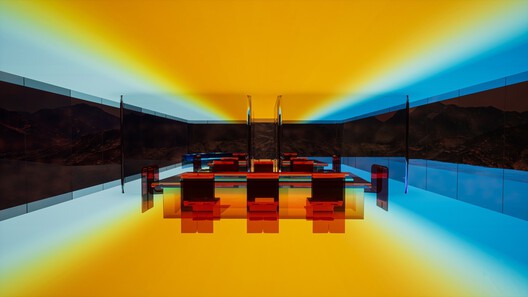
None of this disposes of what the manifesto asked for, which was a shared project, explicit about what to pursue and what to refuse, and over the same eighteen years the discipline has in fact acquired one, from a direction the text did not anticipate. Carbon now comes with its own metrics and prohibitions and with a stronger claim on historical necessity than post-Fordism ever had, and it reached architecture from outside, through regulation and accounting, without needing a manifesto to be adopted. It tells architects what to count and what to avoid and says almost nothing about what a building should be, so that it produces compliance where the 2008 text wanted conviction. The generation of small practices that formed after 2008 has made a position out of declining to sound certain, and the sensibility that followed them has yet to settle into a doctrine, which may be why a text so easy to fault has proved so difficult to put away. The question it asked in Venice, whether architecture can still share a project about form, remains open long after its own answer stopped convincing.
This article is part of the ArchDaily Topic: Beyond Buildings: Architectural Imaginaries and the Evolving Language of Design, proudly presented by Gendo.
Gendo is an AI design canvas built for architecture studios. Gendo supports this topic because the tools architects use to imagine have always shaped what they build. Understanding that shift matters more than any single render.
Every month we explore a topic in-depth through articles, interviews, news, and architecture projects. We invite you to learn more about our ArchDaily Topics. And, as always, at ArchDaily we welcome the contributions of our readers; if you want to submit an article or project, contact us.


