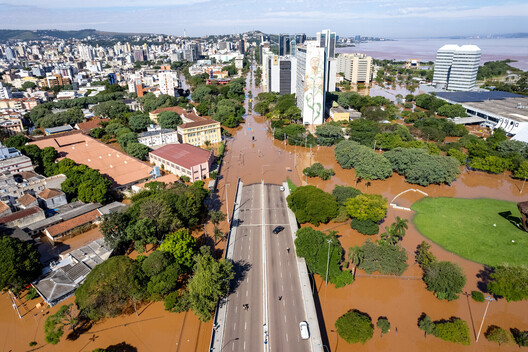
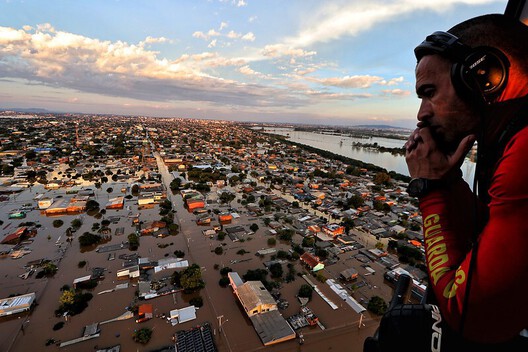
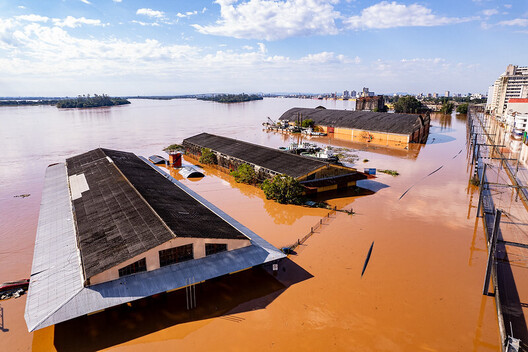
In May 2024, the floods that hit Rio Grande do Sul exposed a contradiction common to contemporary cities. Many were built alongside rivers and shaped by their presence, yet spent decades trying to control water without incorporating its dynamics into urban planning. Extreme weather events will intensify that vulnerability. More than two years later, reconstruction in the Brazilian state has progressed, infrastructure has been restored, and new protection strategies are taking shape. But are these cities rebuilding their relationship with water, or only restoring the systems that failed?
The occupation of flood-prone areas, soil sealing, ecosystem degradation, and reliance on aging drainage systems have increased municipalities' vulnerability. The disaster was not merely hydrological; it also resulted from decades of urban planning decisions that urgently need reconsideration.
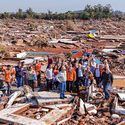
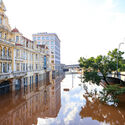
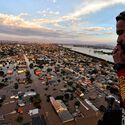
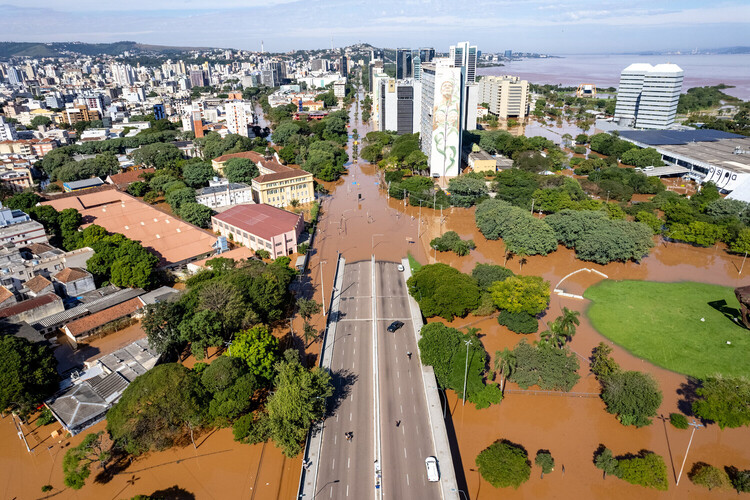
The scale of the loss shows what is at stake. The state Civil Defense agency reported more than 581,000 people displaced in a disaster that affected 478 of Rio Grande do Sul's 497 municipalities. A survey conducted by IBGE, published in 2026, estimated that 81,272 homes in the surveyed areas were destroyed and another 190,253 suffered very severe structural damage.
Related Article
Floods in Rio Grande do Sul: The Tragedy of Non-Resilient CitiesThe survey also identified 922,000 people who had changed addresses after the disaster; for about half, the floods were the reason they moved. These figures show that rebuilding does not simply mean replacing buildings. It means restoring opportunities and social ties, as well as people's sense of security.
Porto Alegre: Strengthening Defenses, Rethinking Resilience
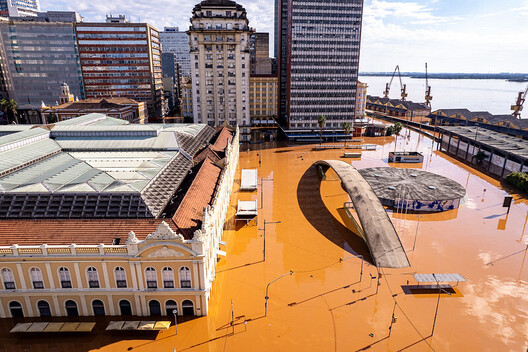
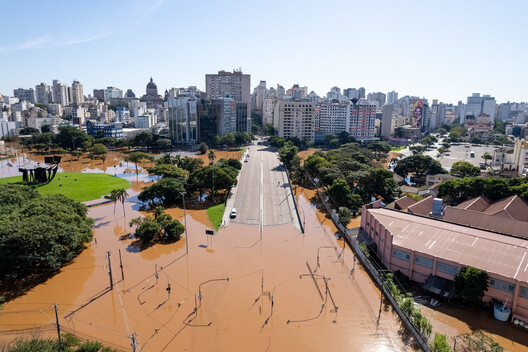
In Porto Alegre, the state capital, home to approximately 1.4 million inhabitants, the response has focused in part on restoring and modernizing the flood protection system designed in the 1960s. The system comprises approximately 68 kilometers of levees, 14 passages originally equipped with floodgates, and 23 stormwater pumping stations. In May 2024, the Guaíba River reached 5.37 meters, well above the three-meter flood level. The scale of the event exposed weaknesses in both the physical barriers and the operation and integration of different components of the urban infrastructure, laying bare the lack of maintenance of these structures.
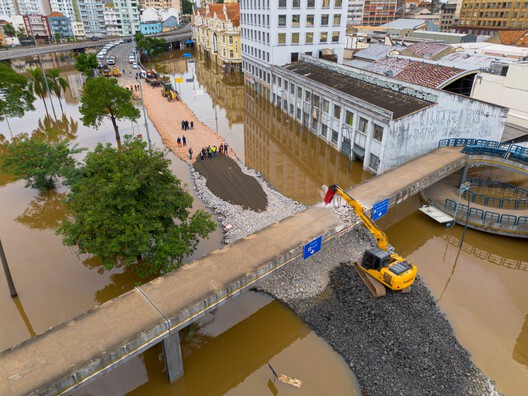
However, progress in structural interventions does not reduce the amount of work that remains. The city government plans to expand urban drainage with 9 new pumping stations, 26 kilometers of drainage networks and galleries, 11 stormwater detention basins, and 2 kilometers of linear park. The improvements, distributed across different watersheds, are expected to be completed by 2031.
A key limitation of a strategy based primarily on levees, walls, and pumps is that these structures cannot eliminate risk under all circumstances. These structures are essential in densely populated areas, but when water exceeds their design capacity, or they fail, the city can be suddenly exposed. In addition, barriers that protect certain areas can hinder rainwater drainage within those zones. Resilience therefore depends on combining conventional infrastructure with solutions that slow runoff, increase water storage capacity, and restore space to waterways.
This is precisely where the sponge city approach, developed and promoted in several Chinese cities, offers a complementary perspective. Rather than relying exclusively on pipes and channels to carry water away as quickly as possible, the strategy seeks to absorb and gradually release rainwater. The Chinese experience is particularly interesting because it demonstrates that this transformation need not be limited to small or sparsely developed cities. The sponge city approach can also be incorporated into major urban centers by retrofitting existing squares, streets, parking lots, schoolyards, and public spaces.
Indeed, the approach is widely advocated by urban planning scholars in Porto Alegre, considering the city particularly well suited to implementing this strategy. This perspective does not imply replicating the Chinese model wholesale, but rather adapting its underlying principles to Porto Alegre's existing natural features, including its waterways and remaining green areas.
We don't need to import sponge city models. We have the conditions to create a sponge city that makes use of the nature we still have. -- Rualdo Menegat, professor at the Federal University of Rio Grande do Sul (UFRGS).
Despite these favorable conditions, some ongoing urban interventions appear to be moving in the opposite direction. For example, repaving large areas of the city center with concrete pavers raises questions about how much permeability and water absorption are being incorporated into the city's reconstruction efforts. Rather than moving toward a sponge city, Porto Alegre risks becoming a paver city.
Cruzeiro do Sul: Rebuilding on Safer Ground
If Porto Alegre represents the challenge of transforming an established metropolis, Cruzeiro do Sul offers a more radical example of territorial reconstruction. Located in the Taquari Valley, approximately 126 kilometers from Porto Alegre, the municipality has 11,600 inhabitants. In 2024, flooding along the Taquari River severely affected the city, forcing approximately half the population to leave their homes and affecting around 95% of commercial establishments.
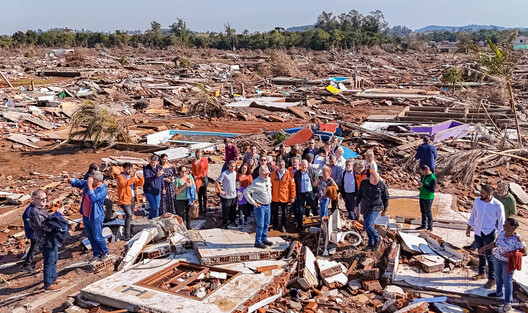
In the Passo de Estrela neighborhood, for example, more than 600 houses were destroyed. However, rather than rebuilding the community on the same site, the adopted strategy calls for relocating it to higher ground, approximately three kilometers from the former neighborhood. The project includes 150 houses, 174 plots, recreational areas, environmental preservation areas, and plots designated for public facilities such as a school and a church. The plan also includes commercial areas and public gathering spaces. Construction began in May 2026, and the schedule anticipates delivering homes between December 2026 and October 2027. On the original site, the proposal is to establish a memorial park and prohibit new residential construction.
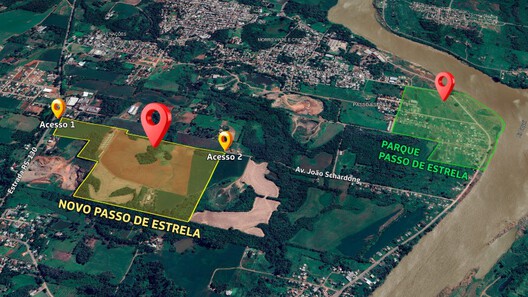
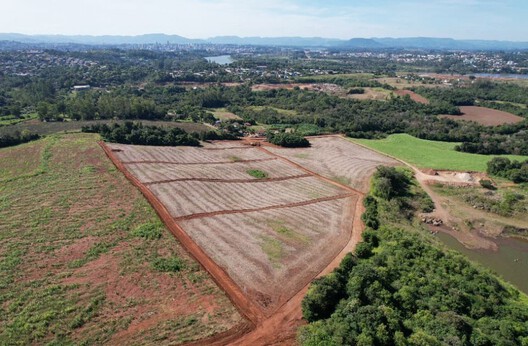
The difference from Porto Alegre is significant. While the capital seeks to strengthen and complement its protection infrastructure, Cruzeiro do Sul may need to reorganize an affected territory completely. In smaller areas, where development is less dense and land is relatively more available, relocation may be more feasible. Even so, resettlement is not a simple solution. The success of relocation depends not only on providing safer homes, but also on enabling residents to maintain the relationships and support networks built in their former neighborhood.
That's what I asked for: to be placed near my neighbors. We're all on the same street; we've just changed neighborhoods. -- Ines Rodrigues, a resident affected by the floods in the Taquari Valley.
Homes Delivered, a City Still to Be Built
Beyond the cities mentioned, numerous other municipalities are undergoing reconstruction. Returning to the housing figures, in February 2026, the federal government reported that more than 10,000 homes had been contracted through the "assisted purchase" program, which allows eligible families to choose new or existing properties in areas considered safe. In April 2026, the federal government's reconstruction report indicated that 12,468 housing units had been delivered through this program, with approximately 25,000 homes contracted or in the process of being contracted across all housing initiatives.
Although significant, these figures require careful interpretation. Contracted homes are not necessarily delivered homes, and handing over a house does not, in itself, mean that a family has recovered its previous living conditions. Purchasing an existing property can speed up assistance, but it can also relocate families far from their former places of work, study, and social interaction. The challenge is to prevent the housing response from creating new problems of segregation.
Rebuilding Also Means Deciding Where Not to Build
Two years later, Rio Grande do Sul has seen tangible changes, but the reconstruction also reveals the gap between restoring infrastructure and transforming urbanization. The next step is to translate climate adaptation into master plans, building codes, and housing policies that recognize the limits of land occupation. This means preventing new construction in areas where risk cannot be mitigated, restoring floodplains and wetlands, increasing soil permeability, and combining protection systems with nature-based solutions.
The heavy rains of June 2025 offered a further reminder of the state's vulnerability. More than 120 municipalities were affected by flooding and landslides after intense rainfall caused rivers to overflow, particularly in the central and western regions of Rio Grande do Sul.
These events do not, by themselves, prove that reconstruction efforts have failed, as major infrastructure projects take years to complete and different rainfall events produce different impacts. However, they reinforce the need to rethink what reconstruction should achieve. The question that should guide the coming years is not how to restore cities to the way they looked before May 2024, but how to build cities better than those that existed before the floods. Cities in which water is neither ignored nor treated as an enemy, but recognized as a natural force that must be part of urban design.
This article is part of the ArchDaily Topic: The Architecture of Water: Territories, Tensions & Transformations. Every month we explore a topic in-depth through articles, interviews, news, and architecture projects. We invite you to learn more about our ArchDaily Topics. And, as always, at ArchDaily we welcome the contributions of our readers; if you want to submit an article or project, contact us.


