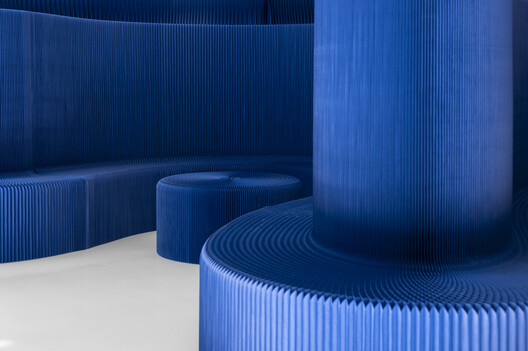
Selecting a material during the design process involves more than defining an appearance. Its behavior in response to light, sound, touch, and the passage of time can transform how a space is perceived and used. At the same time, factors such as durability, strength, recyclability, and the environmental impact associated with its production introduce new variables into architectural decision-making. For Stephanie Forsythe and Todd MacAllen, cofounders of Vancouver-based design and production studio molo, these considerations have led to an exploration of paper and its potential to shape flexible, sensory spaces.
Lightweight, malleable, and visually delicate, paper is often associated with small objects, two-dimensional surfaces, or temporary applications. However, its possibilities change when it is understood as a material capable of acquiring volume, structure, and scale. Through folds, cellular geometries, and modular systems, paper can become an architectural element that defines boundaries, organizes circulation, and alters the perceptual conditions of an interior.
Forsythe and MacAllen have explored paper as a medium for creating spaces, questioning what happens when a material is no longer defined by its conventional uses and is instead explored for its spatial capabilities. With backgrounds in architecture and experience working with more traditional building materials, they have discovered a sculptural purity, freedom, and surprising strength in creating functional objects from this humble material.
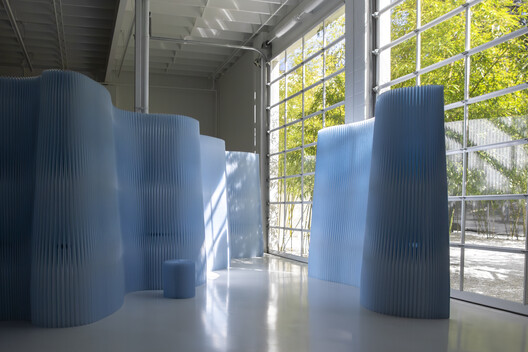
This exploration led Forsythe and MacAllen to develop the soft collection, a family of space dividers, building blocks, furniture, and lighting made from paper or textile. Rather than treating these elements as isolated objects, the collection proposes using them as tools for transforming entire interiors. A panel can be opened, folded, extended, or reconfigured to create different degrees of privacy and varying scales of occupation.
Architecture can thus move beyond relying exclusively on permanent elements and begin to incorporate components that can change alongside the needs of their users. Here, geometry is as important as the material itself. Paper gains strength through its configuration, while its folds and internal cavities create a lightweight structure designed to stand and extend through space. The material's apparent fragility becomes a design quality: its lightness allows for the creation of boundaries that do not behave like conventional walls, but instead act as surfaces that encourage interaction with light, sound, and movement.
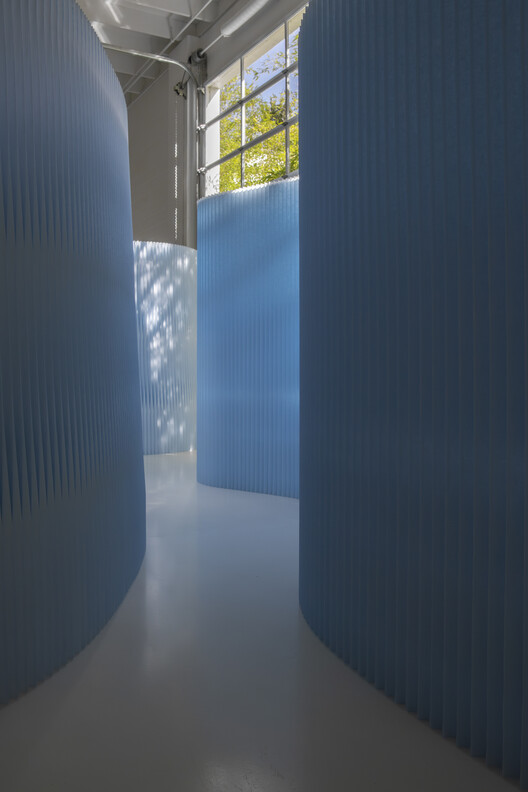
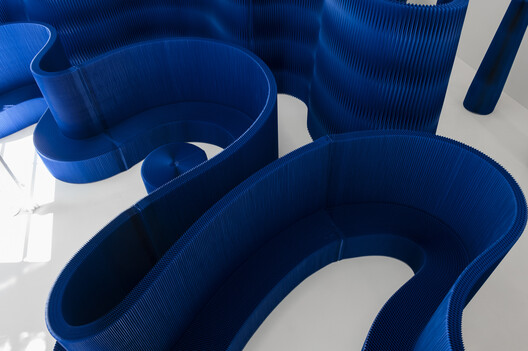
The collaboration between molo and Gmund Paper deepens this exploration by engaging with new sensory qualities, while still meeting stringent technical requirements. The first papers developed for the collection are deep blue and glacier blue. Custom-made, fire-retardant, long-fiber papers, they are free of harmful components. They are also lightfast, resist ink migration, and are recyclable. FSC® certification, along with the use of sustainable sources and production processes, adds another dimension to the material, extending the focus beyond its appearance to consider its performance throughout its life cycle.
Located along the Mangfall River in Germany, Gmund produces paper using hydroelectric power: approximately 75 percent comes from its own turbines, while the remaining 25 percent is supplied by certified plants in the region. The new blue papers developed for molo are produced on a machine with more than 140 years of history, updated with contemporary technologies such as lasers, robotics, and advanced water treatment systems. Wastewater is treated locally until it reaches drinking-water quality, while solid waste generated through the production of the papers for this collaboration is not sent to landfills.
Innovation, therefore, does not always mean replacing what already exists. It can also involve updating, adapting, and extending the life of systems that are part of an established manufacturing tradition. This relationship between material, technology, and perception becomes particularly evident in the sloped softwall, a sculptural version of molo's space-divider system that expands the possibilities for shaping space both visually and acoustically.
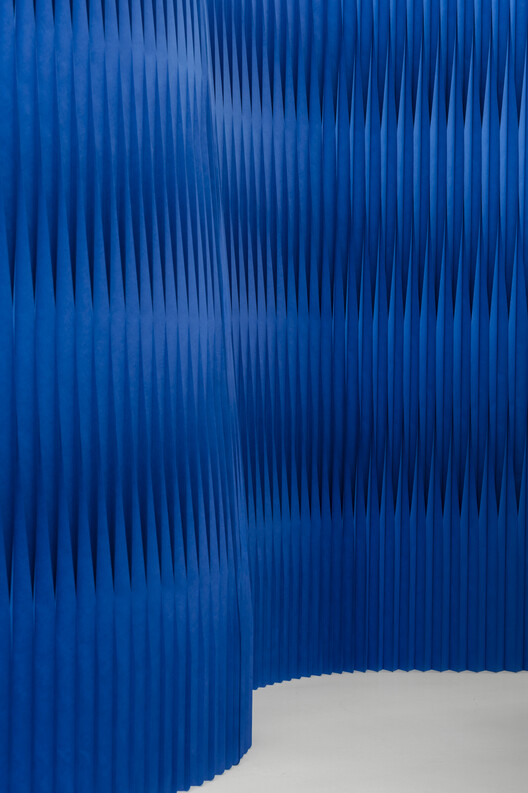
Its geometry changes the way the panel interacts with its surroundings. While one side retains vertical folds that emphasize its structure, the other is cut diagonally to reveal the internal cells. The result is a three-dimensional surface that interacts with light and alters the perceived dimensions of a space. The sloped side can also define rooms or circulation paths that visually expand upward, creating a sense of comfort and embrace. Its geometry establishes a shifting relationship between the body, the boundary, and the field of vision, while the internal structure transforms the way light passes through the material.
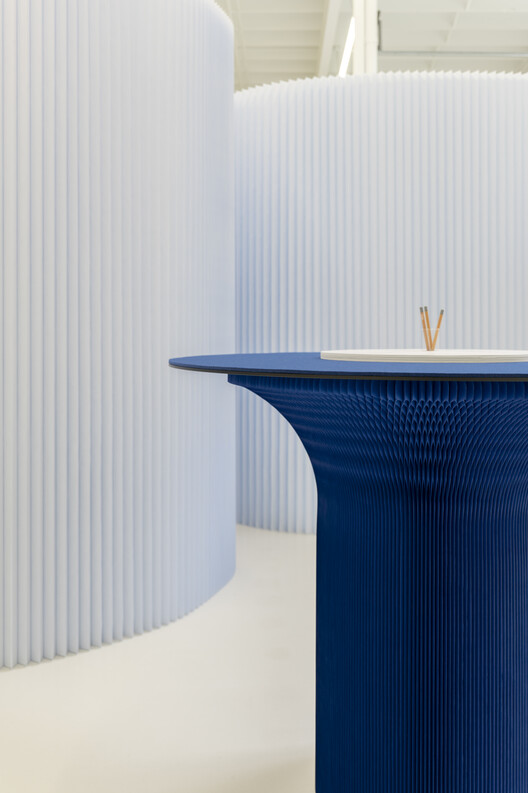
The two new tones further enhance this experience. Deep blue creates a more intense interplay between light absorption and reflection, evoking the shifting surface of the ocean and the deep hues of twilight. Glacier blue, by contrast, introduces a lighter and more translucent quality. When exposed to direct sunlight, the paper fibers take on an almost ethereal appearance, transmitting light rather than simply reflecting it. In both cases, color becomes more than a surface treatment; it becomes part of the material's spatial performance. Light, shadow, texture, transparency, and geometry come together to create atmospheres that shift according to the viewer's position and changing light conditions.
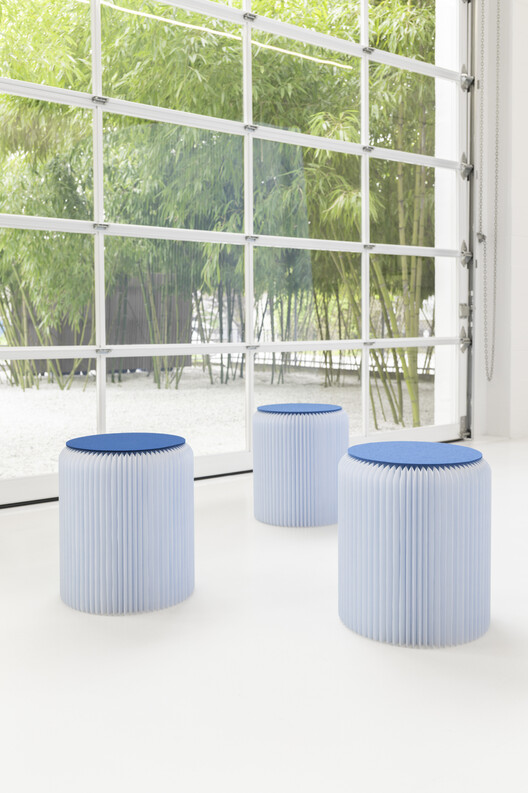
Presented at the 2026 International Contemporary Furniture Fair (ICFF) in New York, the collaboration between molo and Gmund Paper offers a reading of paper that extends beyond its traditional condition. The material can be strong without losing its lightness, structural without appearing heavy, and technically sophisticated without giving up its poetic dimension. By approaching materiality as a process in which physical properties, environmental conditions, and sensory experiences all contribute to the construction of space, new atmospheres and spatial configurations emerge through the interplay of light, color, and texture.
If a sheet of paper can become a wall, a piece of furniture, or a structure capable of organizing an interior, why couldn't architecture also emerge from what, at first glance, seems too fragile to build with?


