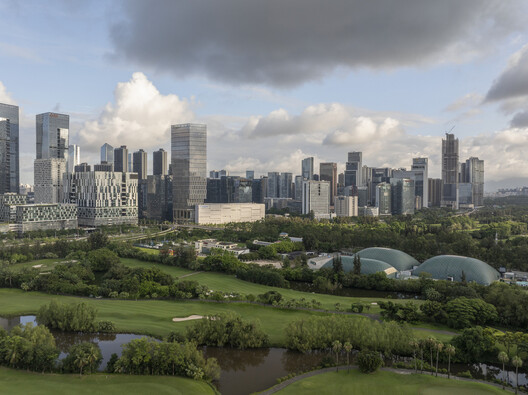
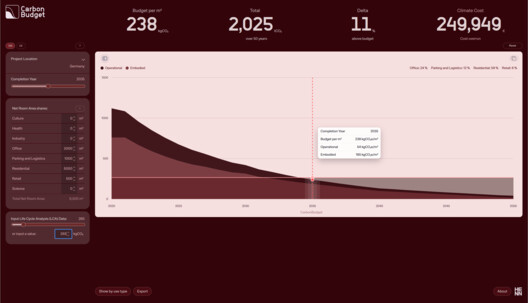
Architecture firm HENN has launched CarbonBudget, a digital tool that calculates project-specific CO2 budgets for buildings. The new platform, free of charge, is a contribution for designers to help reach the 1.5°C target, a global goal from the Paris Agreement to limit long-term global warming to 1.5°C above pre-industrial levels. As the construction industry is responsible for around one-third of global CO2 emissions, architectural design decisions can effectively contribute to containing global warming. The tool is designed to calculate whether the emissions of a building project located in Europe are compatible with the Paris Agreement target, based on specific inputs such as location and building area. The new platform joins other projects from international offices such as MVRDV NEXT's CarbonSpace, Grimshaw's Minoro, and Henning Larsen's OpenDetail, addressing decarbonization through shared digital information.
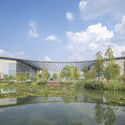

In view of current global warming, HENN set out to answer a central question: How can abstract temperature limits be translated into actionable data for individual buildings? And, when thinking through architectural design, how can a CO2 budget for a specific architectural project be determined? A building's carbon footprint is determined by its entire life cycle assessment, split mainly between operational carbon (daily energy and water use) and embodied carbon (materials and construction). A life cycle assessment (LCA) accounts for the materials and resources used in construction, as well as the building's operation and eventual demolition. HENN's new tool, CarbonBudget, adds a framework to the calculated CO2 value to determine whether the building's carbon footprint is actually high, and how its use can affect the assessment in practice.
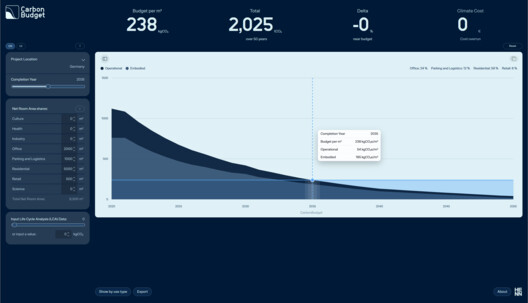
The platform, available free of charge at carbonbudget.eu, was developed within HENN's sustainability team to enable architects, engineers, developers, researchers, and policymakers to understand the climate boundaries of architecture projects and make informed decisions from the start. CarbonBudget is designed to calculate project-specific budgets and provide a reliable framework for assessing them in context. From a design standpoint, it helps provide an order-of-magnitude estimate of the impact related to a building's projected structure and use, with the understanding that not all buildings require the same amount of energy. Technology-intensive buildings such as hospitals and laboratories naturally require more energy than offices, and mixed-use typologies can be harder to calculate.
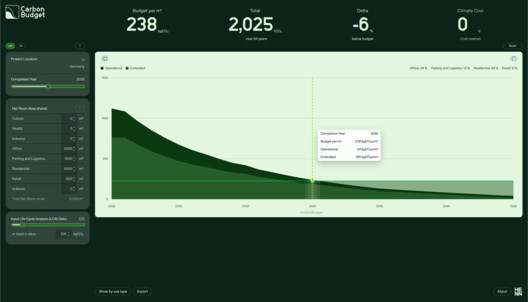
By entering simple information about the project, such as location, year of completion, and building area, the software determines whether the emissions of a European building project are compatible with the 1.5°C target. For existing LCA values, the tool visualizes whether emissions fall within or outside the allocated CO2 budget. The Calculating Climate Cost option adds a monetary dimension to the tool. It quantifies the societal follow-on costs, based on figures published by the German Federal Environment Agency, incurred when a building exceeds its individual CO2 budget aligned with the target. CarbonBudget is based on recognized scientific decarbonization pathways and integrates data from the Science Based Targets initiative (SBTi) and the Carbon Risk Real Estate Monitor (CRREM), while taking into account the ongoing decarbonization of electricity grids.
Architecture professionals worldwide are gathering and organizing to offer more sustainable views of the future. The Copenhagen Architecture Biennial recently announced the theme of its upcoming edition, "Elements," turning its attention to the planetary elemental forces that architecture has sought to master and prepare to inhabit, questioning one of modernity's most persistent promises: control over the environment. In Canada, the Lawson Centre for Sustainability recently opened at Trinity College, with a building complex designed by Mecanoo and RDHA as a sustainable community and "living lab," building on the College's traditions around shared meals and communal gatherings. In Estonia, the 8th Tallinn Architecture Biennale (TAB 2026) brings the question "How Much?" to the center of its program, examining how cost, scarcity, and constraint shape architectural production.


