In an era where digital fabrication and automation are increasingly present in architectural practice, manual craft is often seen as a luxury item—restricted to high-end projects whose clients can afford extended deadlines and collaborative processes requiring constant dialogue with artisans. This scenario might have sounded contradictory a few decades ago, when Lina Bo Bardi denounced that a process of "deculturation" was underway and that an appraisal of "popular" Brazilian civilization was urgently needed to confront totalizing universalisms and *folklore*—the latter viewed by her as an instrument of state alienation designed to neutralize the subversive and transformative character of popular culture:
"A reexamination of the country's recent history is imperative. An appraisal of 'popular' Brazilian civilization is necessary, even if meager in the light of high culture. This appraisal is not that of folklore, always paternalistically supported by high culture, but rather an appraisal 'seen from the other side,' a participatory appraisal." – Lina Bo Bardi, in "Tempos de Grossura," p.12
This appraisal translated into a systematic survey of Brazilian craftsmanship—particularly in the Northeast—but it also profoundly shaped Lina's worldview and her practical work. For her, architecture went beyond the mere design of buildings, manifesting transversally in furniture design, scenography, exhibition design, visual communication, and writing.
The publication Tempos de Grossura is a central source for understanding the architect's critical thinking regarding popular production. Its opening chapter, "An appraisal sixteen years later," highlights the temporal gap between 1980—the year she began structuring the book [1]—and 1964, the milestone of the military coup that established the dictatorship in Brazil and cut short her work in Salvador. It was in Bahia that Lina began her research into the popular and connected with key figures of the cultural scene, such as Martim Gonçalves (with whom she co-curated the exhibition Bahia no Ibirapuera in 1959), Glauber Rocha, and Pierre Verger.
In the publication, Lina Bo Bardi makes it clear that craftsmanship, as a social body, never existed in Brazil, but rather what she termed "pre-craftsmanship," since craft presupposed a "union of specialized workers brought together by common work interests and mutual defense, in associations that in the past were called 'guilds'" (Bardi, 1992, p. 12). However, this categorization is controversial and demands a critical eye. The absence of formal guilds does not negate the existence of "a complex social organization, which was also fundamental in the transmission of knowledge, following a father-to-son relationship" (Jacques; Pereira, 2019, p. 64). Therefore, the category of "pre-craftsmanship" risks invalidating this reality.
Furthermore, the very etymology of the word traces back to the Latin ars—technique or skill allied with manual practice—underlining a practical dimension transformed through time, space, and the subjects who experience it. Craft-making thus reveals itself as a heterogeneous expression of high material value and rich immaterial significance, an aspect reflected in the transversal and unifying approach of the exhibitions designed by Lina, both in form and content.
"Bahia no Ibirapuera," 1959
Lina Bo Bardi arrived in Salvador in 1958 to deliver lectures at the School of Fine Arts and subsequently took up residence in the city after being invited to fund and direct the Museum of Modern Art of Bahia (MAM-BA), which opened in 1960. During this period, she met theater director Martim Gonçalves, with whom she conceived the exhibition Bahia no Ibirapuera, held in parallel with the 5th São Paulo Biennial.
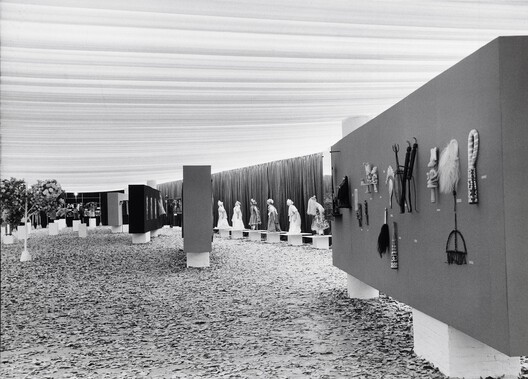
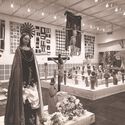
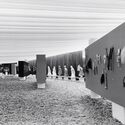
Her experience in Bahia represented a turning point in the architect's career, allowing her to engage with artistic vanguards and draw closer to popular culture. In the exhibition, Lina and Gonçalves contrasted "Art" (institutionalized and self-centered) with "art" (a utilitarian notion tied to daily needs). By displaying photographs, ceramics, ex-votos, and carrancas (figureheads) within a sensory setting—featuring a floor covered in eucalyptus leaves and a fabric-lined ceiling—the exhibition challenged the boundaries between high culture and popular production.
"Nordeste," 1963
The Museum of Popular Art (MAP) at Unhão was an offshoot of the MAM-BA. Its program aimed to survey the country's popular "pre-craftsmanship," operating not only through the museum but also through the Center for Craft Studies and Work (CETA). Lina did not believe in importing "industrial models existing in so-called First World countries" (Perrotta-Bosch, 2021, p. 155), maintaining instead that scientific advancement in any nation must develop from within its own culture.
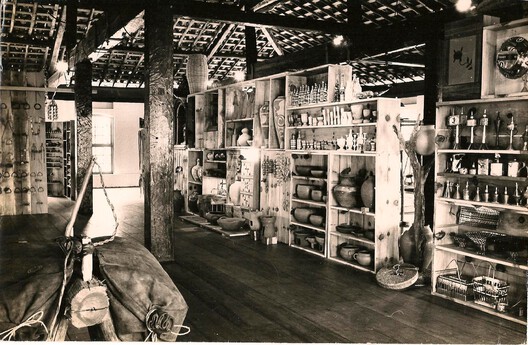
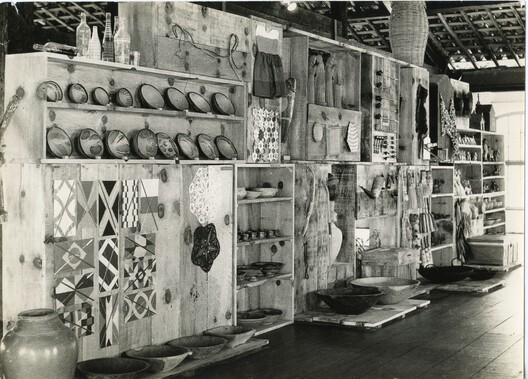
The MAP opened with the exhibition "Nordeste," in which Lina focused critically on popular production as a form of expression. She did this not only by bringing popular culture objects into the museum space but also by intervening in the exhibition design itself, creating an atmosphere reminiscent of street markets and warehouses through materials like unfinished pine boards used for bases and shelving.
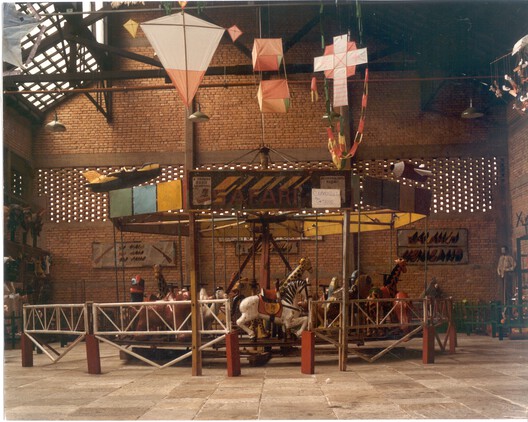
"A Mão do Povo Brasileiro," 1969
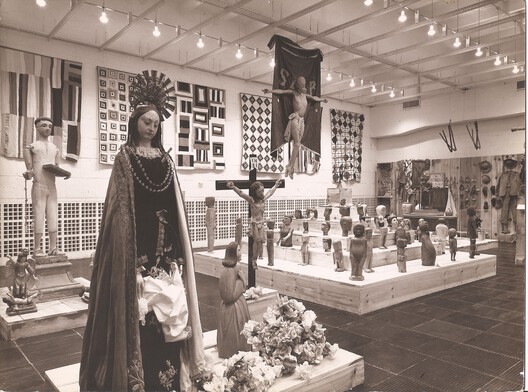
The exhibition "A Mão do Povo Brasileiro" marked the opening of the second headquarters of the São Paulo Museum of Art (MASP) on Paulista Avenue and demonstrated a continuity of the themes Lina had been exploring in Bahia. In the show, Lina sought—by displaying a wide variety of objects such as tools, transportation devices, everyday items, toys, ex-votos, carrancas, ceramics, and paintings—to showcase popular ingenuity and creativity.
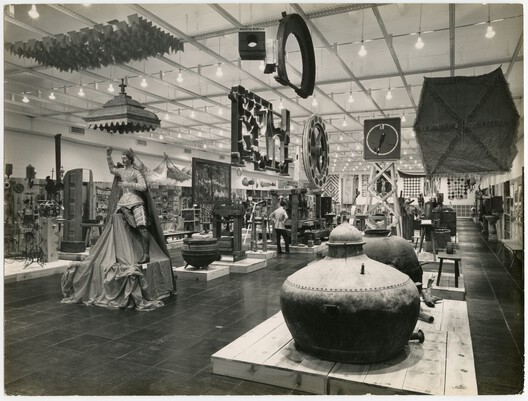
The exhibition design recalled that of the "Nordeste" exhibition, held six years earlier in Salvador, utilizing bases and shelving made of pine boards. In "Mão do Povo Brasileiro," as in other exhibitions, Lina also proposed alternative solutions to accommodate the variety of the exhibited objects and their unique characteristics, such as hanging fabrics on the walls and suspending certain items.
"Design no Brasil - História e Realidade," 1982
In 1977, restoration work began on the old factory of Sesc Pompéia, in collaboration with André Vainer and Marcelo Ferraz. Although the project was only officially completed in 1986, exhibitions began occupying the old factory sheds as early as 1982, starting with "Design no Brasil - História e Realidade." This also marked the beginning of Lina Bo Bardi's role as the center's programming director.
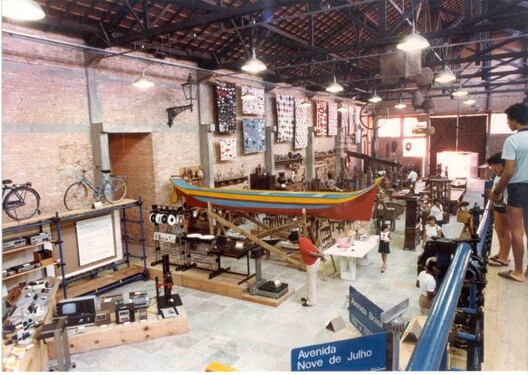
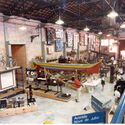
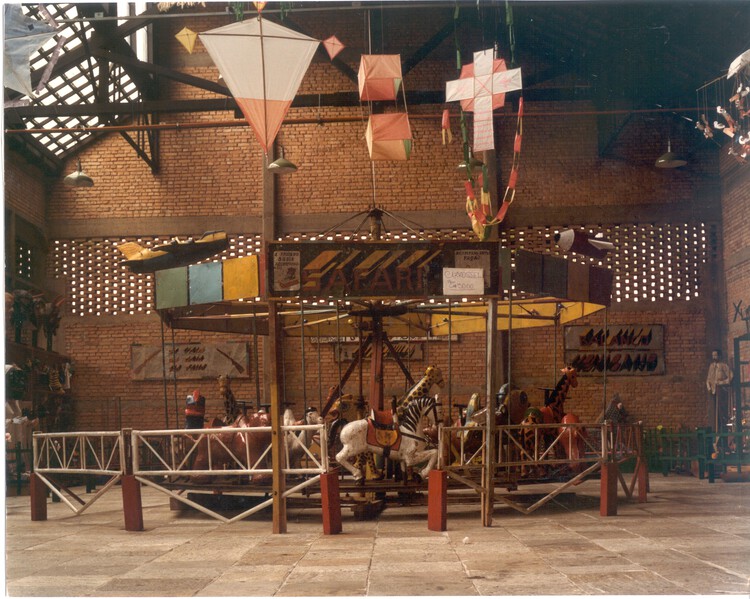
Just as the architectural project for Sesc developed in tandem with its construction, the process of curating, organizing, and setting up the exhibition was shaped by hands-on contact with the items to be displayed (Sartorelli, 2019, p. 70). "Design no Brasil: História e Realidade," like "Nordeste" and "Mão do Povo Brasileiro," featured a large number of objects organized to emphasize the collection as a whole, while also grouping them according to specific criteria, such as the thematic division between "Manual Brazil (up to 1960)" and "Industrial Brazil (1970/1980)." Scaffolding with ramps was used to display the pieces while simultaneously providing panoramic views of the rest of the exhibition.
"Caipiras, Capiaus, Pau a Pique," 1984
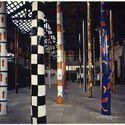
Another exhibition held at Sesc two years later was "Caipiras, Capiaus, Pau a Pique," which featured a theme more closely aligned with architecture. The exhibition resulted from research conducted in the Brazilian countryside, particularly in the Ribeira Valley and southern Minas Gerais. While the "Bahia no Ibirapuera" and "Nordeste" exhibitions focused on Northeastern culture through everyday objects, this show explored the interior of Southeastern Brazil and *caipira* culture through a series of elements representing local life.
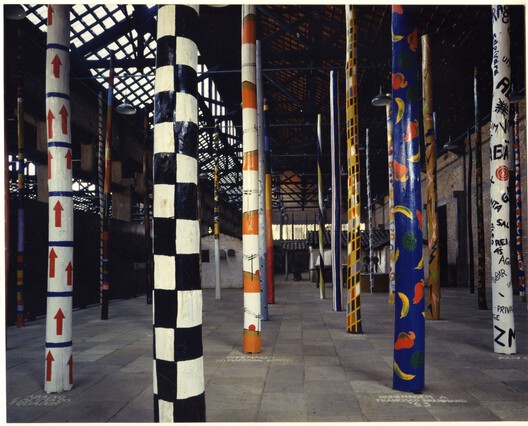
In addition to hand-painted festival poles, the exhibition featured small wattle-and-daub structures built directly inside the exhibition space by Capitão and Dona Zita, a couple from Minas Gerais. Far from romanticizing scarcity, the show documented rural architecture as a popular art integrated into daily life—a utilitarian response to a harsh reality to be overcome, radically rejecting the reduction of popular making into a mere decorative object or symbolic fetish.
The exhibitions presented here are but a selection from Lina Bo Bardi's vast curatorial and exhibition design career. Beyond the extensive survey of the country's cultural foundations she set out to conduct, her studies on popular production and what she called pre-craftsmanship translated into exhibition designs and curatorial texts that refused to view popular culture in a superficial or romanticized way. Her goal was always to approach this production critically, aiming for its integration into industrial processes and its connection to schools and workshops integrated within museums and cultural centers.
In a contemporary landscape marked by digital acceleration and automation, the loss of contact with manual craft causes a profound estrangement, disconnecting individuals from the production process and the very materiality of the world. Looking at this production through the lens of Lina Bo Bardi does not mean seeking a nostalgic return to the past, but rather recognizing manual knowledge as a design ethic, a constructive intelligence, and an indispensable path to democratizing access to good design. By reclaiming the dignity of popular making and its daily utility, Lina's vision urges us to conceive an architecture truly engaged with its social reality.
Notes:
[1] Although she began preparing it in 1980, the book was only actually published in 1994, after her death, by the Instituto Lina Bo e P.M. Bardi.
References:
BARDI, L. B. Tempos de grossura: o design no impasse. São Paulo: Instituto Lina Bo e P.M. Bardi, 1994.
JACQUES, P. B. et al. Fazer por desvios. In: JACQUES, Paola Berenstein; PEREIRA, Margareth da Silva (Eds.). Nebulosas do pensamento urbanístico. Salvador: EDUFBA, 2019.
LATORRACA, G. (Ed.). Maneiras de expor: arquitetura expositiva de Lina Bo Bardi (exhibition catalog). Museu da Casa Brasileira, Governo do Estado de São Paulo, Secretaria da Cultura do Estado, 2014.
PERROTTA-BOSCH, F. Lina: Uma Biografia. São Paulo: Todavia, 2021.
SARTORELLI, C. A. Arquitetura de exposições: Lina Bo Bardi e Gisela Magalhães. São Paulo: Edições Sesc, 2019.
This article is part of the ArchDaily Topics: Architecture and Craft: Handmade Stories in a Digital Age. Every month we explore a topic in-depth through articles, interviews, news, and architecture projects. We invite you to learn more about our Topics. And, as always, at ArchDaily we welcome the contributions of our readers; if you want to submit an article or project, contact us.
This article was written by Susanna Moreira. The translation is powered by AI.


