Imagine a corridor. Concrete walls two meters apart, a low ceiling, artificial lighting with neither shadow nor gradation. At the far end, a bulletproof glass window, and on the other side, a uniformed officer. You are at a port of entry. It could be in Calais, El Paso, or Lampedusa. An anonymous space, yet far from neutral. Designed so that anyone can understand: passage is not a right; it is a concession.
Yet, this corridor is no exception; rather, it is the expression of an architectural language repeated across contemporary borders. Labyrinthine airports, screening stations, walls—architectures that turn hostility into a defining element of space, demonstrating that it transcends the stern expression of the person behind the glass.

In 1975, Michel Foucault popularized the concept of the panopticon in his book Discipline and Punish, describing a circular prison with a central watchtower. Because inmates never know when they are being watched, they internalize surveillance and self-monitor their behavior, ensuring perfect discipline. The efficacy of the panopticon lies precisely in the depersonalization of power, or its transformation into a geometric figure—into architecture.
But what kind of architecture has the capacity to control, watch, and delimit? Exodus, or The Voluntary Prisoners of Architecture is Rem Koolhaas's graduation project—developed with Elia Zenghelis, Madelon Vriesendorp, and Zoe Zenghelis—presented in 1972. Inspired by Koolhaas's visit to the Berlin Wall, the project transforms the "wall" into a conceptual spatial condition, turning it into the structuring element of the very idea of architecture.
Employing a deliberately exaggerated language reminiscent of Superstudio, its system of parallel walls cut through the center of London, isolating a strip that functioned as a territory and establishing a dichotomy between good and evil, inclusion and exclusion. The idea was to transform a specific border condition into the foundation of a vision that treats architecture as the hedonistic science of designing collective facilities capable of fully satisfying individual desires. For Koolhaas, the supposed absence of a program in the wall gave it a stability superior to any other building, which also challenged the prevailing notions of the discipline's social role at the time.
While this wall, viewed in isolation, might be understood as a rhetorical masterpiece, its function is derived precisely from the surrounding city. It is this urban relationship that allows it to exert its architectural power: that of creating a border.
The Line That Does Not Fit on the Map
In collective memory, borders are often reduced to an imaginary vector in space, a black line drawn on a map. However, this line contains many layers—a stroke capable of defining a "here and there," an "us and them," representing a psycho-spatial experience lived by people. It is a relational entity, constituted both by the techniques and devices of bordering and by the processes it generates. It is, therefore, an elastic concept: for some, distant and impassable; for others, easily crossed.
This territorial control is indeed made up of institutions, laws, and administrative measures, but it is also inseparable from the production of physical space. The border does not exist only on the map; it exists in the square footage, the height of the wall, the width of the corridor, and the angle of the cameras.
From Concrete to Barbed Wire
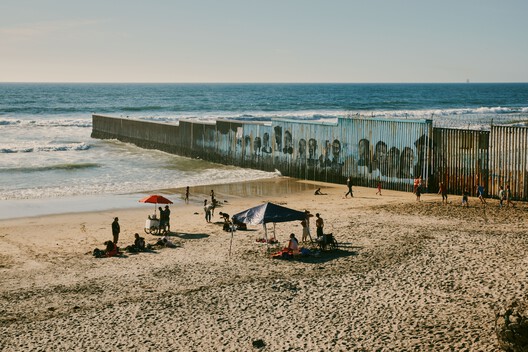
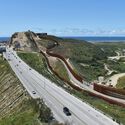
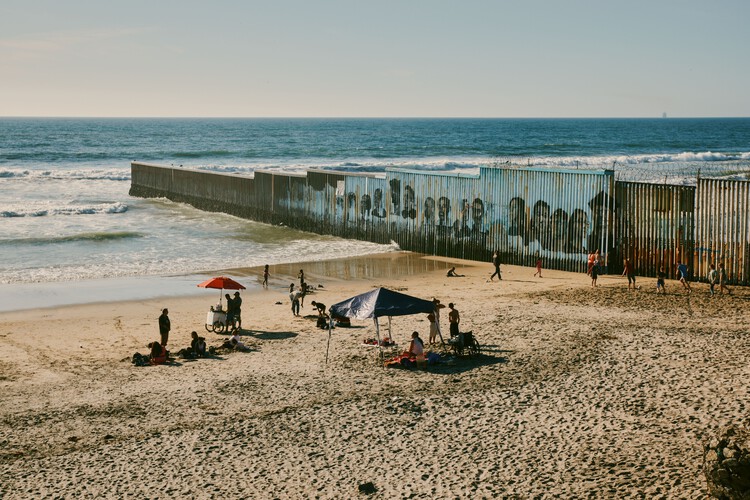
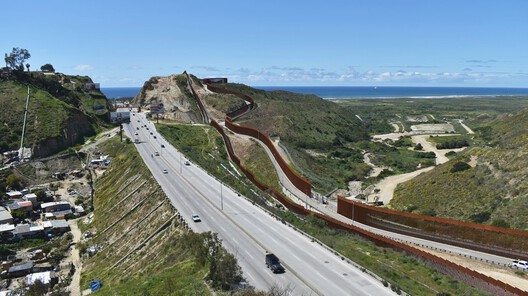
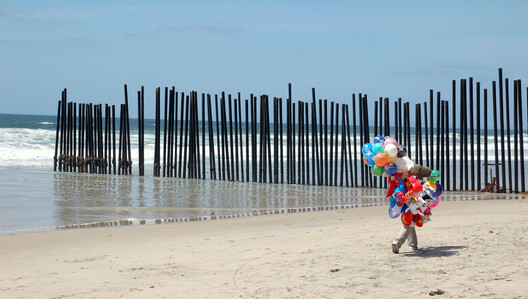
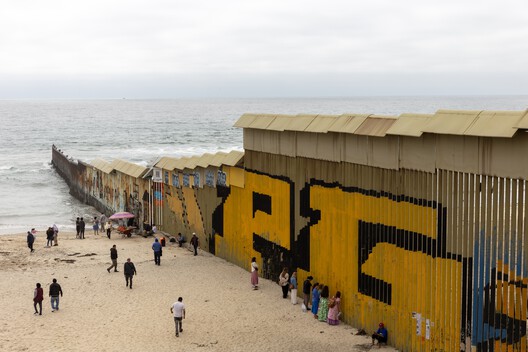
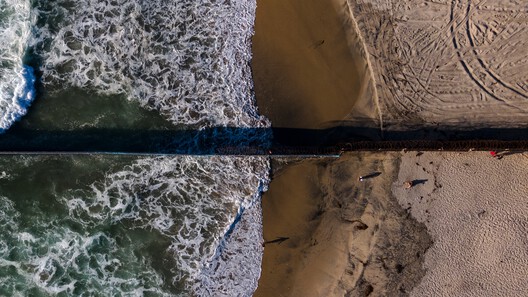
Thirty feet is the height of the well-known barrier erected between the United States and Mexico—a dimension described as enough to ensure the death of anyone who falls while trying to climb it. This is one of the most iconic borders in the world, precisely because its bounding function is reinforced by an architectural object. Here, the border is not merely political or social; it is laid bare to the naked eye.
Yet beyond the infamous wall, border architectures also span different typologies. In the book Architectures of Resistance: Negotiating Borders Through Spatial Practices, Aleksandar Staničić describes the history of the Gevgelija border checkpoint on the boundary between Greece and North Macedonia, and how its architectural transformations mirror the political context of each era.
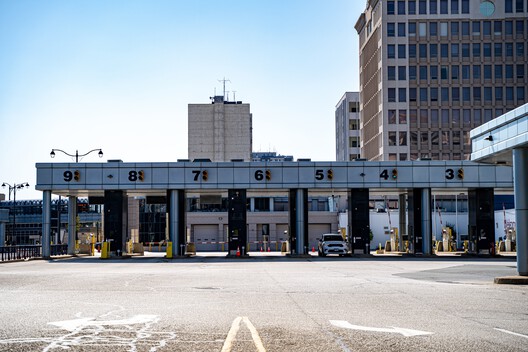
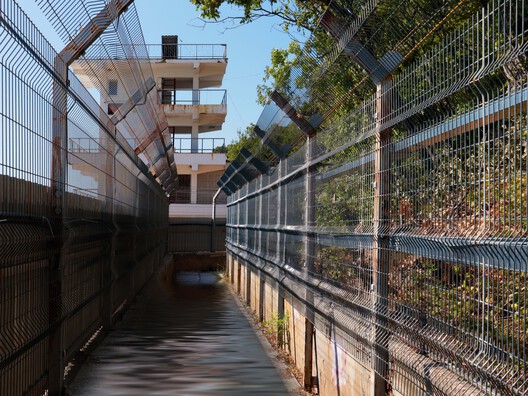
He notes that in 1960, the crossing reached its peak, serving as the main gateway to the Socialist Federal Republic of Yugoslavia from Greece. The demolition of its modernist architecture in 1990 marked the dismantling of the federal state and preceded nationalist projects, such as the controversial Skopje 2014. Today, Gevgelija has become consolidated as a space of conflict, where the wire fence installed along the border acts as an impassable barrier for thousands of refugees moving toward Western Europe.
Between the welcoming modernist port of entry and the barbed-wire fence lies a political and cultural gulf that reveals just how much border architecture has to say. However, just as it can be used as an instrument of control, it also holds the potential to resist these very borders through its speculative and propositional capacity.
Is It Possible to Do Things Differently?
It is possible to have border checkpoints designed with dignity in mind—waiting areas with natural light, clear signage, and spaces for children. It is possible to have reception centers that reject the logic of detention. Yet these are exceptions, and highly vulnerable to the first political shift. This suggests that architecture, no matter how relevant, remains subordinate to the program. As long as the border is conceived as an instrument of selective exclusion, any architecture that serves it participates in that exclusion.
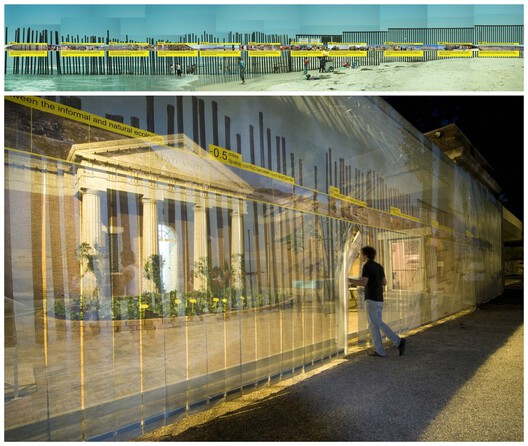
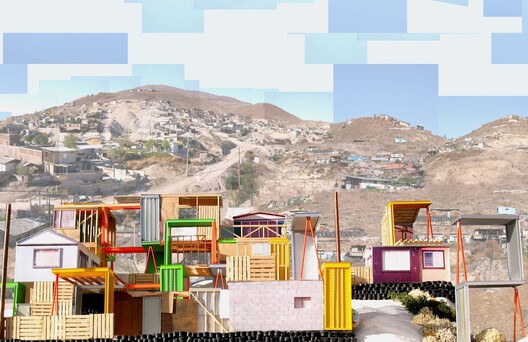
In light of this complex landscape, several initiatives deserve mention. Teddy Cruz and Fonna Forman, for instance, combine activism, research, and creative practice to rethink how borders, and the communities around them, are conceived and function. For them, the region between Tijuana and San Diego is a global laboratory for the core challenges of contemporary urbanization. While ICE continues its dehumanizing operations, thousands of Central American migrants wait by the wall for an asylum that never comes. Out of this reading emerged the UCSD Community Stations, a network of hubs in marginalized neighborhoods on both sides of the wall, where teaching and research are co-produced by public universities and migrant communities.
Along this same border, a notable 2019 intervention by architects Ronald Rael and Virginia San Fratello featured the installation of pink teeter-totters, connecting children and adults on both sides of the wall through the simple act of play. Though brief, the intervention succeeded in exposing the interdependence of the two territories—a symbolic critique of exclusionary policies and proof that an action on one side of the border inevitably affects the other.
Finally, it is worth highlighting the publication Two Sides of the Border: Reimagining the Region, in which thirteen offices and student groups from the US and Mexico, curated by Tatiana Bilbao, use design and architecture to address social, political, and ecological issues along the shared border. Among the student projects imagining the region's future is Marilyn Reyes's plan to assist monarch butterflies in their migration, providing these non-human migratory creatures with a resting space in the US-Mexico borderlands, and Hallie Black's floating building—belonging to both countries at once—which pushes neoliberalism to its limits.
Beyond the Wall
While they do not erase the border from the map, these examples show that this "line" can be inhabited differently. A teeter-totter does not tear down the wall, but for a brief moment, it transforms concrete into a space of encounter, rather than merely one of separation.
Yet, this may be where the limits of architecture lie. It can make the wait less cruel, create more dignified spaces, and reveal alternative ways of coexistence, but on its own, it can rarely alter the logic that produces these places. The hostility of borders is born not merely of fences or corridors, but of the political agenda that shapes them.
Perhaps, then, the question is not how to design a more humane border, but why contemporary borders are conceived primarily to exclude rather than to welcome. Architecture merely materializes this choice, serving as a built mirror of society.
This article is part of the ArchDaily Topics: Architectures of Movement: Territory, Borders, and the Politics of Belonging. Every month we explore a topic in-depth through articles, interviews, news, and architecture projects. We invite you to learn more about our monthly topics. And, as always, at ArchDaily we welcome the contributions of our readers; if you want to submit an article or project, contact us.
This article was written by Camilla Ghisleni. The translation is powered by AI.


