Architecture is often understood as a matter of enclosure. Walls define space, separating interior from exterior and establishing clear limits. Yet across many projects in Latin America, this distinction becomes less precise. Rather than operating as closed objects, buildings often remain open, allowing air, light, and movement to pass through them.
This condition is tied to more than form. Across the region, architecture has long responded to climates marked by heat, humidity, strong solar exposure, and seasonal rainfall, as well as to building cultures shaped by adaptation, collective labor, and direct engagement with the environment. In these contexts, fully sealed interiors are not always the most effective response. Space is often organized through shade, ventilation, and intermediate zones that regulate rather than isolate.
Within this context, lightness is not simply a visual effect or a structural decision. It is a spatial condition that emerges through permeability, climate, and use. Open structures, permeable boundaries, and shaded transitions shape environments that are not fully contained, but continuously connected to their surroundings.
Permeability as Spatial Structure
If lightness in these projects does not begin with structure alone, it also does not depend on transparency or visual openness. It often begins with a different way of organizing space, one in which enclosure is partial and continuity remains possible. Rather than defining a clear interior, architecture sets up conditions for occupation through roofs, frames, and boundaries that do not fully separate the building from its surroundings.
This changes the role of construction. Structural elements do not operate primarily as limits, but as supports for space that remains open to air, light, and movement. What is built is often just enough to establish use, while the surrounding environment continues to shape the experience of the project. Lightness emerges here not from dematerialization, but from the decision to avoid complete enclosure.
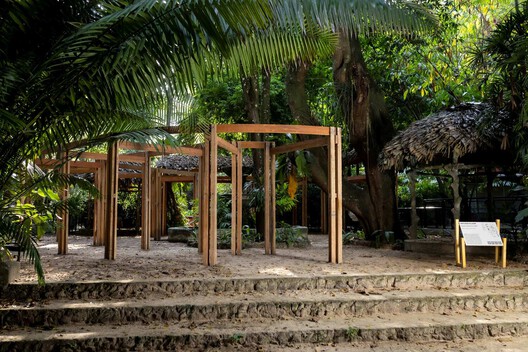
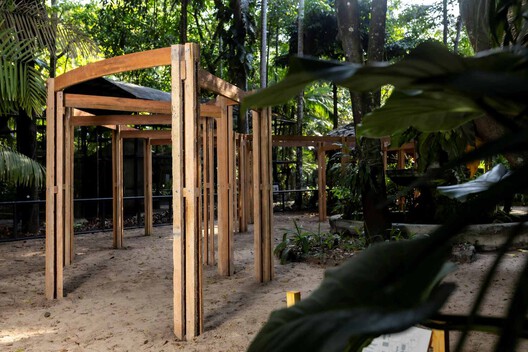
In the River Does Not Exist Alone by Studio Flume, this spatial logic appears through a series of interventions that extend into the landscape without detaching from it. The project does not produce a conventional interior. Instead, it organizes a space of occupation where ground, vegetation, and structure remain intertwined, allowing the built elements to operate more as support than as containment.
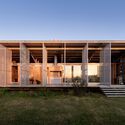
A similar condition appears in Pavilion Tess by Estúdio Leonardo Zanatta, where repetition gives the project its spatial order. The structure creates rhythm and sequence, but not closure. Space remains exposed to changing light and airflow, and the pavilion is defined as much by what moves through it as by its physical frame.
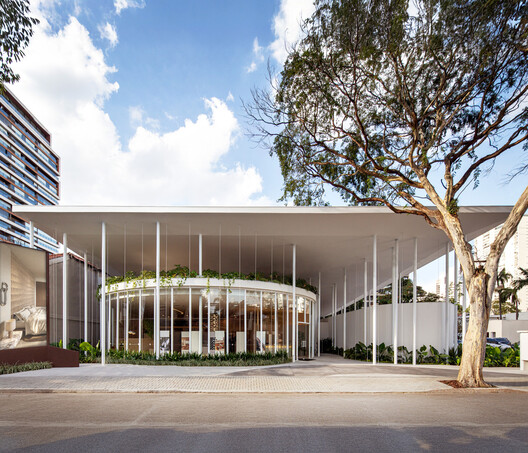
Similarly, in Pamba Bike Shelter by URLO Studio, the project is conceived as a refuge rather than as an enclosed building. Its structure supports pause and occupation under the Andean climate while remaining open to its surroundings.
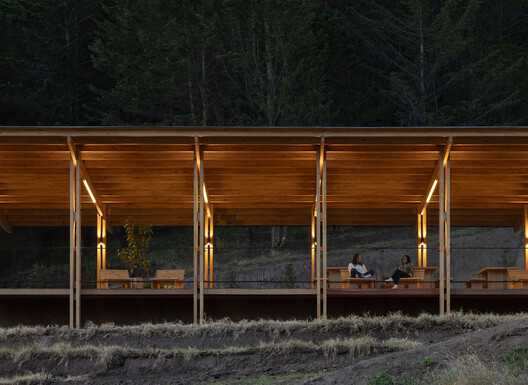
Across these examples, permeability is not an added feature layered onto the building. It is the spatial logic that organizes it. Space is shaped less by what is closed than by what is allowed to remain open.
Climate as Generator
If permeability defines how space is organized, climate defines how it operates. In many regions across Latin America, heat, humidity, and solar exposure demand more than enclosure. Rather than relying on sealed environments, architecture often regulates these conditions through shade, airflow, and spatial depth.
Climate is not treated as an external force to be controlled, but as a condition that shapes the organization of space itself. This produces a sequence of intermediate spaces rather than a clear division between interior and exterior. Covered areas, recessed rooms, and shaded thresholds allow the building to respond gradually to its surroundings.
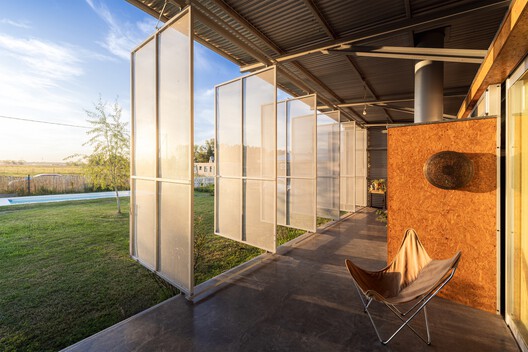
In the House in Las Golondrinas, this condition is articulated through a layout that prioritizes cross-ventilation and spatial continuity. Living spaces extend outward into shaded areas, allowing air to circulate and reducing the need for fully enclosed rooms.
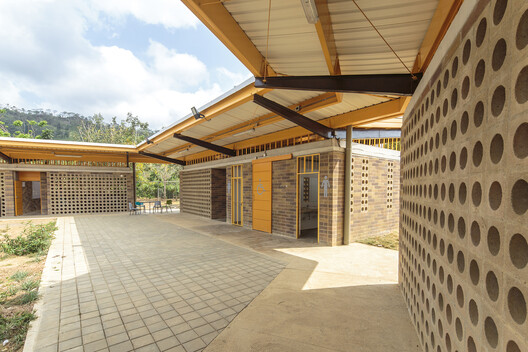
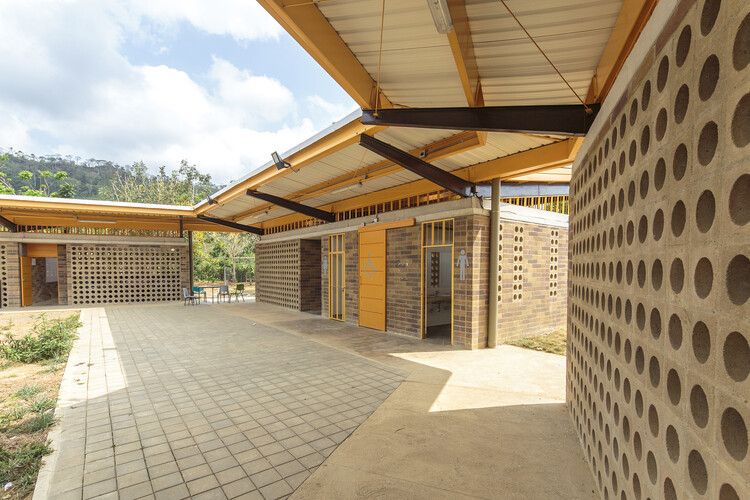
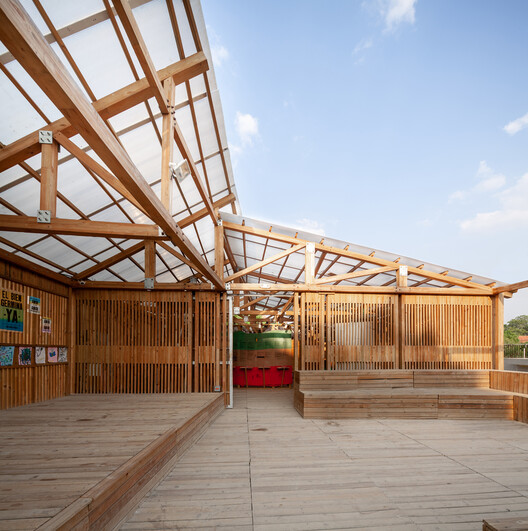
A related condition appears in the Siete Vueltas Rural Educational Institution, where a system of open corridors, patios, and covered spaces organizes the school around shade and airflow. Rather than isolating classrooms, the project distributes them across a sequence of ventilated spaces that remain connected to the surrounding landscape.
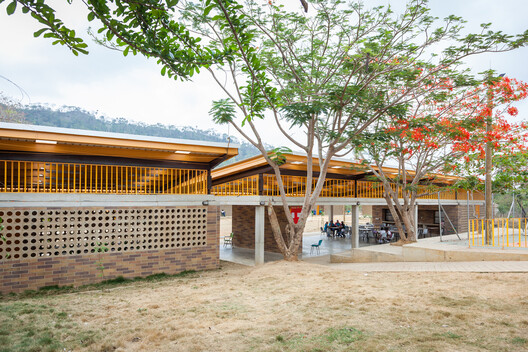
In both cases, comfort is not produced through separation, but through adjustment. Architecture works with climate rather than against it, allowing environmental conditions to remain active within the experience of inhabitation. Lightness, in this sense, is not visual or structural, but environmental.
Porosity and Collective Use
Permeability not only shapes how these spaces respond to climate. It also affects how they are occupied. In many of these projects, openness allows architecture to accommodate multiple forms of use, where movement, gathering, and shared activity are embedded in the spatial organization itself.
In the MIM Itinerant Museum of Memory and Identity of Montes de María, this condition materializes in a lightweight and reconfigurable structure designed to move across different contexts. Rather than fixing a single arrangement, the project allows space to be assembled around encounter, circulation, and collective participation. Its flexibility is not only constructive, but spatial.
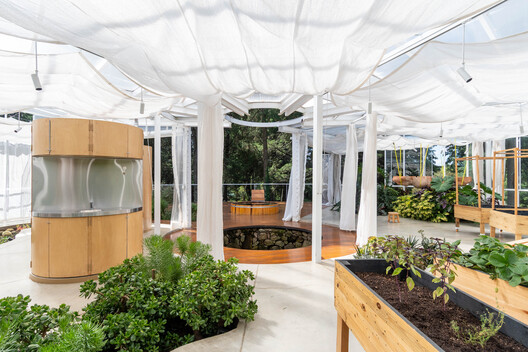
A related condition appears in the Impluvium Choza, where a central void organizes gathering, movement, and exposure as part of the project itself. Space is structured around shared use, allowing climate and occupation to remain active within the same spatial system. Here, lightness emerges through availability. Space is left open enough to support changing forms of occupation over time, making permeability a condition of use as much as of form.
Across these projects, lightness does not depend on reducing weight or using specific materials, but on a way of organizing space that allows air, climate, and use to remain active within it. Open structures, shaded transitions, and permeable boundaries do not define a single architectural language, but a spatial approach that resists complete enclosure and remains in continuous exchange with its surroundings. If lightness is not only a structural question, but also a spatial and environmental one, then how much architecture is actually needed to define space, and how much can still be left open?
This article is part of the ArchDaily Topic: Light, Lighter, Lightest: Redefining How Architecture Touches the Earth, proudly presented by Vitrocsa, the original minimalist windows since 1992.
Vitrocsa designed the original minimalist window systems, a unique range of solutions, dedicated to the frameless window boasting the narrowest sightline barriers in the world. Manufactured in line with the renowned Swiss Made tradition for 30 years, Vitrocsa's systems "are the product of unrivaled expertise and a constant quest for innovation, enabling us to meet the most ambitious architectural visions."
Every month we explore a topic in-depth through articles, interviews, news, and architecture projects. We invite you to learn more about our ArchDaily Topics. And, as always, at ArchDaily we welcome the contributions of our readers; if you want to submit an article or project, contact us.