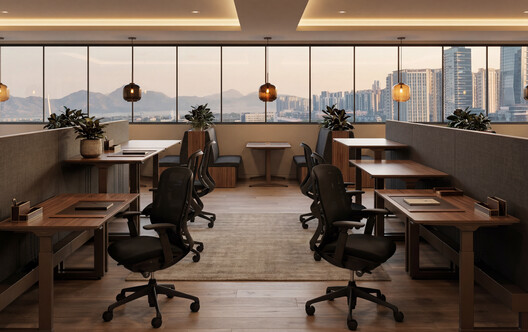
For all the spatial experimentation of the contemporary workplace, one condition has remained largely unchanged: people are still sitting. Studies suggest that office workers spend up to 89% of their working day seated—close to 36 hours a week—despite decades of ergonomic awareness. As workplaces become more flexible, social, and design-led, this contradiction becomes harder to ignore.
The office is no longer organized around a single mode of operation, nor by a fixed spatial logic. Work has become multifunctional, shifting between collaboration and concentration, collective exchange and individual focus. In response, architecture and interior design are moving away from uniform, repetitive layouts towards environments that reflect the variability of human behavior.
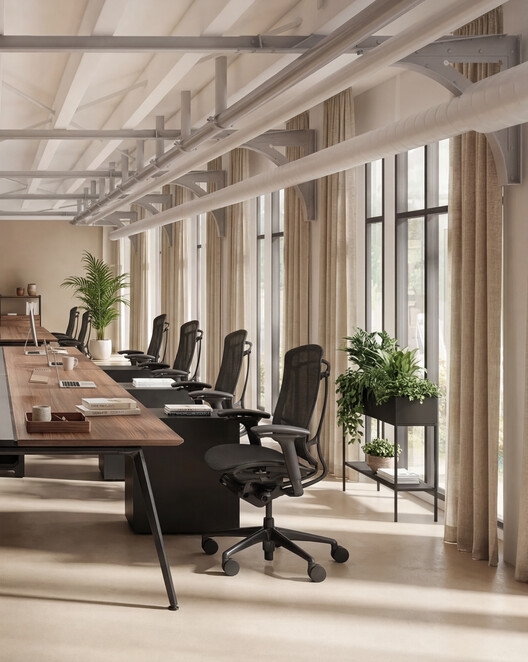
The Gap Between Design Intent and Daily Behavior
One response is the move towards a constellation of purposeful environments, often referred to as "Destination Spaces". Inspired by hospitality and residential typologies, these spaces layer atmosphere, material softness, and spatial variations to make the office somewhere people might choose to be. Informal lounges, touchdown areas, quiet zones, and meeting settings support different modes of work, allowing movement—both physical and cognitive—between tasks. But this shift raises a question. If the workplace becomes more social, more open, and more experience-driven, what happens to concentration?
Supporting focus, which leads to decision-making, creativity, and long-term value, requires more than acoustic control or spatial separation. Companies such as Boss Design have approached this shift as a broader spatial strategy. Their framing of "Destination Spaces" positions furniture as an active component of behavior, shaping how environments are experienced and encouraging people to seamlessly transition between modes of work and settings.
The Office Still Sits, but Work has Already Changed
Still, spatial variety alone does not guarantee movement. The persistence of prolonged sitting highlights a gap between design intention and actual behavior. Health research continues to link static postures, repetitive movement, and poorly adapted workstations to fatigue, discomfort, and reduced productivity. If movement is essential, it must be supported not only by space, but by the objects that mediate between body and environment.
This is where task seating regains significance as a responsive system. The idea of a single "correct posture" has largely been replaced by a more dynamic understanding: no single position can be sustained indefinitely without strain. What matters instead is variation, such as small, continuous adjustments that keep the body active even while seated. The most effective task chairs are not those designed to hold the user in place, but those that move with them, accommodating subtle shifts in posture throughout the day.
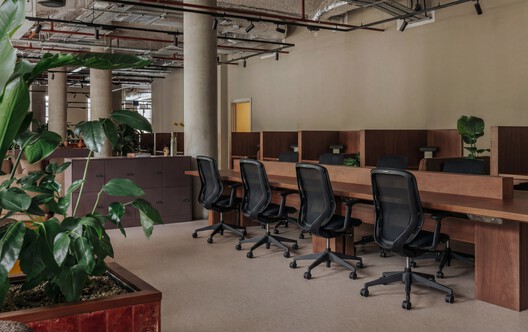
Designing for Flexibility and Concentration
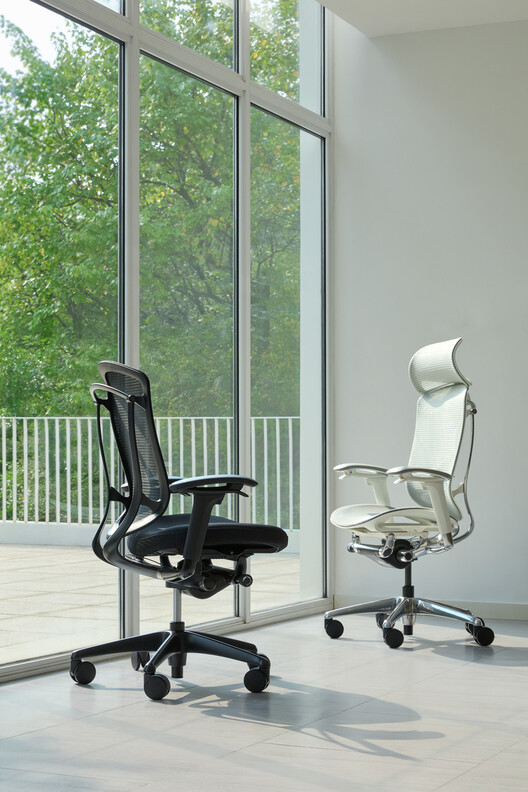
This approach is evident in task seating developed by Okamura, particularly in models such as Sylphy and Contessa II. Both are designed to respond to the user, allowing attention to remain on the task itself. Integrated into a broader spatial framework, they complement settings such as focused work areas, meeting rooms, and training environments, as well as lounge and collaborative spaces, such as those from Boss Design, reinforcing the idea that no single environment or posture can support the full spectrum of work.
Contessa II, originally developed in collaboration with Italdesign nearly two decades ago, brings an additional layer through its formal expression. Drawing on automotive design principles, the chair's exposed die-cast aluminum frame serves as a structural chassis, making its construction visible, providing stability and strength, while allowing the rest of the chair to remain visually light. Controls for seat height, recline, and tension are integrated into the armrests, allowing intuitive adjustments without interrupting workflow, while a synchro-tilt mechanism supports balanced movement.
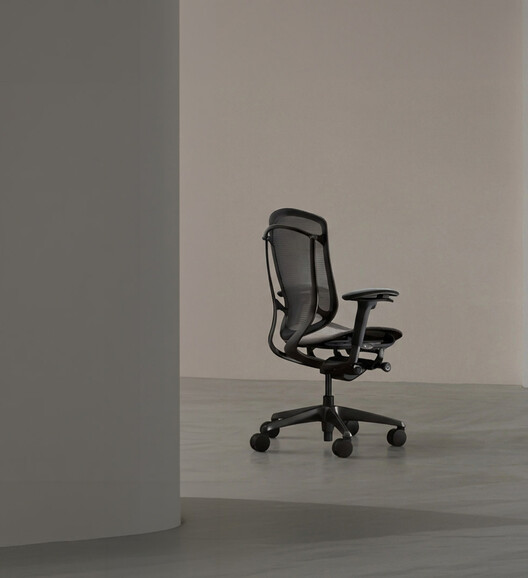
A breathable mesh inspired by Japanese weaving provides targeted lumbar support, while recycled PET, reclaimed materials, and BioPUR® foam help reduce environmental impact. Tested to BIFMA X5.1 and designed for longevity, it balances mechanical detailing with a light visual presence suited to contemporary interiors.
At the Intersection of Spatial Design and Engineering
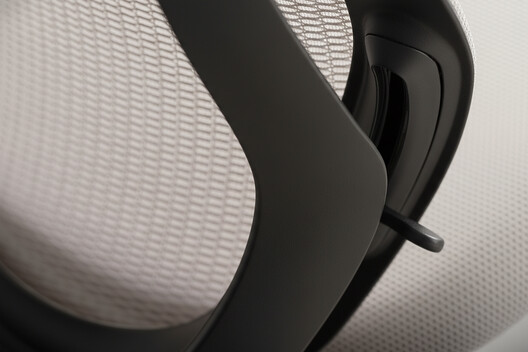
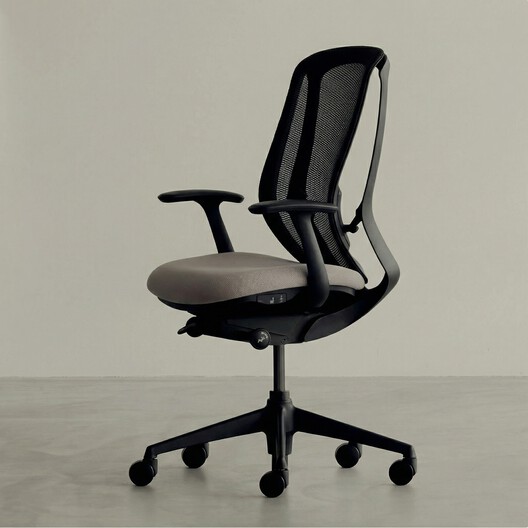
Sylphy operates more quietly, but addresses a similarly fundamental issue: the diversity of users themselves. Its Body Curve Adjustment allows the backrest to be subtly reshaped to accommodate different body types without adding complexity. A double-frame structure combines stability with flexibility, allowing the chair to move naturally with the body. While the outer frame accommodates a wide range of users and provides structure and stability, the inner frame offers a more responsive layer that moves naturally with the body, allowing the backrest to reshape to the user's natural spinal contour and provide targeted lumbar support.
Together with synchro-tilt, forward tilt, and multi-density cushioning, Sylphy supports a range of postures throughout the day while maintaining a simple, intuitive user experience that meets BIFMA X5.1 standards and supports users up to 124 kg. Like Contessa II, it meets BIFMA LEVEL®3 standards and incorporates recycled materials and plant-based foam, reinforcing durability while supporting environmental considerations.
Towards a More Adaptive Workplace
The emphasis on adaptability reflects a broader conversation around well-being and neurodiversity. Individuals experience space differently, with sensitivity to noise, light, posture, and interaction varying widely. Designing for this does not require specialized solutions, but a range of choices that allow users to self-regulate. The most resilient workplaces provide support without prescribing behavior.
What unites these approaches is an understanding that workplace performance is inseparable from experience. Ergonomics, materiality, and spatial planning are interdependent elements of a larger system. The collaboration between Boss Design and Okamura brings together a European lens on craft and comfort, with a Japanese approach to engineering detail and longevity, balancing sociability with focus and comfort with performance.
As the office continues to evolve, its success may depend less on efficiency alone and more on how well it supports people. Destination Spaces, responsive furniture, and an emphasis on movement all point towards a more human-centered model, one that recognizes comfort, focus, and well-being as dynamic conditions. In this context, design becomes less about defining space than enabling it: creating environments that are not only functional but fundamentally attuned to the rhythms of everyday life, capable of evolving alongside the people who use them.