1. ArchDaily
  2. Theory and History

Theory and History: The Latest Architecture and News

4 Proven Artistic Principles That Can Help Make Better Architecture

This article was originally published by Common Edge as "Enduring Principles of Art That Also Apply to Architecture."

It is safe to say that architects, academics, critics and even the public have been arguing about the merits of architectural style for centuries. Even during the course of my own career, the more general style categories of contemporary-vs-traditional have continued in an unabated battle. For better or worse, contemporary has generally won out as the default position for most schools and publications, probably because of the sheer visual entertainment value it offers, and the lucrative merits of its two stepchildren, branding and advertising.

I’d like to propose another position: that certain enduring principles of art, rather than any temporary style—and, remember, they are all temporary—should be our real architectural goal. This presumption means you must be agnostic when it comes to style and put aside any notion of an ideological stance regarding the right or wrong of your architectural preferences. There are those, of course, who say that to imagine that “my art” is better than yours, or even that I can define real art in the first place, is a fool’s errand.

I think otherwise.

Have Your Say on the Landscape of Emerging Practices With the Interactive Architectural Political Compass

If you were to identify, categorize and map the 21st century’s emergent architectural practices from the world over, all on one diagram, what would it look like? Considering how the current architectural landscape consists of several different approaches, attitudes and political stances, how would you map them without being too reductive? And how would you ensure that out of hundreds of emergent practices and firms across the globe, you don’t leave anyone out? Perhaps the Global Architectural Political Compass V 0.2 could offer a clue.

Created by Alejandro Zaera-Polo and Guillermo Fernandez-Abascal, the diagram is part of an ongoing inquiry into “the state of the art in (global) architectural practice” [1]. In 2016, Zaera-Polo explored the subject in a comprehensive essay for El Croquis titled “Well into the 21st Century” in which he set down the framework for 11 political categories that now form the compass diagram.

How to Choose an Undergraduate Architecture Thesis Topic

Subscriber Access | 

As architecture students head to their final year of BArch, half-crazy from years’ worth of scraped fingers, ghastly juries, sleepless nights, and a general lack of social life, they encounter the mighty problem of choosing a thesis topic. There are many subjects to choose from, but a personal interest in a particular subject is just one of the many factors that should influence this decision. Students need to ask themselves several other questions: Is the topic significant enough? Is it expansive enough? Is the project realistically doable?

The process can be daunting, for the decision has many consequences; sometimes, the choice of topic alone can mean the difference between the success and failure of a thesis. With so many factors to consider and deadlines closing in, students easily end up making decisions that they regret later. Here are eight tips to help you make an informed choice on the matter:

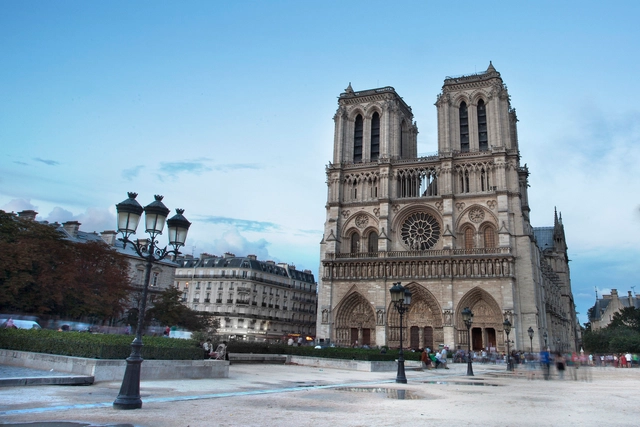
How a Novel Saved Notre-Dame and Changed Perceptions of Gothic Architecture

This article was originally published by Common Edge as "It’s a Book. It’s a Building. It’s a Behavioral Intervention!"

A few years ago, while visiting, or rather exploring, Notre-Dame, the author of this book found, in an obscure corner of one of the towers, this word carved upon the wall:

'ANÁΓKH

These Greek characters, black with age, and cut deep into the stone with the peculiarities of form and arrangement common to Gothic calligraphy that marked them the work of some hand in the Middle Ages, and above all the sad and mournful meaning which they expressed, forcibly impressed the author.

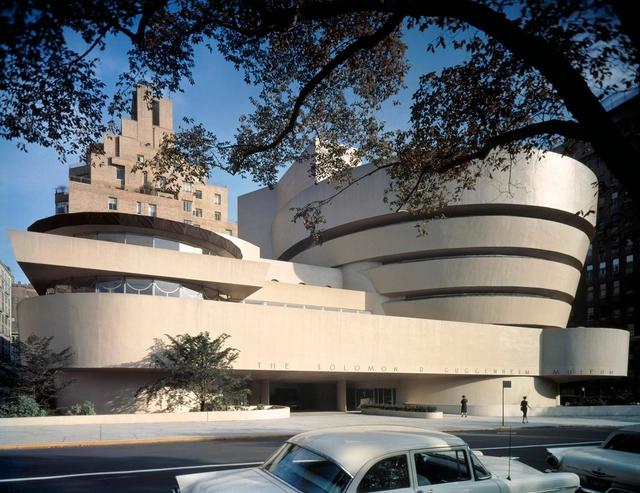
The 58-Year Evolution of Frank Lloyd Wright's Guggenheim Museum

Subscriber Access | 

This article originally appeared on guggenheim.org/blogs under the title "Wright’s Living Organism: The Evolution of the Guggenheim Museum," and is used with permission.

Standing on the Solomon R. Guggenheim Museum construction site in 1957, architect Frank Lloyd Wright proclaimed, “It is all one thing, all an integral, not part upon part. This is the principle I’ve always worked toward.” The “principle” that Wright referred to is the design ideology that he developed over the course of his seventy-year career: organic architecture. At its core, that principle was an aspiration for spatial continuity, in which every element of a building would be conceived not as a discretely designed module, but as a constituent of the whole.

Although not Wright’s intention per se, it is fitting that the building he conceived of as a living organism has evolved over time. The overall integrity and character-defining spiral form have remained unchanged, but there have been a series of additions and renovations necessitated by the growth and modernization of the institution.

How Photography Helped to Dehumanize Our Cities

This article was originally published on Common Edge as "How Photography Profoundly Reshaped Our Ideas About Cities."

Early in the 19th century, an invention arrived that would change the form and function of cities for generations.

Like all new technologies, it started out rudimentary, expensive, and nearly ineffectual. But it caught many imaginations and developed dramatically, eventually reaching the point of mass accessibility. Soon enough, it took aim at the public realm, with consequences that were indirect and unintended yet profound.

It reconfigured streets. It influenced the height of buildings. It altered foot traffic. It recast the relationship between buildings and streets. It changed how people felt about their cities and changed their points of reference. It turned cities into abstractions and, in some ways, turned city-dwellers against each other. Its influence nearly complete by the close of World War I, the invention has remained fundamentally unchanged, and is still universally celebrated, to this day.

All this with the press of a button.

How Air Conditioning Helped Shape Architectural History (For Better or Worse)

Subscriber Access | 

This article originally appeared on Curbed as "How air conditioning shaped modern architecture—and changed our climate."

During a conversation with the New Yorker, a window washer who worked on the Empire State Building says that some of his toughest moments have been cleaning the trash that tenants toss out the windows. In his many years working on the Depression-era skyscraper, he’s wiped numerous half-empty coffee cups off window panes, and even scraped 20 gallons of strawberry preserves from the building’s facade. Tossed out in the winter, it stubbornly clung to the outside of the skyscraper.

Cracking a window open in a skyscraper seems like a quirk, especially today, when hermetically sealed steel-and-glass giants offer the promise of climate-controlled comfort. But ever since Chicago’s Home Insurance Building, considered one of the first skyscrapers, opened in 1884, the challenge of airflow, ventilation, and keeping tenants cool has been an important engineering consideration shaping modern architecture.

The great commercial buildings of the modern era owe their existence, in many ways, to air conditioning, an invention with a decidedly mixed legacy.

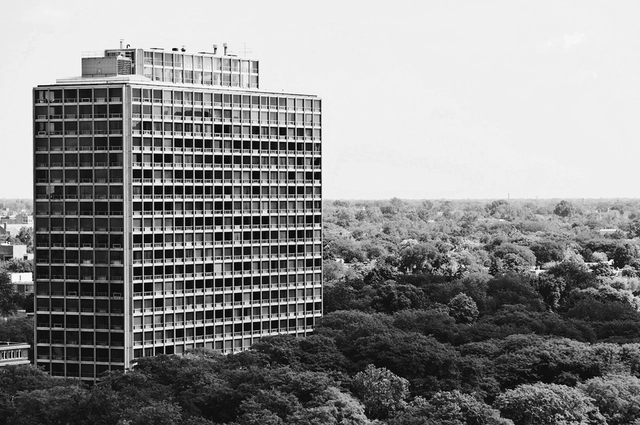
Mies van der Rohe's Lafayette Park Named National Historic Landmark

One of the first and most successful examples of urban renewal, Detroit's 78-acre Lafayette Park is known for being the world's largest collection of works by Mies van der Rohe. Now, the mid-century modern "masterpiece" is the first urban renewal project to be declared a National Historic Landmark. This is partially due to the fact that, as Ruth Mills, architectural historian for Quinn Evans Architects told the Detroit Free Press, "Lafayette Park was one of the few urban renewal projects that's done it successfully." It is now Michigan's 41st landmark.

Havana Revisited: Postcards of the Cuban Capital Through the Years

Subscriber Access | 

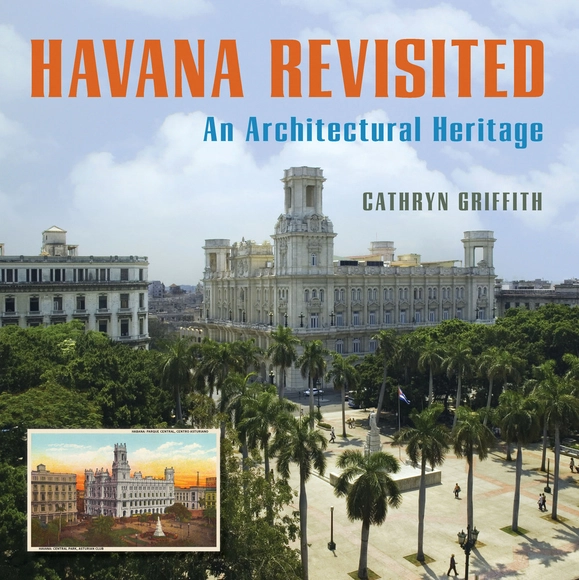
Thanks to its privileged position as a gateway to North America and Cuba's unique political history, the architecture of the City of Havana has a rich and layered quality rarely found. In a new book edited by Cathryn Griffith, "Havana Revisited: An Architectural Heritage," this history is explored in detail through 12 essays by renowned architects, historians, scholars, preservationists, and urban planners in both Cuba and the United States and a selection of 350 color images comparing historic postcards with the city of today. The following text is the book's introduction, written by Cuban architect, urban planner and critic Mario Coyula (1935-2014).

Havana’s modest beginnings came in the sixteenth century, as the springboard for Spain’s conquest of America. When the port became the obligatory last American stop for Spanish ships making their return voyages to Europe, its significance grew until Havana had become the most important city in the Gulf of Mexico and the Caribbean. From the beginning, it was a settlement oriented toward providing services, especially that of protection. Hence, Havana became home to the most formidable system of defensive fortifications in the colonial Americas.

#wikiD: Help ArchiteXX Add Women Architects to Wikipedia

Inspired by Despina Stratigakos' essay "Unforgetting Women Architects: From the Pritzker to Wikipedia," ArchiteXX has launched #wikiD, a global event to coincide with International Women's Day on March 8. With the slogan of "Women. Wikipedia. Design," #wikiD prompts people to "write into Wikipedia women designers, architects and all those involved in the creation of our environment."

Learn more about the event and how to get involved after the break. 

King George III, an Aspiring Architect

Not sure if “manic” can be classified as an architectural style, but that is what some are choosing to describe the newly discovered, hand-drawn floor plans of a grand place envisioned by King George III. According to the British Library, the King was “passionately interested” about architecture and drew plans for a future living quarters in Kew - now a district in West London - during a time when he was suffering from severe mental illness in the late 1780s. Learn more about the King’s vision for a grand palace, here.

A Theory of Architecture Part 3: Why Primitive Form Languages Spread

Subscriber Access | 

As you may have seen, ArchDaily has been publishing UNIFIED ARCHITECTURAL THEORY, by the urbanist and controversial theorist Nikos A. Salingaros, in serial form. However, in order to explain certain concepts in greater detail, we have decided to pause this serialization and publish three excerpts from another of Salingaros’ books: A THEORY OF ARCHITECTURE. The first excerpt explained the difference between “Pattern Language” and “Form Language,” while the second established how these languages can combine to form the “Adaptive Design Method.” The following, final, excerpt distinguishes between viable, complex form languages that have evolved over time and primitive, “non-languages” that have come to dominate the 20th century due to their iconic simplicity (and despite their non-adaptive characteristics).

Independently of their technological achievements, all groups of human beings have developed a richly complex spoken language. Differences arise in specificities, in the breadth of vocabulary for concepts important to that culture, and in their transition to a written language, but those do not affect the general richness of the language. Every language’s internal structure has to obey general principles that are common to all languages. A primitive language or non-language, by contrast, is characterized by the reduction or absence of such internal complexity and structure. The complexity of human thought sets a rather high threshold for the complexity that any language has to be able to express through combinatoric groupings. 

Turning now to architecture, a viable form language is also characterized by its high degree of internal complexity. Furthermore, the complexity of different form languages has to be comparable, because each form language shares a commonality with other form languages on a general meta-linguistic level. A primitive form language severely limits architectonic expression to crude or inarticulate statements. 

A Theory of Architecture Part 2: The Adaptive Design Method

Subscriber Access | 

As you may have seen, ArchDaily has been publishing UNIFIED ARCHITECTURAL THEORY, by the urbanist and controversial theorist Nikos A. Salingaros, in serial form. However, in order to explain certain concepts in greater detail, we have decided to pause this serialization and publish three excerpts from another of Salingaros’ books: A THEORY OF ARCHITECTURE. The previous excerpt explained the difference between “Pattern Language” and “Form Language.” The following excerpt will establish how these languages can combine to form the “Adaptive Design Method.”

Proposition: An adaptive design method arises out of a complementary pair consisting of a pattern language and a form language.

I have indicated very briefly what a pattern language and a form language are; we still need to understand what an adaptive design method refers to. Out of many contemporary approaches to design, there are very few that result in structures and environments that are adapted both to physical human use, as well as to human sensibilities. In the past, the opposite was true. Human use is straightforward to understand: the physical dimensions and geometry have to accommodate the human body and its movement.

By accommodating human sensibilities, I mean that environments should make human beings feel at ease; make them feel psychologically comfortable so that persons can carry out whatever functions they have to unselfconsciously, without being disturbed by the built environment in any way. This imposes a strong constraint on the design process to adapt to the many factors (both known and unknown) that will influence the user on many levels, including emotion. An adaptive design method should accommodate all these criteria, and this Chapter shows how this may be accomplished.

A Theory of Architecture Part 1: Pattern Language vs. Form Language

Subscriber Access | 

As you may have seen, ArchDaily has been publishing UNIFIED ARCHITECTURAL THEORY, by the urbanist and controversial theorist Nikos A. Salingaros, in serial form. However, in order to explain certain concepts in greater detail, we have decided to pause this serialization and publish three excerpts from another of Salingaros’ books: A THEORY OF ARCHITECTURE. The following excerpt, the first, explains the terms “Pattern Language” (as well as“antipatterns") and “Form Language.”

Design in architecture and urbanism is guided by two distinct complementary languages: a pattern language, and a form language

The pattern language contains rules for how human beings interact with built forms — a pattern language codifies practical solutions developed over millennia, which are appropriate to local customs, society, and climate. 

A form language, on the other hand, consists of geometrical rules for putting matter together. It is visual and tectonic, traditionally arising from available materials and their human uses rather than from images. Different form languages correspond to different architectural traditions, or styles. The problem is that not all form languages are adaptive to human sensibilities. Those that are not adaptive can never connect to a pattern language. Every adaptive design method combines a pattern language with a viable form language, otherwise it inevitably creates alien environments.

Architectural design is a highly complex undertaking. Heretofore, the processes at its base have not been made clear. There have been many attempts to clarify the design process, yet we still don’t have a design method that can be used by students and novices to achieve practical, meaningful, nourishing, human results. 

In the absence of a design method and accompanying criteria for judging a design, things have become very subjective, and therefore what is built today appears to be influenced largely by fashion, forced tastes, and an individual’s desire to garner attention through novel and sometimes shocking expressions.

This Chapter puts forward a theory of architecture and urbanism based on two distinct languages: the pattern language, and the form language

Rise of The New Radical Pragmatist

Subscriber Access | 

Using Australia as her focus, Marissa Looby, in a recent article for the Australian Design Review, argues that the disappearance of architectural styles, combined with the proliferation of various guidelines and building codes, has created a new breed of architect: The New Radical Pragmatist. Her article "The New Radical Pragmatist (On Validation)" is reprinted here.

The Architectural Review (December, 1955) first published Reyner Banham’s epochal and pivotal article, ‘The New Brutalism’, in which the critic pointed to the rise of a new architectural style. He also described an influx of -isms that were becoming increasingly conspicuous to the discipline, stemming from the then contemporary model of an art historian and their influence on the architectural historian-as-observer of the architectural profession. Banham incisively suggested that any proposition of the term ‘new’ has an unequivocal relationship to the past, so much so that in advocating for a new -ism an architectural theoretician must defend their claim with historic fact. Ironically, Banham acknowledged that even ‘The New Brutalism’ title derived from The Architectural Review’s analysis of the International Style in the postwar article, ‘The New Empiricism’. He stated: “[the] ability to deal with such fine shades of historical meaning is in itself a measure of our handiness with the historical method today, and the use of phrases of the form ‘The New X-ism’ – where X equals any adjectival root – became commonplace in the early 1950s in fourth year studios and other places where architecture is discussed, rather than practised.”

VIDEO: Villa Savoye, The Five Points of a New Architecture

Subscriber Access | 

Andrea Stinga of OMBÚ Architecture has shared with us her latest creation with visual artist Federico Gonzalez: a video that illustrates Le Corbusier’s “Five Points of a New Architecture” in his 1929 masterpiece, Villa Savoye.

LA’s Iconic Case Study Houses (Finally!) Make National Register

Ten of Los Angeles’ Case Study Homes have been deemed historically significant an worthy of being included on US’s National Register of Historic Places. Despite the Los Angeles Conservancy’s belief that all of them deserve “equal preservation protections,” the 11th home was not included due to “owner objection.”

The Case Study Houses spawned from a post-WWII residential experiment, presented by the Arts & Architecture magazine in 1945, which introduced modern movement ideas for affordable and efficient housing. The homes - designed by the likes of Richard Neutra, Charles and Ray Eames, Pierre Koenig, Eero Saarinen and others - redefined the modern home. And, with the help of Julius Shulman, placed Los Angeles as an epicenter for mid-century modernism.

The 11 homes included on the register are:

Chinese Developer Plans to Build Crystal Palace Replica

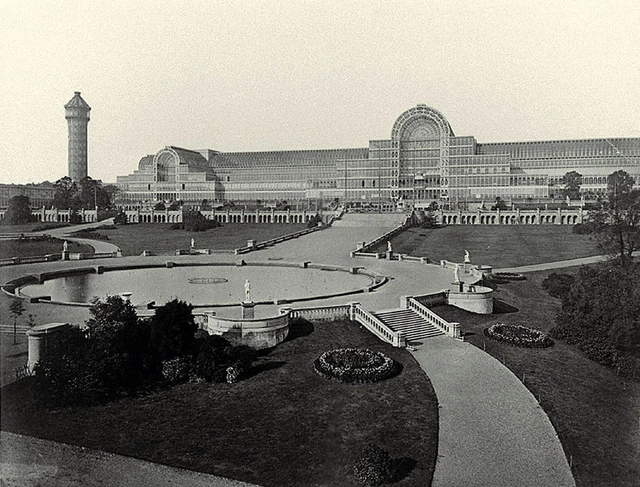
Shanghai-based developer ZhongRong Holdings is working with Arup on an ambitious proposal to reconstruct Joseph Paxton’s Crystal Palace in London. Originally built to house the Great Exhibition of 1851, the 80,000 square-meter cast iron and glass structure was relocated from Hyde Park to south-east London in 1854 where it was ultimately destroyed by fire in 1936.