-
Architects: Hopkins Architects
- Area: 25300 m²
- Year: 2025


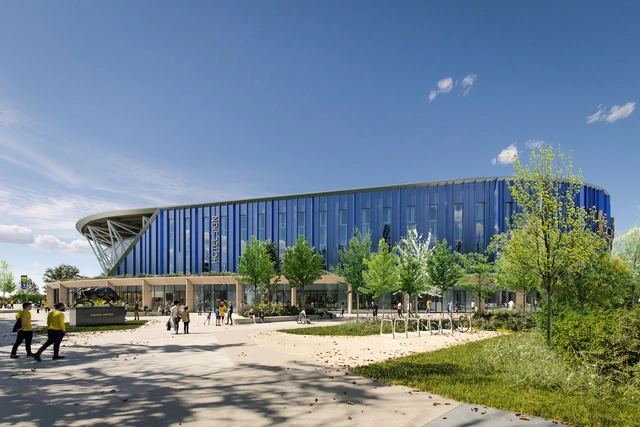
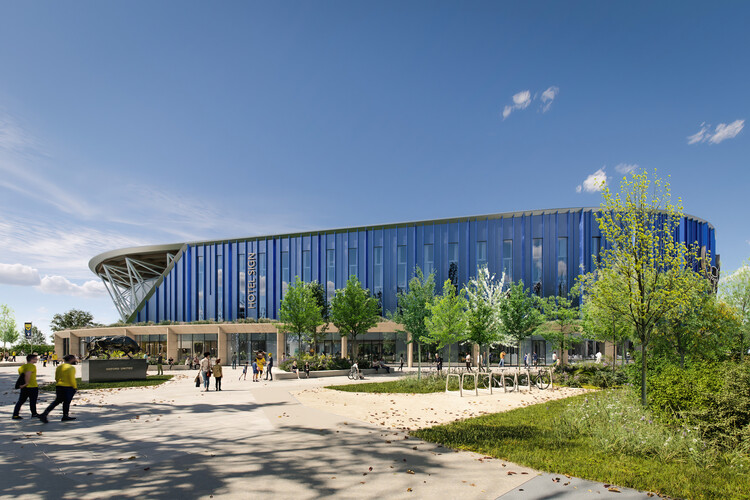
Oxford United Football Club's planning application for a new all-electric football stadium has been approved by Cherwell District Council. The scheme was developed by a team that includes AFL Architects, Mott Macdonald engineering services, Fabrik landscape design, and Ridge and Partners built environment consultants. Designed for a capacity of 16,000 spectators, the master plan also proposes a 1,000-person events space, a 180-bed hotel, a restaurant, a health and wellbeing centre, and a new public plaza with gardens.


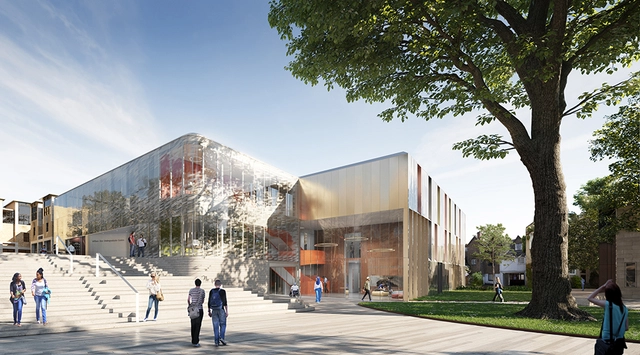
Foster + Partners has just revealed the designs for the Ellison Institute of Technology (EIT) campus in Oxford. Initially established as a research and development center, the campus is now gaining a significant expansion. The Institute’s core focus and research was around cancer, wellness, and public health at large, and it is now extending its mission to encompass new vital domains: medical science and healthcare, food security, sustainable agriculture, clean energy, climate change, and government policy economics.


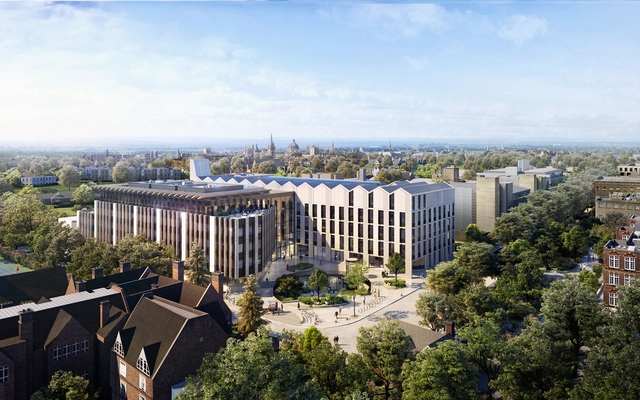
The University of Oxford and internationally-renowned architecture practice NBBJ have unveiled images of the new Life and Mind Building. The development, the University’s largest building project in its history, will be the new home of the Departments of Experimental Psychology and Biology, including Plant Sciences and Zoology, accommodating 800 students and 1,200 researchers.

_Shortlisted_Teams_and_Malcolm_Reading_Consultants.jpg?1507914687&format=webp&width=640&height=580)
The National Infrastructure Commission and Malcolm Reading Consultants have revealed an online gallery of the four final design concepts for The Cambridge to Oxford Connection: Ideas Competition.
The competition, which launched in June, focuses on the 130-mile corridor connecting Cambridge, Milton Keyes, Northampton, and Oxford. It acknowledges the presence of world-leading universities, highly skilled workers and tech firms, but also the corridor’s failure to function as a connected economic zone.

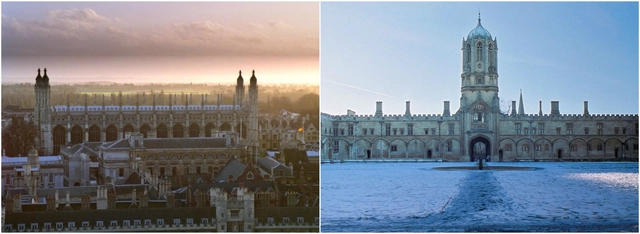
The National Infrastructure Commission and Malcolm Reading Consultants have announced the shortlist for The Cambridge to Oxford Connection: Ideas Competition. The free-to-enter competition focuses on integrating placemaking with infrastructure in one of the UK’s leading growth regions: 130-mile Cambridge-Milton Keynes-Oxford corridor. The region is home to 3.3 million people and hosts some of the country’s most successful cities, as well as the world-leading Oxbridge universities. Launched in June 2017, the first stage encouraged entries from teams with a range of backgrounds - made up of urban designers; architects; landscape designers, planners and community specialists (to name a few).
A new train station in Cambridge is getting a lot of attention from a surprising audience: mathematicians. Cambridge North Station is clad in aluminum panels with a geometrical cutout design. The architecture firm, Atkins, originally claimed that the pattern was derived from Cambridge alumnus John Conway’s “Game of Life,” but eagle-eyed mathematicians soon realized that was incorrect. As the above video points out, the design is in fact based on a mathematical rule studied by Stephen Wolfram, an Oxford alumnus, much to the dismay of rival university Cambridge. Though the firm’s website still references Conway, a Senior Architectural Designer at Atkins, Quintin Doyle, has since confirmed that it was, in fact, Wolfram’s Rule 30 that they used in the design.

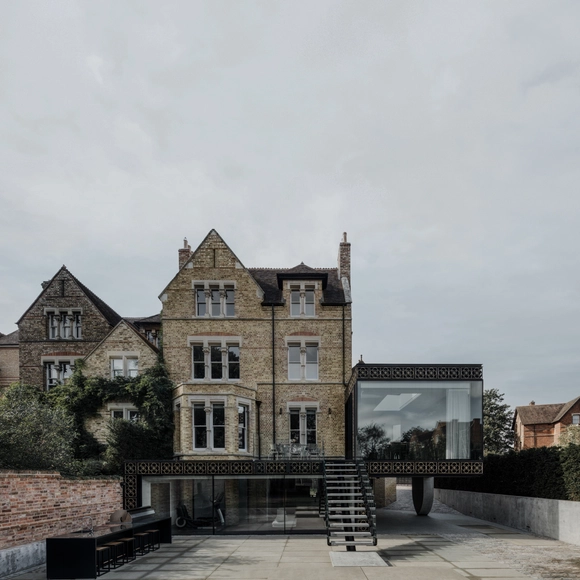
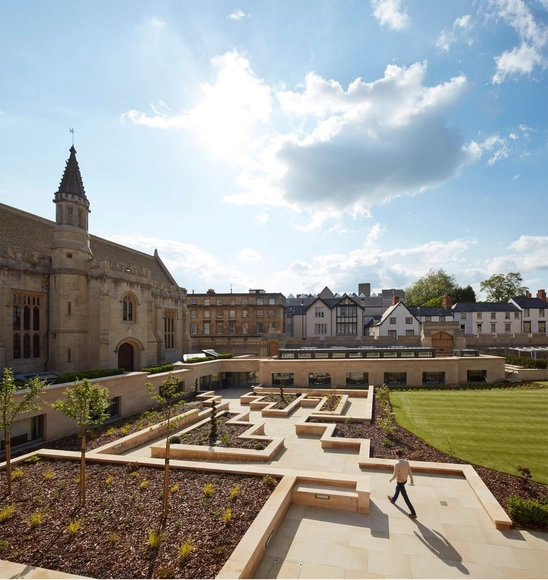
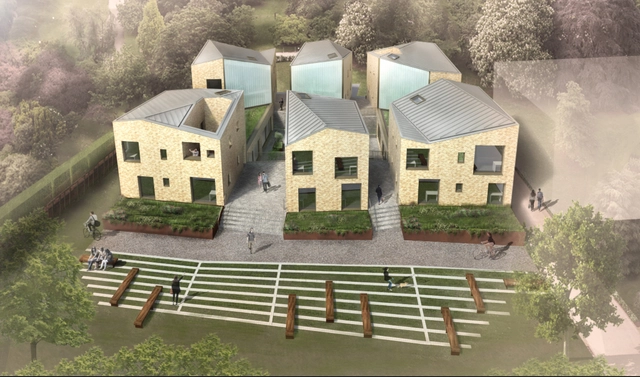
Belsize Architects has released the plans for 6 Pavilions, a new student accommodation project that will form a part of the University College’s larger masterplan in north Oxford.
To be built on the site of a Victorian residential home, the project will feature 30 units arranged within six pavilions around a central courtyard. Communal areas of the pavilions will be connected at the ground level.

Since 1957, the Middle East Center at St. Antony's College has been the University of Oxford's facility for research and teaching on the Arab world, Iran, Israel and Turkey. Over the years, the center's world-class archive has grown exponentially, leading to the commission of Zaha Hadid Architects to expand its facility; the recently completed Investcorp Building doubled the center's library and archive space, while delicately integrating a new 117-seat lecture theater into the college's restricted site.
Honoring its success and "vital role" in the community, the Investcorp Building has been selected as a winner in the Oxford Preservation Trust Awards' New Building category - now in its 38th year.

.jpg?1432940460&format=webp&width=640&height=580)


Make Architects have just received planning permission to build a world-class institute devoted to research and processing of health-related data on Oxford University's Old Road Campus. The Big Data Institute (BDI) will be built adjacent to two other Make-designed buildings: The Kennedy Institute of Rheumatology and the NDM Research Building. The BDI will be London-based Make Architects' fifth building on Oxford's Old Road Campus.
Wondering what's inside? Find out more after the break.