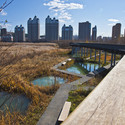
Liz Diller, one of the three partners of Diller Scofidio + Renfro, discusses the history of the High Line and the active design decisions which led to its success.
The elevated railroad, which was designed to penetrate city blocks rather than parallel an avenue, saw its last delivery (of frozen turkeys) in 1980. By 1999, a “very strange landscape had formed, with a whole eco system around it,” says Diller. Advocacy for the site’s preservation began with two local residents, and culminated in its reclamation with the multidisciplinary collaboration of city officials and impassioned designers (namely James Corner Field Operations, Diller Scofidio + Renfro, and planting designer Piet Oudolf). "The High Line project couldn’t have happened without the right people, the right time and the right administration."
Arctic Harvester was the first prize winning entry in the “Innovation and Architecture for the Sea” category of the Jacques Rougerie Foundation International Architecture Competition, 2013. It proposes an itinerant soil-less agricultural infrastructure designed to drift the circulating ocean currents between Greenland and Canada, exploiting the nutrient-rich fresh water released by melting icebergs as the basis for a large-scale hydroponic-farming system. The floating facility is equipped to house a community of 800 people, inspired in its compact urban form by vertically oriented, bayside Greenlandic villages and their social, cultural and economic relationship to the sea.
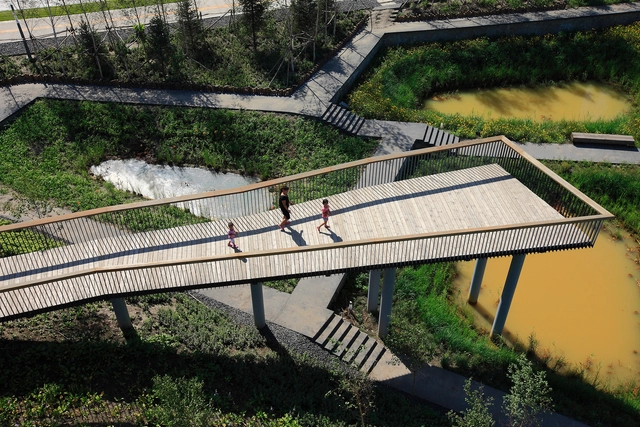
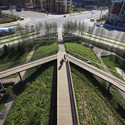
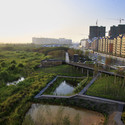
In June this year, the Turenscape Consortium was shortlisted to prepare a design proposal for Zaryadye Park, Moscow. The scheme, titled “The Blue Circle of Moscow,” centered around a circular reflecting pool that would serve as a mirror to the Moscow skyline, while managing urban stormwater. According to Turenscape, “The Blue Circle was envisioned as a new city icon, which links the past with the present and the future, which reconnects man with nature, which reunites the separated urban space, and which gathers individuals of all kinds.”
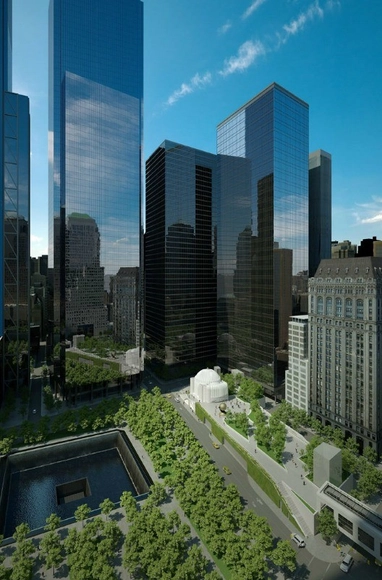
Early Schematic Rendering of St. Nicholas Greek Orthodox Church and Liberty Park. Image Courtesy of Tribeca Citizen
The World Trade Center’s “best-kept secret” has been revealed. As reported by the New York Times, the Port Authority released details on what will be “Liberty Park,” an acre-sized, elevated park lifted 25 feet above Liberty Street on the WTC site. Planned for completion in 2015, the $50 million landscaped terrace will connect the financial district with Battery Park City, while providing a panoramic view of the National September 11 Memorial and serving as a forecourt for the new St. Nicholas Greek Orthodox Church. More information on Liberty Park can be found here.
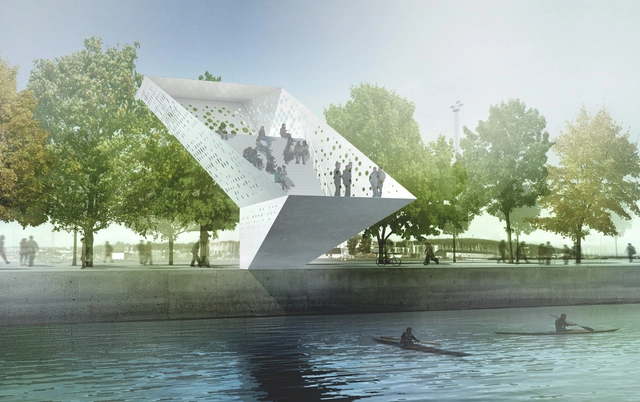
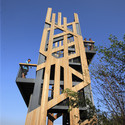
Dorte Mandrup Arkitekter has won a competition to design a landmark urban sculpture in Aarhus Harbour, a new district in Denmark's second largest city. The tower, shaped like a "sharp origami cut," is designed to "celebrating vision and social encounters at the edge of the water." Made of welded steel plates, the structure will be manufactured in a shipyard before being sailed to site.
Water scarcity is a profound challenge for designers of the built environment. Beyond looking for water sources and creating sustainable ecosystems, how can we begin to create cities and buildings that will help us to celebrate and mitigate hydro-logical concerns? Hadley and Peter Arnold, co-directors of the Arid Land Institute (ALI) at Woodbury University, have decided to tackle this problem around Los Angeles. With the support of the World Water Forum and the Metropolitan Water District of Southern California, they recently developed a high-resolution geospatial model to strategically identify and quantify the potential for improving storm water capture within urban areas.
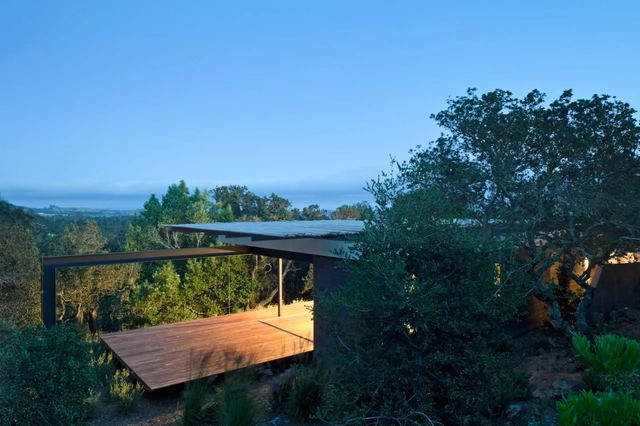
Sonoma Spa Retreat. Image Courtesy of Aidlin Darling Design
San Francisco-based Aidlin Darling Design has received the 2013 Professional Award for residential design from the American Society of Landscape Architects (ASLA) for their work on the Sonoma Spa Retreat in Northern California’s wine country. The project started with reclaiming an overgrown hillside, revitalizing it with a series of paths that preserved its natural features, and then integrating an outdoor kitchen, solar heated pool and recreational areas. For more information on the project and the award, which evaluates context, design value and sustainability, click here.










.jpg?1390765290)
.jpg?1390765288 "© Hamilton Knight")
.jpg?1390765324 "© Hamilton Knight")
.jpg?1390765266 "© Hamilton Knight")
.jpg?1390765232 "© Hamilton Knight")
.jpg?1390765290)