1. ArchDaily
  2. Keller Easterling

Keller Easterling: The Latest Architecture and News

The Architecture of Restraint: When Choosing Not to Build Becomes Design

In a world facing ecological exhaustion and spatial saturation, the act of building has come to represent both creation and consumption. For decades, architectural progress was measured by the new: new materials, new technologies, new monuments of ambition. Yet today, the discipline is increasingly shaped by another form of intelligence, one that values what already exists. Architects are learning that doing less can mean designing more, and this shift marks the emergence of what might be called an architecture of restraint: a practice defined by care, maintenance, and the deliberate choice not to build.

The principle recognizes that the most sustainable building is often the one that already stands, and that transformation can occur through preservation, repair, or even absence. Choosing not to build becomes a political and creative act, a response to the material limits of the planet and to the ethical limits of endless growth. That Architecture moves beyond the production of new forms to embrace continuity, extending the life of structures, materials, and memories that already inhabit the world.

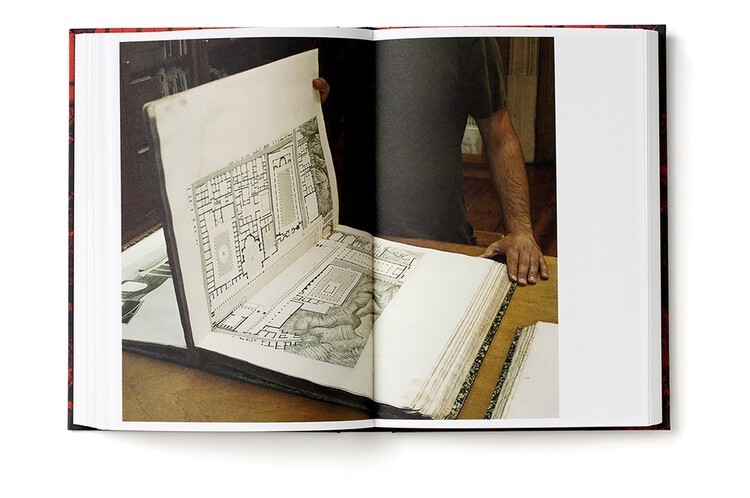
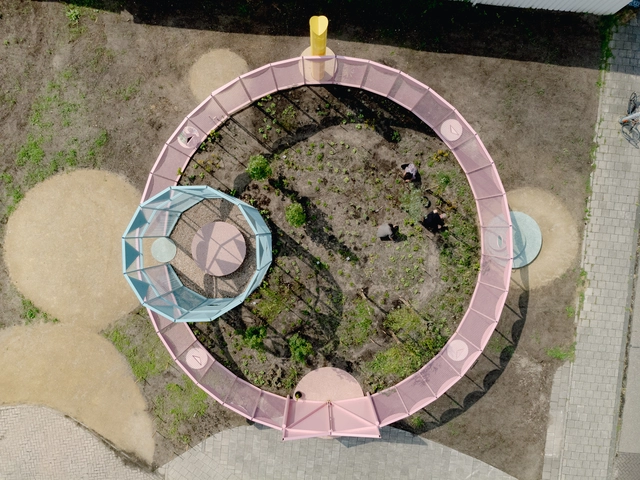
The Architecture of Restraint: When Choosing Not to Build Becomes Design - Image 1 of 4The Architecture of Restraint: When Choosing Not to Build Becomes Design - Image 2 of 4The Architecture of Restraint: When Choosing Not to Build Becomes Design - Image 3 of 4The Architecture of Restraint: When Choosing Not to Build Becomes Design - Image 4 of 4The Architecture of Restraint: When Choosing Not to Build Becomes Design - More Images+ 33

The Architect as Writer: Expanding the Discipline Beyond Buildings

Architecture has always been more than bricks and mortar. It is equally constructed through words, ideas, and narratives. From ancient treatises to radical manifestos, from technical manuals to poetic essays, the written word has served as a spatial, pedagogical, and political tool within the field. Writing shapes how architecture is conceptualized, communicated, and critiqued — often long before, or even in the absence of, physical construction.

Historically, figures such as Vitruvius, Alberti, and Palladio employed writing to codify principles, project ideals, and legitimize architecture as a discipline. In the modern era, Le Corbusier, Adolf Loos, and Lina Bo Bardi wrote prolifically to expand the scope of architecture beyond form and function, often using publications as tools for persuasion and experimentation. The postwar period gave rise to new editorial strategies, as evident in the manifestos of Archizoom and Superstudio, and the polemical publications of Delirious New York and Oppositions, where writing served as both critique and project.

The Architect as Writer: Expanding the Discipline Beyond Buildings - Image 1 of 4The Architect as Writer: Expanding the Discipline Beyond Buildings - Image 2 of 4The Architect as Writer: Expanding the Discipline Beyond Buildings - Image 3 of 4The Architect as Writer: Expanding the Discipline Beyond Buildings - Image 4 of 4The Architect as Writer: Expanding the Discipline Beyond Buildings - More Images+ 31

The Architecture of Rewilding: Designing for Ecosystem Recovery

As climate instability reshapes design priorities, architecture is increasingly drawn into ecological debates not as a spectator but as a participant. Among the concepts gaining traction is rewilding, a practice rooted in the restoration of self-sustaining ecosystems through the reintroduction of biodiversity, the removal of barriers, and the rebalancing of human presence in the landscape. Though often associated with conservation biology, rewilding also opens up new spatial and architectural imaginaries — ones that challenge conventional notions of permanence, authorship, and use.

The Architecture of Rewilding: Designing for Ecosystem Recovery - Image 1 of 4The Architecture of Rewilding: Designing for Ecosystem Recovery - Image 2 of 4The Architecture of Rewilding: Designing for Ecosystem Recovery - Image 3 of 4The Architecture of Rewilding: Designing for Ecosystem Recovery - Image 4 of 4The Architecture of Rewilding: Designing for Ecosystem Recovery - More Images+ 68

Dimensions of Citizenship: The US Pavilion at the 2018 Venice Biennale

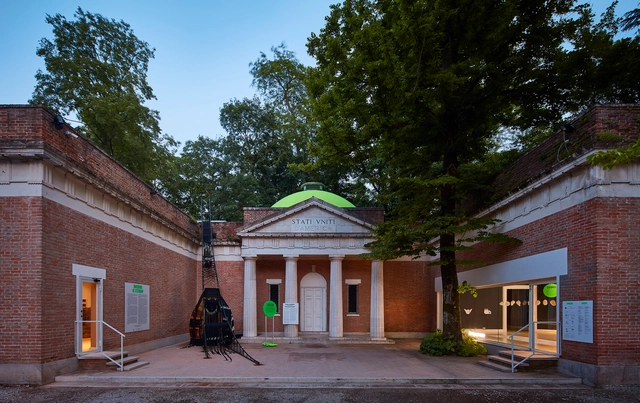
As part of our 2018 Venice Architecture Biennale coverage, we present the completed United States Pavilion. To read the initial proposal, refer to our previously published posts, “Curators and Theme Announced for US Pavilion at 2018 Venice Biennale” and "Studio Gang, Diller Scofidio + Renfro Among Exhibitors Selected for US Pavilion at 2018 Venice Biennale"

The pavilion representing the United States at this year’s biennale brings together the work of seven different transdisciplinary teams who each prepared an installation addressing the concept of citizenship at a different scale. Entitled Dimensions of Citizenship, the exhibition is intended to challenge the definition and conception of citizenship, examining issues and citing examples on the scale of the citizen, civitas, region, nation, globe, network and cosmos. The pavilion was commissioned on behalf of the US Department of State’s Bureau of Educational and Cultural Affairs by the School of the Art Institute of Chicago and the University of Chicago.

Dimensions of Citizenship: The US Pavilion at the 2018 Venice Biennale - Image 1 of 4Dimensions of Citizenship: The US Pavilion at the 2018 Venice Biennale - Image 2 of 4Dimensions of Citizenship: The US Pavilion at the 2018 Venice Biennale - Image 3 of 4Dimensions of Citizenship: The US Pavilion at the 2018 Venice Biennale - Image 4 of 4Dimensions of Citizenship: The US Pavilion at the 2018 Venice Biennale - More Images+ 23

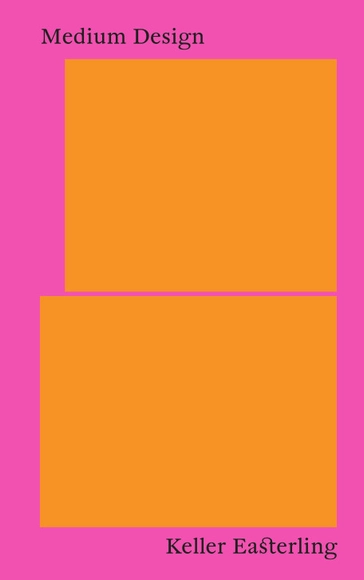
Medium Design by Keller Easterling

Privileging declarations, right answers, proofs, and universals, culture is often banging away with the same blunt tools that are completely inadequate to address contemporary chemistries of power. On the flip side of these logics, Medium Design offers no dramatic manifestos where things are new or right. Instead it only rehearses a habit of mind that has been eclipsed. Even at a moment of digital ubiquity, Medium Design treats space as an information system and a broad, inclusive mixing chamber for many social, political, technical networks. And just as it inverts the typical focus on object over field, it may also invert some habitual approaches to problem solving, aesthetics and politics.

Studio Gang, Diller Scofidio + Renfro Among Exhibitors Selected for US Pavilion at 2018 Venice Biennale

The curatorial team for the U.S. Pavilion at the 2018 Venice Architecture Biennale have announced the seven designers who will create the pavilion’s main exhibitions. Consisting of architects, landscape architects, artists and designers, the group will produce responses to the theme of Dimensions of Citizenship, exploring “the meaning of citizenship as a cluster of rights and responsibilities at the intersection of legal, political, economic, and societal affiliations.”

The seven exhibitors include:

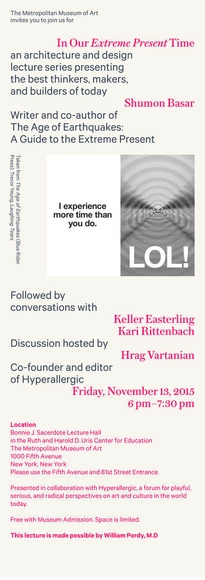
Lecture: In Our "Extreme Present" Time

In Our Time is an architecture and design lecture series presenting the best thinkers, makers, and builders of today.

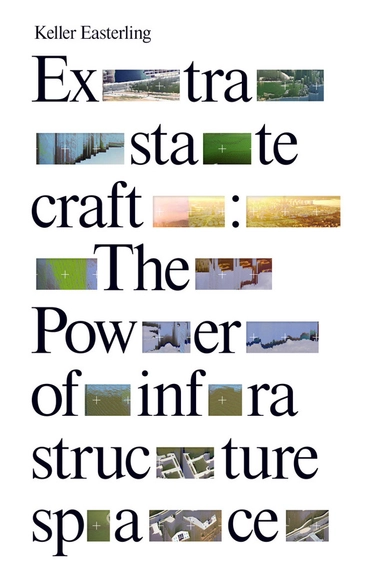
Extrastatecraft: The Power of Infrastructure Space by Keller Easterling

Subscriber Access | 

The following is an excerpt from Keller Easterling's latest publication, Extrastatecraft: The Power of Infrastructure Space, which explores areas of infrastructure with the greatest impact on our world. Easterling is a professor at Yale School of Architecture.

The road between Nairobi and Mombasa is lined with, and virtually lit by, advertisements for the mobile phone companies that have entered the region—all promising new freedoms and economic opportunities. With their images of Masai tribesman in native dress phoning from a remote wilderness, the ads employ an essential trope of leap-frogging—the desire for a perfect collapse between technology and nature, tradition and modernity. The billboards express the enthusiasm of a world turned upside down in which not the developed but the developing world has their hands around a majority of the world’s cell phones.

Over the last 150 years, the ocean floor has been laid with thousands of miles of submarine cable of all types for telegraph, telephone, and fiber-optic infrastructure. In the nineteenth century, it took only thirty years for the British cable-laying companies to string the world with telegraph cable, and a little over a decade from the late 1980s to the late 1990s for most of the world to be connected to fiber-optic cable. Yet until recently, East Africa, one of the most populous areas of the world, had no fiber- optic submarine cable link and less than 1 percent of the world’s broadband capacity. A country like Kenya had to rely for its broadband on expensive satellite technology acquired in the 1970s that cost twenty to forty times its equivalent in the developed world. Before 2009, one Mbps (megabit per second) of bandwidth could cost as much as 7,500 US dollars per month against the world average of $200. The monthly cost of putting twenty-five agents on the phone was $17,000 a month instead of the $600–900 that it would cost in other developed countries.(1)

Holcim Awards Juries Showcase Leading Experts on Sustainability

Subscriber Access | 
Holcim Awards Juries Showcase Leading Experts on Sustainability - Image 1 of 4
Yes is more: an archicomic on architectural evolution – Bjarke Ingels presents his extraordinary architecture in cartoon-form

Selecting the most outstanding projects in sustainable construction from several thousand submissions will be the challenging task of more than fifty leading experts on sustainability. The jury members for the 3rd International Holcim Awards competition include architects Bjarke Ingels (Denmark), Keller Easterling (USA) and Michel Rojkind (Mexico) – all independent experts of international stature engaged in the sustainable development of society, building processes, construction materials, and building projects.

Entries in the USD 2 million competition are evaluated using five “target issues” to define sustainable construction. Three of these stem from the triple bottom line of balanced social, environmental and economic performance. The two remaining issues pay homage to contextual and aesthetic impact, along with innovation and transferability. A series of five jury panels will meet in June/July 2011 in each of the five world regions: Europe, North America, Latin America, Africa Middle East, and Asia Pacific.