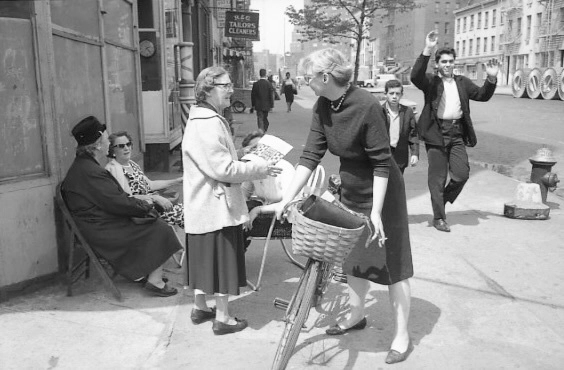
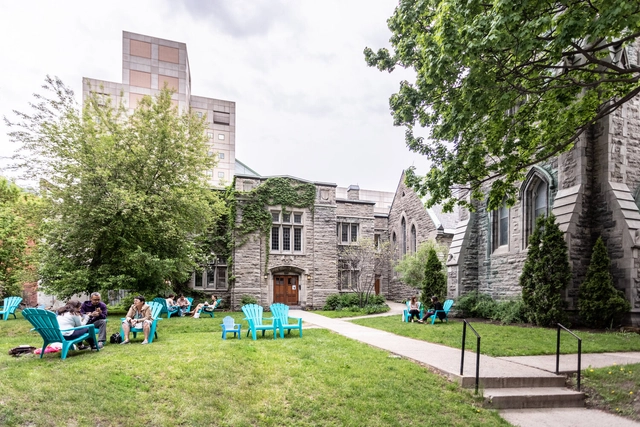
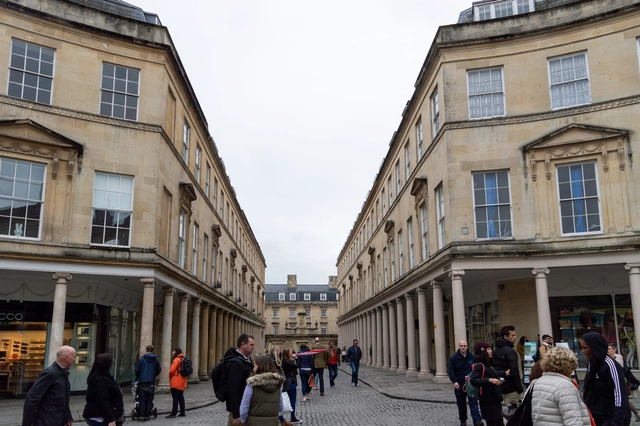
The concept of "eyes on the street" is perhaps the most famous within architectural and urban literature when it comes to urban security. Jane Jacobs uses this expression to refer to people who - consciously or unconsciously - use public spaces or observe them from their homes, generating natural surveillance. A movement that, within our discipline, is encouraged both through quality public spaces and through the powerful relationship between the public and private created through building facades. Advocating for this daily control, Jacobs believes in a way of making architecture and cities that condemns excessive verticalization, reinforced by isolated buildings and single-use ones that deny contact with the street.
Architecture has always been more than bricks and mortar. It is equally constructed through words, ideas, and narratives. From ancient treatises to radical manifestos, from technical manuals to poetic essays, the written word has served as a spatial, pedagogical, and political tool within the field. Writing shapes how architecture is conceptualized, communicated, and critiqued — often long before, or even in the absence of, physical construction.
Historically, figures such as Vitruvius, Alberti, and Palladio employed writing to codify principles, project ideals, and legitimize architecture as a discipline. In the modern era, Le Corbusier, Adolf Loos, and Lina Bo Bardi wrote prolifically to expand the scope of architecture beyond form and function, often using publications as tools for persuasion and experimentation. The postwar period gave rise to new editorial strategies, as evident in the manifestos of Archizoom and Superstudio, and the polemical publications of Delirious New York and Oppositions, where writing served as both critique and project.
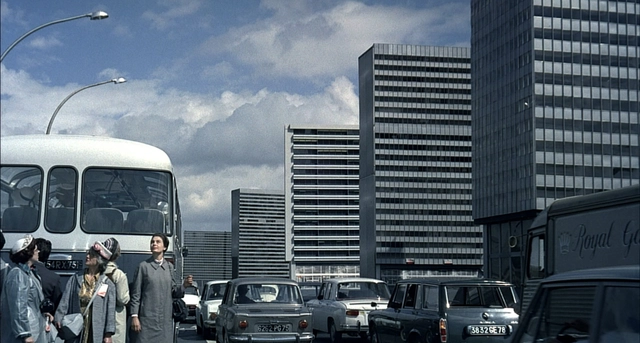
Playtime movie (Jaques Tati 1967) . Image via screenshot
Architecture criticism and journalism are often expected to announce "the good, the bad, and the ugly" in architecture and the built environment. Its purposes go however further than that. As Michael Sorkin put it, "seeing beyond the glittering novelty of form, it is criticism's role to assess and promote the positive effects architecture can bring to society and the wider world". In other words, by telling us what they are seeing, critics are also showing us where to look in order to identify and address the issues plaguing our built environment.
The field of architecture journalism has been led by female writers even in times when the pursuit of a career in architecture was discouraged and inaccessible for women. Ada Louise Huxtable established the profession of architecture journalism by holding the first full-time position of architecture critic at a general-interest American newspaper. In 1970, she also received the first-ever Pulitzer Prize for criticism. Esther McCoy started her career as a draughtswoman at an architecture office, yet, because of her gender, she was discouraged from training as a professional architect despite her ambitions to study the field. Through her writings, she managed to bring attention to the overlooked architectural scene of the American West Coast and advocate for the values of regional Modernism.
"One of the first hits I got when I was googling about female architecture was a high-rise building in Australia, whose architects said that they had been inspired by Beyoncé's curves when they built it," exclaimed the Dutch architect Afaina de Jong in her last talk for TEDxAmsterdamWomen in 2021. "I mean, really? Her body? Beyoncé? Of course, she is amazing, but to translate her body literally in a building… Is that female architecture?", she continued indignantly.
De Jong is the founder of AFARAI studio, where she works with an interdisciplinary methodology combining theory and research with design. She considers her studio as "a feminist practice that encourages change on social and spatial issues and that accommodates differences," so Afaina is likely familiar with the concept of 'intersectionality'.
In 1956, when car ownership and the suburban development that this enabled were just being embraced as American cultural ideals, pioneering urbanist Jane Jacobs wrote that the U.S. was becoming “an unprecedented nation of centaurs. … Our automobile population is rising about as fast as our human population and promises to continue for another generation.” She continued, “the car is not only a monstrous land-eater itself: it abets that other insatiable land-eater—endless, strung-out suburbanization.”
https://www.archdaily.com/1016717/jane-jacobs-cyclistPeter L. Laurence
Architecture has deep wells of research, thought, and theory that are unseen on the surface of a structure. For practitioners, citizens interested, and students alike, books on architecture offer invaluable context to the profession, be it practical, inspirational, academic, or otherwise. So, for those of you looking to expand your bookshelf (or confirm your own tastes), ArchDaily has gathered a broad list of architectural books that we consider of interest to those in the field.
In compiling this list, we sought out titles from different backgrounds with the aim of revealing divergent cultural contexts. From essays to monographs, urban theory to graphic novels, each of the following either engage directly with or flirt on the edges of architecture.
The books on this list were chosen by our editors, and are categorized loosely by type. Read on to see the books we consider valuable to anyone interested in architecture.
https://www.archdaily.com/901525/116-best-architecture-books-for-architects-and-studentsArchDaily Team
Cities need to prepare for a wave of declining houses of worship. While faith institutions, at least the Christian ones, have been asking WWJD (What would Jesus do?), municipalities need to get them to ask another question: WWJJD (What would Jane Jacobs do?). Doing so might lead to a new model for true community houses of worship.
Domino Refinery. Image Courtesy of Practice for Architecture and Urbanism (PAU)
Adaam James Levin-Areddy and Vanessa M. Quirk, the hosts and producers of the Uncertain Things podcast, interview people from diverse backgrounds and a wide range of expertise to ask the question: “now what? What is happening and how did we get here?”. In this episode, they talk with urbanist, architect, and professor Vishaan Chakrabarti, founder of Practice for Architecture and Urbanism, to seek to understand how the cities got so expensive. Together they delve into the affordability crisis, the detrimental effect of progress, and what we need to do to have better cities.
Beneath the Spaceship Earth geodesic sphere and the display of world cultures that symbolize Disney World’s EPCOT lies the buried vision for a utopian city. The original EPCOT - a community built around innovation - was one of Walt Disney’s last visionary projects. Bothered by haphazard urban sprawl, Disney had bold ideas for an urban fabric that would drive progress in the USA. The “Experimental Prototype Community of Tomorrow” was Walt Disney’s antidote to the decay of American cities.
In the 1960s and 1970s, a series of critiques of the modern city appeared. Jane Jacobs’s attack on those intent on redeveloping New York City was the most immediately impactful, loosening the grip of Robert Moses and his followers, but others had a broader influence on practicing architects and planners. As an observer of San Francisco Bay Region’s cities, I wondered if their books from this period would shed light on current issues of adding density in urban contexts.
https://www.archdaily.com/985024/how-do-the-critics-of-yesteryear-think-about-urban-densityJohn J. Parman
Buildings around the world are getting taller. Since the year 2000, global skyscraper construction has increased by 402%. Cities like Dubai are home to nearly 1000 high-rise buildings, and New York’s vibrant luxury real estate market has shown no signs of slowing down, with more high-rise additions slated to be added to its already towering skyline. There’s good in this – high-rises create much-needed space in already dense cities and can reduce urban sprawl in city centres, allowing for better preservation of natural areas.
The development of cities has historically been a slow-moving process. In the everchanging urban landscape that faces the pushes and pulls of a variety of social, economic, and financial factors, it’s been hard to pinpoint just one main reason over another why each city has evolved over time into the way that we experience it today. And as designers and planners speculate about what the future of our cities should be, sometimes the reason that our cities look and operate in the way that they do has come down to a few famous battles between individuals with competing schools of thought.
In the introduction of Cities for People, Jan Gehl stated clearly that most cities have neglected the human aspect when planning the built space. While technologies have allowed us to build large, our focus shifted from creating architecture for humans to erecting structures that look like they are meant for a different kind of species. Top-down urban planning decisions have ignored scales adapted to the senses and organic growth, and new ideologies prioritized speed, functionality, and profitability.
Dictating our city experience, scale, this major spatial component related to the human dimension, stimulates our senses, and influences our well-being. In this article, we lay down historical changes and underline scientific facts to highlight how scale can impact our daily city life, guided by Eden of the Orient, a series of photos by Belgian photographer Kris Provoost, portraying a battle of scale in Hong Kong.
Throughout her career, social activist and urban writer Jane Jacobs (May 4, 1916 – April 25, 2006) fought against corporate globalization and urged post-war urban planners and developers to remember the importance of community and the human scale. Despite having no formal training, she radically changed urban planning policy through the power of observation and personal experience. Her theories on how design can affect community and creativity continue to hold relevance today—influencing everything from the design of mega-cities to tiny office spaces.
https://www.archdaily.com/502096/happy-birthday-jane-jacobsAD Editorial Team
Last week I was in the middle of packing and came across a well-thumbed copy of The Death and Life of Great American Cities. I don’t remember when I read the book, but it was way more than twenty years ago (and predates my professional involvement with cities). As a very belated tribute to the anniversary of her 100th birthday, I decided to dip back into that remarkable book. Here’s ten takeaways from the godmother of the American city.
IFC has announced the release of their latest documentary, Citizen Jane: Battle for the City, which will dive into “the enduring legacies of one of the most prominent figures of modern urban planning, Jane Jacobs, and talks about her David-Goliath fight to save NYC.”
In an exclusive half-hour episode focusing on the life and legacy of Jane Jacobs, "one of the most influential urban thinkers and city activists of our time." Featuring interviews with a carefully selected range of city planners, historians and activists, alongside recordings of Jacobs herself, this special episode of Monocle 24's The Urbanist examines why Jacobs was—and remains—so influential when considering the contemporary city.
https://www.archdaily.com/802951/cities-need-change-the-durability-of-jane-jacobs-legacyAD Editorial Team
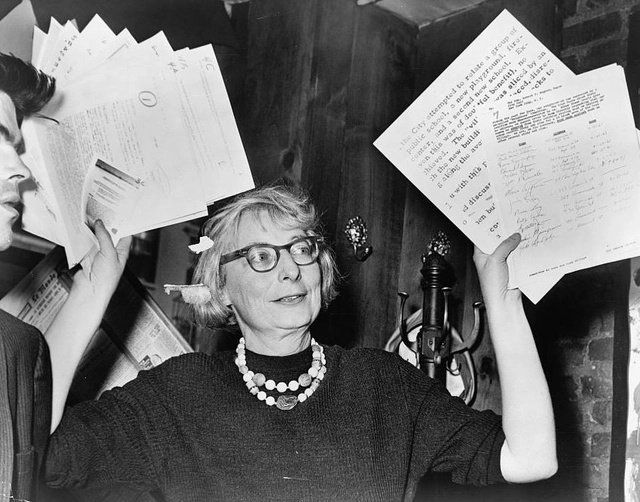
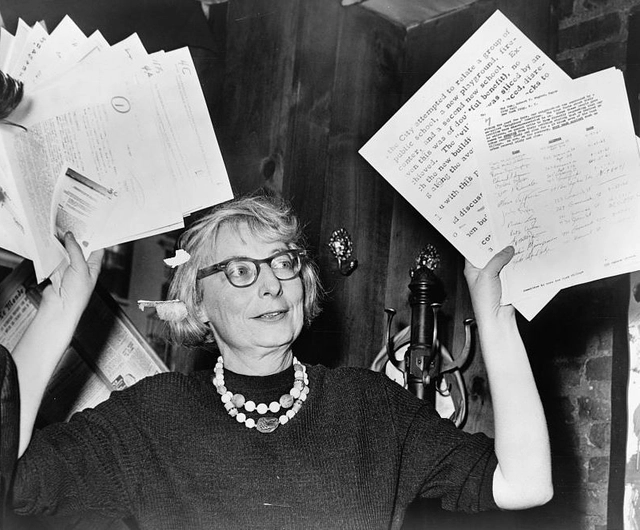
Mrs. Jane Jacobs, chairman of the Comm. to save the West Village holds up documentary evidence at press conference at Lions Head Restaurant at Hudson & Charles Sts. (1961). Public Domain
My introduction to Jane Jacobs was completely ordinary. Like many, many architecture students since its publication in 1962, I read The Death and Life of Great American Cities for an introductory course in urbanism. Jacobs was a joy to read, whip-crack smart and caustically funny, and she wrote in impeccable, old-school sentences that convinced you with their unimpeded flow. She explained her ideas in utterly clear and simple language. Planners are “pavement pounding” or “Olympian.” There are “foot people and car people.”
Why were we reading her? I expect it was to encourage us to look harder at the city, and to imbibe some of her spirited advocacy for experience over expertise. It was a captivating message and delivered at the right time. Today it seems as though everybody interested in cities has read at least part of Death and Life and found personal affirmation in it. Michael Kimmelman wrote, “It said what I knew instinctively to be true.” For David Crombie, “she made it clear that the ideas that mattered were the ones which we understood intimately.”
This quality was important, and one of the reasons that Jacobs endures in our culture is the facility with which we can identify with her. She is one of “us,” whoever that is—not an expert, more like an aunt than a professor. Her speciality was the induction of rules from patterns discovered by individual observation, like a 19th-century gentleman scientist. Her work gave seriousness to reactions that might otherwise be dismissed as taste, ignorance or prejudice.