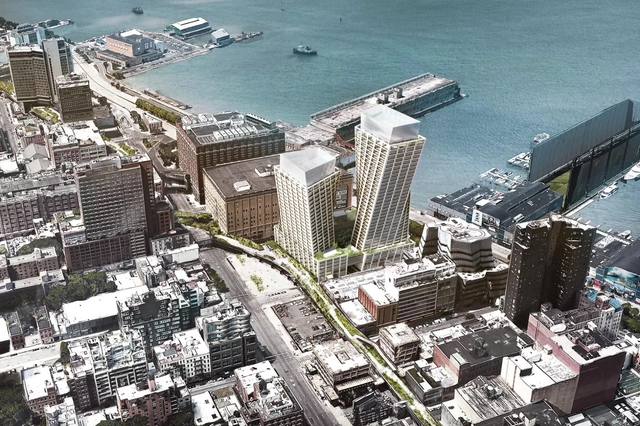
BIG’s planned residential complex along the High Line in New York has gone through multiple iterations since its unveiling last November. Now, in its latest form of two twisting towers rising from a split podium, the project is receiving a new name and key program piece.
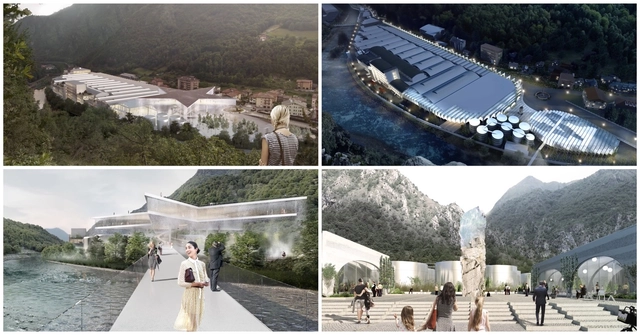
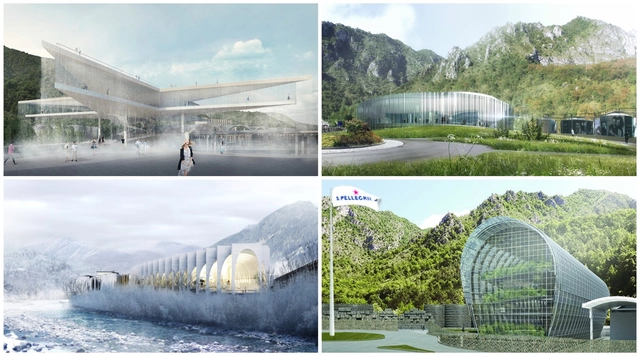
The competition to design a new flagship factory and bottling plant for San Pellegrino has been narrowed down to two firms: BIG and MVRDV. Searching for a “truly innovative project that not only conveys an artistic vision, but also sets new standards in terms of efficiency and compliancy to environmental sustainability,” the jury committee selected the two final proposals from a 4-firm list which also included designs from Snøhetta and aMDL Michele De Lucchi.
“The judging committee were so impressed by the four proposals that they decided to narrow their selection to a shortlist of two and deliberate further before announcing the winning project early next year,” explained San Pellegrino in a press release.
San Pellegrino also released video proposals of the designs, explained by firm founders Bjarke Ingels and Winy Maas.
Videos
2016 Aga Khan Award for Architecture Recipients
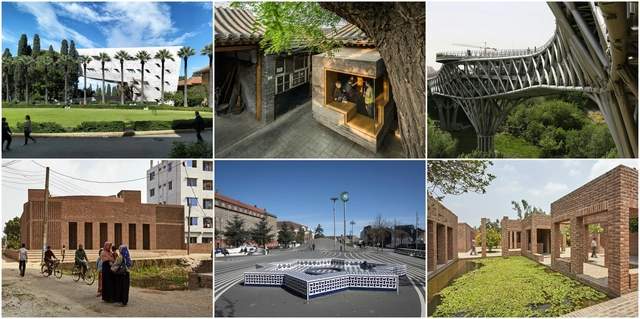
Six exemplary projects have been announced as winners of the 2016 Aga Khan Award for Architecture. Presented once every three years, the award was established by the Aga Khan in 1977 to “identify and encourage building concepts that successfully addressed the needs and aspirations of communities in which Muslims have a significant presence.” To be considered for the award, projects must exhibit not only architectural excellence, but also the ability to improve users overall quality of life.
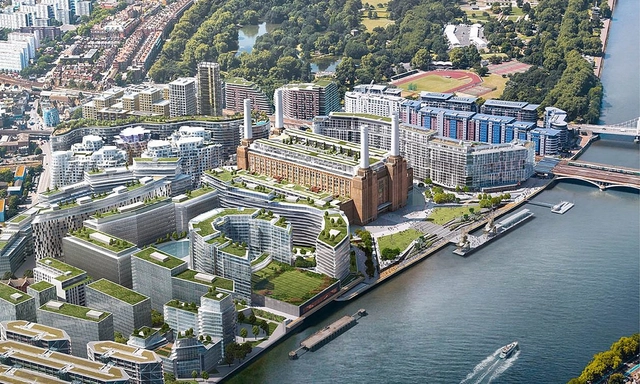
Visualization of the Battersea development, with the Grade II* Listed former power station at its heart. Image Courtesy of Battersea Power Station Development
US tech-giant Apple Inc. have revealed that they will consolidate their UK operations to "a new Apple campus" in London's Battersea, at the heart of a site formerly occupied by the derelict Grade II* Listed Battersea Power Station. The 42-acre complex, which is currently undergoing major redevelopment (and is soon to have a public square designed by BIG connecting to the Electric Boulevard development designed by Norman Foster and Frank Gehry), will provide a mix of commercial space and residential zones. According to the London Evening Standard, Apple will be relocating around 1,400 staff from eight sites around the British capital to the former power station, occupying all six floors of the restored building's extensive new office space. They will be the site's single largest single tenant.
https://www.archdaily.com/796308/apple-to-create-new-london-campus-at-battersea-power-stationAD Editorial Team
During the IV International Congress in Pamplona, organized by the Architecture and Society Foundation, we had the opportunity to speak with Bjarke Ingels about his approach to theme "Architecture: Climate Change." The founder of BIG told us about the importance of clean technology and how these technologies must be integrated into architecture. He asserts that new industrial projects must also break from traditional paradigms and question established concepts in order to be reintegrated into communities as clean, attractive and multi-use spaces. Ingels suggests that clean technologies holds exciting possibilities for public spaces.
The competition brief asked architects to renovate and expand the historic home of San Pellegrino, the world’s leading sparkling mineral water company, with a “truly innovative and technologically-advanced design” aimed at integrating into the natural aesthetic of the surrounding terrain, while responding to the iconic identity of the S. Pellegrino brand.
Continue reading to see each proposal along with official descriptions from each firm.
Similarly to how he prefers to practice architecture, Bjarke Ingels likes speaking in big, bold assertions. In his recent profile for WIRED UK, the Danish architect makes quite a few of those assertions, among them the belief that architecture could learn a thing or two from the imaginative world of architecture-based video games such as Minecraft.
In line with their playful spirit, BIG has teamed up with programmers Ruby Studio to release an alternate version of their icon-filled homepage that allows visitors to play a version of the classic arcade game Arkanoid.
Our editors look at hundreds of websites per week. What do they admire and appreciate the most? Organization and simplicity. Sites that are not only clean, but fast. We actively search for projects to include on our platform, so it’s crucial that when we visit a website we not only know where to look, but how to access information. Filters and facets are our best friends. Typological differentiation is important, but perhaps not as important as distinguishing between built and un-built projects (“Is that a render?” is a question that comes up at least once a day).
https://www.archdaily.com/795078/these-are-the-best-designed-most-useful-architecture-firm-websitesAD Editorial Team
Next Month, architecture will be hitting the mainstream media, as Bjarke Ingels has been selected to grace the cover of the September 2016 edition of WIRED UK. Titled “THINK BIGGER,” the issue will also feature profiles and stories from architects and designers Tom Dixon, Neri Oxman, David Adjaye and Rem Koolhaas. A Condé Nast Publication, the magazine focuses on the effects of science and technology on topics including design, architecture, culture, the economy, politics and philosophy.
Following the success of last year’s virtual tour of Selgascano’s 2015 Serpentine Pavilion, Photographer Nikhilesh Haval of nikreations has shared with us his virtual tour of BIG’s 2016 Pavilion entry. Hosted this year on Google Street View, the tour allows you to move through and around the “unzipped wall” design, giving you the ability to perceive how sunlight interacts with the structure. Check out how visitors are using the pavilion as an escape from the sunny park or sipping on drinks ordered at the pavilion bar – and don’t forget to look up, where it’s easy to get lost in the sea of interlocking fiberglass bricks.
The BIG-designed Grove at Grand Bay is now complete, becoming an new architectural icon for South Miami. Residents will now put the finishing touches on the units before a grand opening and move-in next month. The two twisting 20-story towers have been completely sold out, and mark BIG’s first completed condominium building in the United States.
In this series by renowned financial institution Goldman Sachs, Talks at GS, some of architecture’s leading minds, including David Adjaye and Maya Lin, talk about how their careers have developed, their secrets to success, and what they are working on right now. The most recent video features Bjarke Ingels discussing his design approach and the development of this year’s Serpentine Pavilion. In addition to the videos, Goldman Sachs has also sat down with two other design leaders to talk about their careers.
Sparkling Natural Mineral Water company San Pellegrino has announced an international competition between 4 top architecture firms for the redesign of its flagship factory and bottling plant, located at the source of the mineral water, San Pellegrino Terme, Italy.
“This exciting endeavor aims to celebrate the heritage, special source and terroir of S.Pellegrino, while also promoting new standards of efficiency, environmental sustainability and compliance. Further, this project will support the revitalization of the historic region, harkening back to the golden age of San Pellegrino Terme, at the height of the Belle Époque, when the town served as an exclusive destination for European aristocracy,” a spokesperson for San Pellegrino said in a press release.
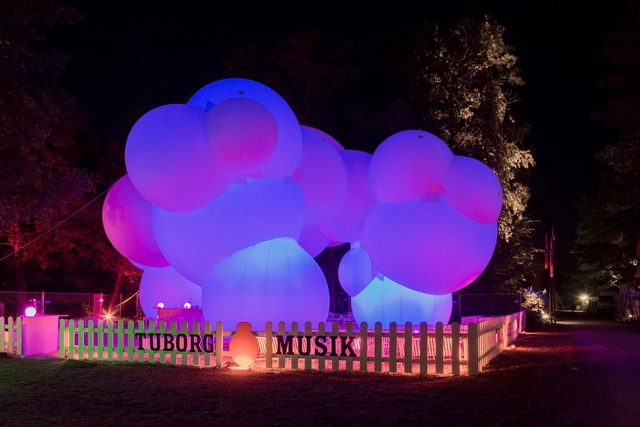
BIG Architects has designed an inflatable mobile pavilion to be displayed at three Danish events, including its original site at the Roskilde Festival 2016. Known as SKUM (Danish for foam), the structure met the challenge of creating an installation that has the ability to be both permanent and fully transportable by creating a whimsical, bubble-like form that can be blown up in just 7 minutes.
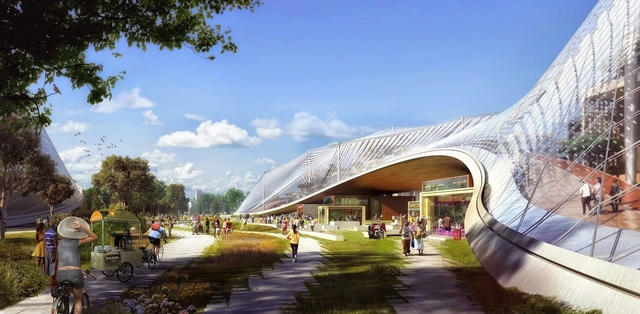
The “Googleplex” is back on. After the Mountain View City Council announced last year that they would be awarding the majority of the land needed to construct the futurist masterplan designed for Google by BIG and Thomas Heatherwick to fellow tech giant LinkedIn, the future of the ambitious glass-canopied corporate campus seemed to be dead in the water, with the architects even releasing images of a pared down design that would occupy a much smaller footprint. But all of that has now changed thanks to a surprising property swap between the two companies that will see over three million square feet of real estate switch hands.
Earlier today, the 17th Serpentine Gallery Pavilionwas unveiled with a press preview ahead of its public opening this Friday. With its 13-meter tall "unzipped wall" of square fiberglass tubes, the pavilion is an impressive presence in Hyde park, standing next to the single-story Serpentine Gallery. As described by Bjarke Ingels in his design statement, the pavilion is all about its visual effects from various angles - going from an expansive, transparent rectangle when viewed from the side, and an opaque, curving sculptural shape when seen from either end.
With so much visual intrigue, the project offers plenty to be explored through photography - and accordingly, photographer Laurian Ghinitoiu was there at the opening to investigate the project's visual effects. He also captured the pavilion's neighboring Summer Houses, by Kunlé Adeyemi of NLÉ, Barkow Leibinger, Yona Friedman and Asif Khan. Read on to see the gallery.








.jpg?1470849628&format=webp&width=640&height=580)
.jpg?1470849628 "© Terra")
.jpg?1470849674 "© Terra")
.jpg?1470849573 "© Terra")
.jpg?1470849542 "© Terra")
.jpg?1470849628)
.jpg?1465489880&format=webp&width=640&height=580)
.jpg?1465489121 "© Laurian Ghinitoiu")
.jpg?1465489810 "© Laurian Ghinitoiu")
.jpg?1465489930 "© Laurian Ghinitoiu")
.jpg?1465489412 "© Laurian Ghinitoiu")
.jpg?1465489161 "© Laurian Ghinitoiu")
.jpg?1465488871 "© Laurian Ghinitoiu")
.jpg?1465489842 "© Laurian Ghinitoiu")
.jpg?1465489672 "© Laurian Ghinitoiu")
.jpg?1465489015 "© Laurian Ghinitoiu")
.jpg?1465489880)