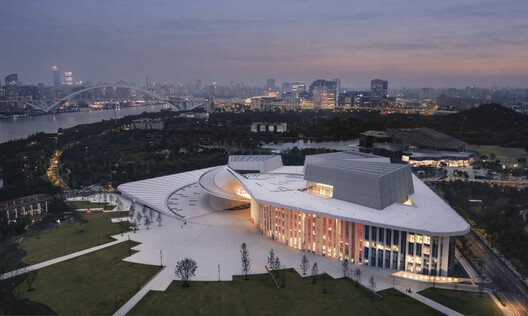
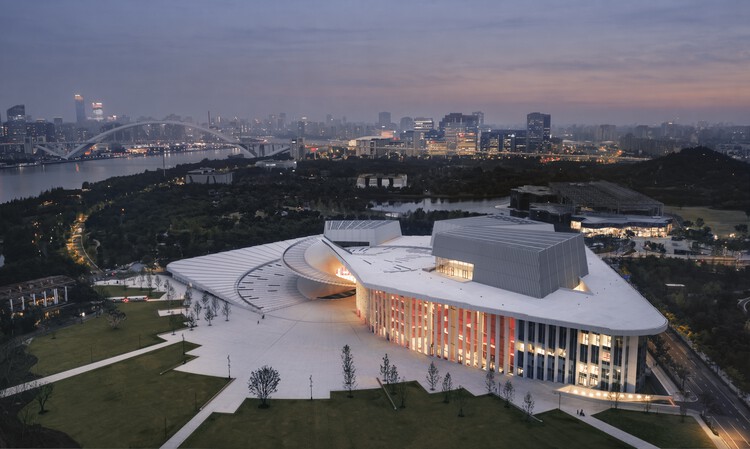
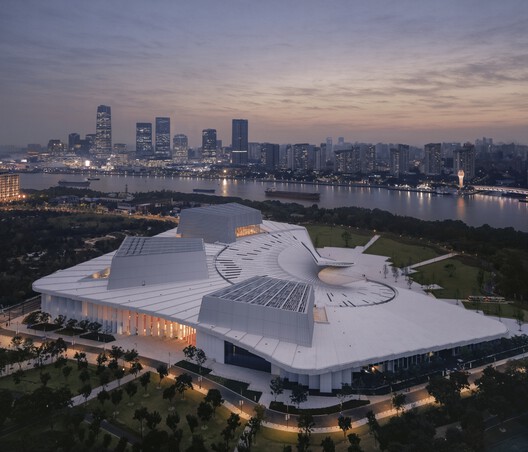
The Shanghai Grand Opera House, designed by Snøhetta in collaboration with East China Architectural Design & Research Institute (ECADI), Theatre Projects, and Nagata Acoustics, officially opened on October 17, 2026, along the Huangpu River in Shanghai, China. The opening marks the completion of a cultural project selected through an international design competition in 2016 and developed over the following decade. Located in the Expo Houtan district, the 146,786-square-meter building brings together three performance venues, production facilities, and publicly accessible spaces as part of the ongoing transformation of Shanghai's waterfront.



The opera house accommodates a total of 4,200 spectators across three auditoriums designed for different performance formats. The 2,000-seat Harmony Hall serves as the main venue, while the 1,200-seat Soar Theatre accommodates smaller-scale productions and the 1,000-seat Open Stage supports experimental performances through adaptable stage and seating configurations. The facilities are complemented by spaces for rehearsal, production, education, exhibitions, and hospitality. The building's opening coincides with the launch of its inaugural performance season, Born to Sing, which runs through February 20, 2027, and features a program of performances and cultural activities. The opening concert also marks the start of the 25th China Shanghai International Arts Festival.
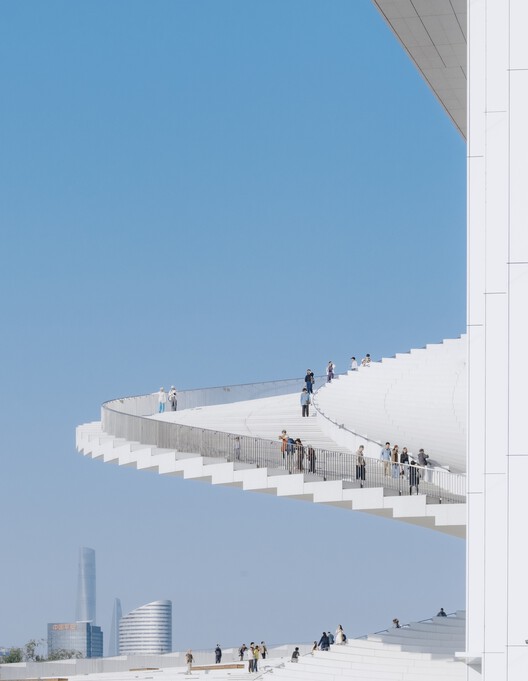
The building is organized beneath a sweeping roof that unifies its different programs while extending the public realm vertically. A spiraling staircase connects the ground level to the rooftop, which functions as an observation deck and gathering space overlooking the Huangpu River and the surrounding skyline. Public routes connect different levels of the complex, allowing visitors to access parts of the building independently of scheduled performances. Restaurants, exhibition spaces, and educational facilities further extend the building's use beyond its auditoriums.
Related Article
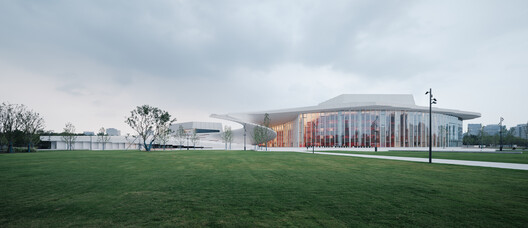
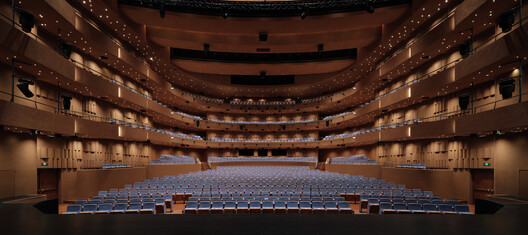
First Look at Snøhetta’s Shanghai Grand Opera House as Construction Nears CompletionInside, the three performance halls have distinct spatial and material characteristics that respond to their respective functions. Harmony Hall features dark red tones and sculptural surfaces shaped by the acoustic requirements of operatic performance, while expansive glazed surfaces introduce natural light into the building's public areas. The predominantly white exterior contrasts with the interiors, establishing a material distinction between the public circulation spaces and the performance venues.
The project also incorporates passive design strategies, daylighting, and landscape integration to address environmental performance and energy demand. The surrounding landscape follows a radial layout informed by the building's geometry, connecting the opera house to the adjacent park and riverfront. Through the combination of performing arts facilities and publicly accessible spaces, the Shanghai Grand Opera House establishes a new cultural venue within Shanghai's evolving waterfront district.
The Shanghai Grand Opera House is among several cultural projects currently being developed by Snøhetta in different urban contexts. In South Korea, the studio's Busan Opera House, commissioned following an international competition in 2012, is under construction along the city's North Port waterfront, with an opening planned for 2027. In Toronto, Snøhetta and Hariri Pontarini Architects have been selected to design the new Ontario Science Centre, a 400,000-square-foot facility that will connect the existing Pods and the historic Cinesphere through elevated walkways and a public promenade. Meanwhile, in collaboration with the Beijing Institute of Architectural Design (BIAD), they are developing the Beijing Art Museum in Tongzhou District, which broke ground in December 2025 and is expected to open in 2029.